
Postscript pricing has two parts: a plan, and a rate for every message you send. The Starter plan has no monthly fee but a $49 minimum on what you spend each month, and it charges $0.009 per SMS and $0.045 per MMS. Growth is $100 a month at $0.008 per SMS, Professional is $500 a month at $0.007 per SMS, and Enterprise is a custom quote. Carrier fees are added on top. This page sets out each plan, what a month of texting costs at five volumes, and how that compares with Klaviyo’s SMS plans. Every figure was read from Postscript’s pricing page on 13 November 2026.
Disclosure: Retention Control is a retention-only marketing agency for Shopify and DTC brands. It builds and runs email and SMS flows, campaigns, segmentation and loyalty on Klaviyo, Omnisend, Brevo and Attentive. We are not a Postscript reseller. The rates below are Postscript’s published US and Canada list rates. The invoice inside your own Postscript account is the final word.
- Starter: $0 a month, $49 monthly minimum spend, $0.009 per SMS.
- Growth: $100 a month, $0.008 per SMS and $0.03 per MMS.
- Professional: $500 a month, $0.007 per SMS and $0.024 per MMS.
- Not public: Enterprise pricing and Postscript’s email price.
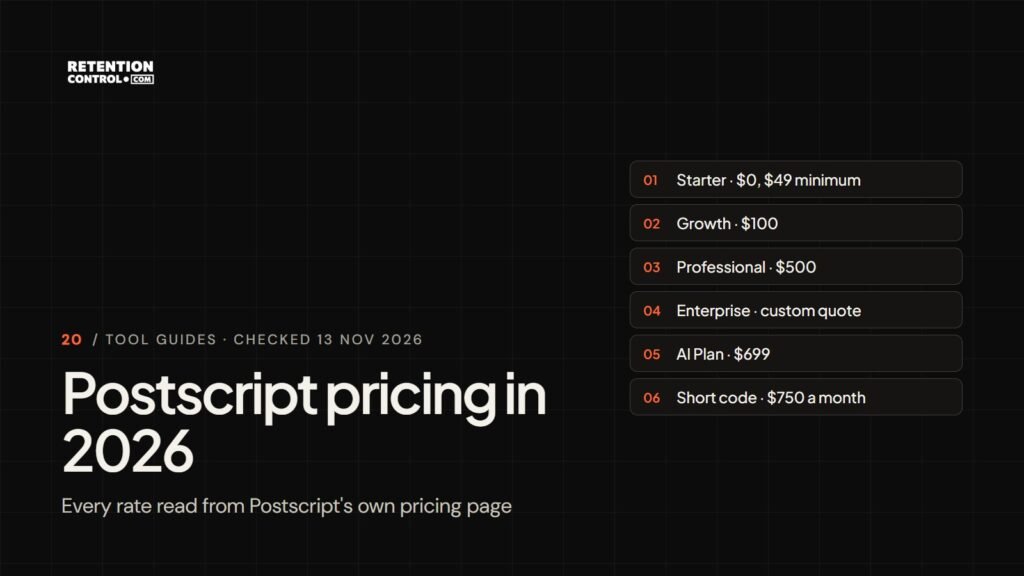
Postscript pricing plans for 2026
Postscript’s page opens with “Best in class products, transparent pricing.” (Postscript) and lists four plans for SMS and RCS. The message rates fall as the plan rises.
| Plan | Listed price | Per SMS | Per MMS | Who it is for, in Postscript’s words |
|---|---|---|---|---|
| Starter | $0 a month, $49 minimum spend | $0.009 | $0.045 | Brands getting started with SMS |
| Growth | $100 a month | $0.008 | $0.03 | Brands building their SMS program |
| Professional | $500 a month | $0.007 | $0.024 | Brands scaling up SMS as a top revenue channel |
| Enterprise | Contact us | Custom | Custom | Brands ready to make SMS their #1 revenue channel |
Every rate has carrier fees on top, which the next section covers. The page also states that “Listed Rates are for US – 50 States/Canada only” (Postscript), so a store that texts the UK or Australia needs the international rate sheet, which Postscript keeps on a separate page.
What each plan adds
Each plan includes the one below it.
- Starter gives you “Campaigns and automations, and unlimited segments” and a dedicated toll-free number, with 2 opt-in keywords and a branded short link subdomain (Postscript).
- Growth adds unlimited opt-in keywords and live chat and email support.
- Professional adds enhanced analytics, priority live chat and email support, API access for custom integrations, and removes “Powered by Postscript” from the opt-in (Postscript).
- Enterprise adds a dedicated Customer Success Manager, personalized messages with custom product recommendations, a Data Warehouse Push, and an option to add RCS.
All plans share the same core tools. Postscript lists a visual flow builder with automation templates, subscriber acquisition tools such as popups and checkout collection, “Advanced segmentation using your Shopify data and third party integrations”, reporting, response management and custom attribution windows (Postscript).
What the pricing page does not say
The page shows Growth as “$100/mo.” and Professional as “$500/mo.” (Postscript) without saying whether that amount is a fee added to your message charges or a minimum spend that your messages count toward. Starter is clearer: it says “$49 monthly minimum spend” (Postscript). We do not guess. The worked examples below show message charges on their own, then show both readings of the plan price so you can see how much the answer matters. Ask Postscript which reading applies before you pick Growth or Professional.
Carrier fees on top of the rate
The listed per-message rates do not include the charge the mobile networks make. Postscript’s page gives average US carrier fees of $0.00435 per SMS and $0.00832 per MMS, and describes carrier fees this way: “Carrier fees are small surcharges that mobile carriers (e.g. Verizon, AT&T, T-Mobile) charge for sending messages using their networks.” (Postscript)
The fee on your own invoice may differ from that average, because carriers set it. Postscript’s page says it lists “that exact amount on your invoice without any additional markup” (Postscript). So a Starter SMS costs about $0.01335 when you add the average carrier fee to the $0.009 rate. A Starter MMS costs about $0.05332.
Klaviyo handles this differently. Its SMS rates already include the carriers’ charges: “Carrier fees remain included in your rates” (Klaviyo). That matters when you compare the two, and the comparison further down adds the average carrier fee to Postscript’s rate to keep it fair.
How Postscript counts a message
A plain-text SMS holds 160 characters. Postscript’s FAQ says “Postscript allows 160 characters per SMS message without emojis, and 70 characters per SMS message with emojis.” (Postscript) A longer message is split into segments and “each of which is charged at the per-SMS rate” (Postscript).
So a 120-character text with one emoji is two segments and costs twice the rate. MMS is treated differently: Postscript allows “up to 1,600 characters per MMS message with or without emojis” (Postscript). At the Starter rates, an MMS costs five times an SMS before carrier fees, so once carrier fees are counted the saving only appears when a message would need four or more SMS segments.
What a month of Postscript costs at five volumes
These are worked examples at Postscript’s published rates plus the average carrier fee. They are single-segment US SMS. They are not client bills.
| SMS a month | Starter | Growth | Professional |
|---|---|---|---|
| 1,000 | $49 (minimum) | $12.35 | $11.35 |
| 5,000 | $66.75 | $61.75 | $56.75 |
| 10,000 | $133.50 | $123.50 | $113.50 |
| 25,000 | $333.75 | $308.75 | $283.75 |
| 50,000 | $667.50 | $617.50 | $567.50 |
The Growth and Professional columns are message charges only. The Starter figure at 1,000 is the $49 minimum, because $13.35 of messages falls under it.
Now add the plan price, because that is where the choice is made. If the $100 for Growth is charged on top of messages, Growth costs more than Starter at every volume in the table: at 50,000 texts it is $717.50 against $667.50. Growth only pays back at around 100,000 SMS a month, because it saves $0.001 per SMS and costs $100 more. If the $100 is a minimum spend that messages count toward, Growth is cheaper than Starter from about 7,500 texts a month, once the messages cost more than the minimum. The same arithmetic applies to the $500 Professional plan. The gap between Growth and Professional is also $0.001 per SMS, so on top-of-messages billing Professional needs about 400,000 SMS a month to cover its extra $400.
That is why the question about the plan price matters more than the rate table. For most Shopify brands under 50,000 texts a month, the plan price decides the bill.
Postscript vs Klaviyo SMS cost
Klaviyo sells text messages as a plan bought upfront, and the plan sizes come from the calculator on its pricing page. Our Klaviyo pricing breakdown has the full table. For US toll-free SMS, the smallest plan covering each volume costs:
| SMS a month | Klaviyo, toll-free | Postscript Starter, with average carrier fee | Postscript Growth, message charges only |
|---|---|---|---|
| 1,000 | $15 | $49 minimum | $12.35 |
| 5,000 | $70 | $66.75 | $61.75 |
| 10,000 | $125 | $133.50 | $123.50 |
| 25,000 | $295 | $333.75 | $308.75 |
| 50,000 | $575 | $667.50 | $617.50 |
Read the table with three cautions. First, Klaviyo’s figures are plan sizes bought in advance, so they cover a little more than the volume in the row. Second, Postscript’s Growth column leaves out the $100 plan price, for the reason above. Third, Postscript averages carrier fees, so your own invoice may be higher or lower.
What the table does show is that the two platforms are close on message cost at 5,000 to 10,000 texts a month. The difference is the rest of the bill. Postscript sells texting. Klaviyo sells email and texting on one profile, and its email plan is priced separately by active profiles. If you only need SMS, Postscript’s lack of a per-profile charge matters. Its page says “Zero profile fees – we don’t punish you for growing your list.” (Postscript) If you run email and SMS together, Klaviyo keeps both in one account.
The question to ask is whether you want to replace Klaviyo’s text plan, or Klaviyo altogether. Many stores keep Klaviyo for email and add Postscript for texts. For how to divide messages between the two channels, see SMS vs email flows, and for the wider set of tools, our list of Klaviyo alternatives for Shopify.
Short code and toll-free number costs
Postscript gives you a number to text from. Its FAQ names two options, a dedicated short code and a toll-free number. The toll-free number comes with the install: “This TFN and the verification process is available to all Postscript merchants for free.” (Postscript)
A short code is the expensive choice. “DSCs cost $750/month through the carriers (AT&T, Verizon, etc.).” (Postscript) Postscript says it passes that fee on with no markup. Postscript’s own guidance is that a toll-free number suits “a low volume of subscribers” and that a designated short code “may be a better fit” for a high volume sender who wants fast, consistent delivery.
At $750 a month, a short code is a decision for large lists. A store sending 10,000 texts a month pays about $133.50 in message charges on Starter, so the code alone would cost more than five times the messaging.
The Postscript AI Plan and add-ons
Postscript also sells a separate bundle for its AI products: “Postscript AI Plan $699/mo.” with “Per Message Rates: $0.003 – $0.30 (depending on the product and message type)” (Postscript). It includes Brand Center, Infinity Testing and Shopper, each described on the pricing page. Its page sends you to sales for it, and it does not say how the $699 combines with the per-message range, so we cannot cost it for you.
Two add-ons have no price. Postscript Plus is “our managed marketing service for leading ecommerce brands and agencies” (Postscript), pairing the platform with strategists. CashBack is a coupon alternative priced separately. Neither has a public price, so any figure you see for them elsewhere is an estimate.
Is Postscript free?
Not permanently. It has a trial, not a free plan. The page says “When you start a free trial, you’ll receive a credit equal to $100 that you can use during your first 30 days.” (Postscript) The credit “applies toward message and carrier fees”, and once it is used up you are charged at the Starter rate unless you choose a different package.
The page also says you do not have to sign a contract: “we do not require it.” (Postscript) Contracts exist for people who want “the pricing benefits that come with having one”, and you can upgrade or downgrade between plans as your volume changes.
What Postscript email costs
Postscript has an email product, but it has no public price. On the pricing page, the email section says “Get 20-30% lower email pricing compared to legacy providers” with a “Join the Waitlist” button (Postscript). That is a claim about relative price, not a price. We cannot say what a list of 10,000 profiles would cost, and we will not guess. If you want email and SMS from one vendor today, compare Klaviyo’s published tiers in our Klaviyo pricing guide and the options in Omnisend vs Klaviyo.
How to keep a Postscript bill down
- Keep texts to one segment. Write under 160 characters, and skip emoji unless one is worth the cost: a single emoji drops the limit to 70.
- Stay above the Starter minimum, or below it on purpose. A store sending under 3,700 texts a month pays the $49 minimum whatever it sends, so use the room.
- Confirm how the plan price is billed before upgrading. It decides whether Growth is worth it below 100,000 texts.
- Text the people who want texts. A win-back flow that sends fewer, better-timed messages costs less than a blast to everyone.
- Use MMS where an image earns its price. At Starter rates an MMS costs five times an SMS.
If you are choosing between SMS tools, our guide to SMS marketing agencies for Shopify covers who can run the program for you.
Where to start
Count how many texts you send in a normal month and in November, then price them on Starter before looking at anything bigger. If the plan price turns out to be on top of messages, most stores under 50,000 texts a month will stay on Starter. If you also want someone to build the welcome, abandoned-cart and win-back texts and decide what goes to SMS and what stays in email, book the free 60-minute audit and we will go through where your messaging spend goes.