
SMS vs email marketing is usually framed as a choice between channels. It is not a useful question. SMS is a delivery mechanism with different economics, different etiquette and different legal obligations from email, and the useful question is narrower: for this particular message, which channel has earned it? This post closes our series on the automated flows DTC brands run by going through them one at a time and answering exactly that.
- SMS earns the message when its value decays fast: time-critical, operational, short, or a last resort after email.
- Everything else belongs in email, where length, images and context cost nothing per send.
- Consent to email is not consent to text. They are separate permissions, collected separately.
- SMS has a per-message cost, and that cost is what keeps good SMS programmes selective.
- One flow with channel branches, one frequency cap across both channels, so nobody gets the same message twice.
Is SMS or email marketing better?
Neither, in general. Each is better for specific messages. Klaviyo’s 2026 benchmarks show the pattern clearly on the SMS side: SMS flows account for just 7.6% of SMS sends yet drive 45.2% of SMS revenue, with flow click rates nearing 10%. Automated, well-timed texts do the work; broadcast texts mostly do not. The same is true of email, where flows generate nearly 41% of email revenue from 5.3% of sends.
Watch the comparison people make, though. SMS usually shows a higher response rate than email because it is used for the highest-intent moments. That is a selection effect, not proof that SMS is the better channel. Compare like for like, or you will reach the wrong conclusion and start texting your newsletter.
The four moments SMS beats email
SMS wins in a small number of situations, and they share one trait: the value of the message decays fast.
- Time-critical. A restock of something that will sell out, a window that closes today. If being seen an hour later materially reduces the value, it is an SMS.
- Operationally useful. Out for delivery, ready to collect, delivery failed. These are welcomed rather than tolerated, because the customer wanted to know.
- Short and single-action. If the message needs a paragraph of context or three product images, it is an email pretending to be a text.
- When email has already failed. A second-chance touch to a customer who has not opened an email in months is a legitimate use, provided you have consent for it.
Everything else, from education and storytelling to browsing and anything that benefits from images or length, belongs in email, where it costs nothing per send and nobody feels interrupted.
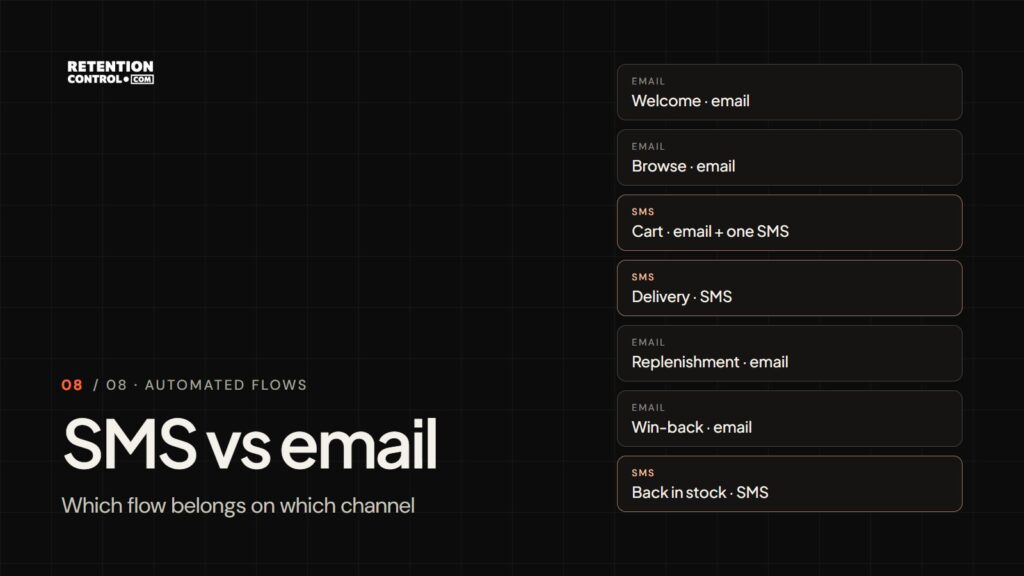
The table: which flow belongs where
| Flow | Primary channel | Why |
|---|---|---|
| Welcome | Needs length, context and images. An SMS welcome is a wasted first impression. | |
| Browse abandonment | The weakest intent signal of any flow. A text here reads as surveillance and costs you per send. | |
| Cart abandonment | Both | Email for the trust and detail touches; one SMS for the time-sensitive reminder. Never both at once. |
| Post-purchase | Both | Email for use, review and cross-sell; SMS for delivery status, which customers actively want. |
| Replenishment | Not urgent. Timed weeks out, benefits from product imagery and a clear reorder link. | |
| Win-back | Needs a reason and some warmth. A text to a lapsed customer is intrusive at the worst moment. | |
| VIP and loyalty | Both | SMS suits early access, where minutes matter and the audience opted in enthusiastically. |
| Back in stock | SMS | The clearest case on the list: decays in hours, single action, explicitly requested. |
Consent, in plain English
The single most important thing to understand: consent to email you is not consent to text you. They are separate permissions and must be collected separately, with the phone number captured for that purpose and the customer told clearly what they are signing up for and how often.
Beyond that, three practical rules travel well: respect quiet hours in the recipient’s time zone rather than yours; make opting out trivially easy and honour it immediately; and keep records of when and how each consent was captured, because the ability to prove it is the whole defence.
The detail varies by market. In the US, federal rules (the Telephone Consumer Protection Act) and some state laws apply, alongside the carriers’ own messaging guidelines; the UK and EU have their own regimes. Treat the above as the shape of the obligation, not legal advice, and have someone qualified check your setup against the markets you actually send to.
Cost per message against cost per outcome
Email is effectively free at the margin. SMS is not: every send has a unit cost, and longer messages or messages with images cost more.
That changes the question you ask of each message. With email, the bar is “is this worth the attention?” With SMS it is “is this worth the attention and the money?” The second bar removes a great deal of mediocre marketing before it is ever sent, which is one reason well-run SMS programmes show strong returns: the channel’s cost forces a selectivity email never imposes.
So judge SMS on cost per outcome, not response rate. A text that costs a few cents and recovers a cart is excellent. A weekly promotional text to the whole list that recovers nothing extra is a line item.
Where to start if you are adding SMS
If you run email today and are adding SMS, resist the urge to switch it on everywhere. Start with the three messages where speed changes the outcome, and add more only once they are earning their cost.
- Back in stock. Customers asked to be told. It is the highest-intent text you will ever send, and it is useful rather than promotional.
- One cart reminder. A single text within the first hour of an abandoned checkout, then leave the rest of the sequence to email.
- Delivery updates. “Out for delivery” and “delivery failed” are texts people genuinely want, and they cut “where is my order?” contacts.
Collect SMS consent where intent is highest: at checkout, and as a second step on your signup form after the email address, with the frequency stated plainly. A small list of people who asked for texts is worth far more than a large list of people who were surprised to get them.
Then set a monthly cap for promotional texts before the first campaign goes out, not after the first wave of opt-outs. Campaigns are where SMS programmes lose subscribers fastest, because a text is interruptive in a way an email in a promotions tab is not.
Running both channels without doubling up
The failure mode of a two-channel programme is the same message arriving twice within a minute. It is worse than either channel alone, because it announces that nobody is coordinating. Three things prevent it:
- One flow with channel branches, rather than two parallel flows, so the logic lives in one place.
- Suppress across channels. If the SMS converted, the email should not send, and the other way round.
- One frequency cap counting both channels, because your customer does not experience them as separate programmes. They experience them as you.
In Klaviyo that means building SMS steps inside the same flow as the email steps, splitting on SMS consent, and using the flow’s exit filter so an order ends every branch at once. Whether Klaviyo or another platform suits your SMS volume is a separate question; we compare the two most common options in Omnisend vs Klaviyo.
Where to go next
This closes the series. Start at the automated flows hub for the whole map, or pick the flow you are missing from the table above.
We build across both channels on Klaviyo, Omnisend, Brevo and Attentive, and the first thing we do is work out which messages have earned a per-send cost. Book a free 60-minute audit and we will map it against your flows, or see how we run SMS retention marketing.