
Most ecommerce brands look at Klaviyo’s pricing page, see a starting price, and assume that’s roughly what they’ll pay. Then the first real invoice arrives after a holiday campaign, an SMS push, or a big list import, and the number looks very different.
That’s because Klaviyo pricing isn’t one flat subscription. Your bill depends on how many active profiles you have, how many emails your plan lets you send, how much you spend on SMS and other mobile messages, which channels and regions you send to, which extra Klaviyo products you add, and how your sending changes through the year. Two Shopify stores with similar revenue can pay very different amounts.
This Klaviyo pricing 2026 guide explains how Klaviyo plans and billing work, including the July 2026 change to SMS pricing, and walks through what an ecommerce business is likely to pay in practice, both for the software and for running it well.
Key Takeaways
- Klaviyo pricing is primarily determined by active profiles. The Profile & Email plan is priced by the number of profiles you can email, and each tier includes a set monthly email send allowance.
- An active profile is any profile that can be emailed through Klaviyo, regardless of consent status. Suppressed profiles don’t count toward your billable total.
- SMS is priced separately. Since July 13, 2026, Klaviyo Mobile Messaging uses dollar-based, per-message rates instead of credits. Rates vary by channel (SMS, MMS, WhatsApp, RCS), recipient country, and, for US and Canada SMS, number type such as toll-free or short code.
- Klaviyo has a free plan, but it’s built for small lists and testing. Most growing stores move to a paid plan once their active profiles or sending needs pass the free limits.
- Your total bill can include several products: Profile & Email, Mobile Messaging, and optional add-ons such as Marketing Analytics, Reviews, Customer Hub, Helpdesk, Customer Agent, and the Advanced Klaviyo Data Platform, each with its own pricing basis.
- Bills rise when usage rises: profile growth, extra sends during peak season, flexible sending or auto-upgrades, and higher SMS volume are the most common reasons.
- The software is only part of the cost. Strategy, flow setup, design, copy, segmentation, and ongoing optimization are usually handled by an in-house team or an agency, and that cost sits on top of the subscription.
How Does Klaviyo Pricing Work in 2026?
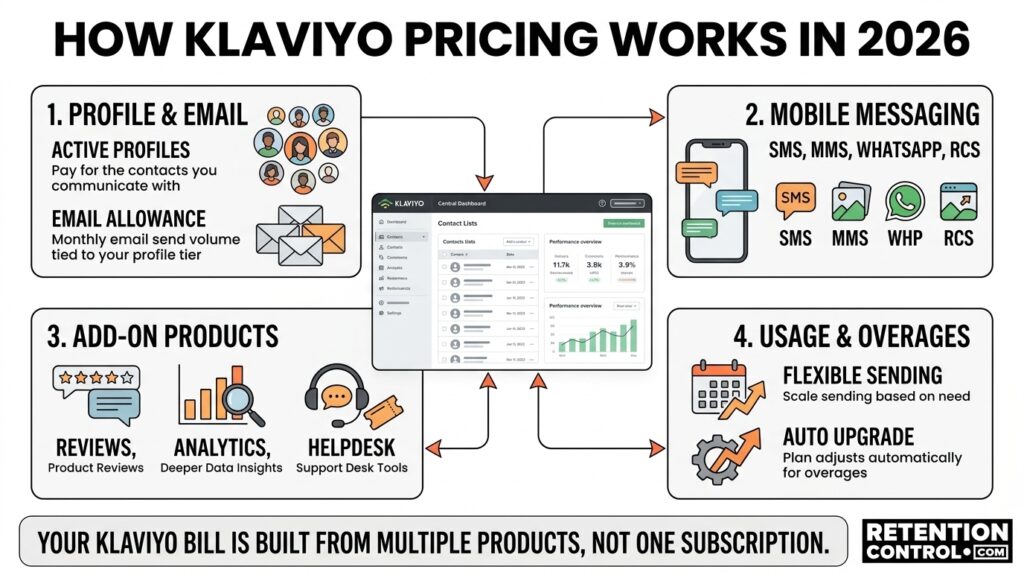
Klaviyo pricing in 2026 is modular. Your core email plan is priced by the number of active profiles in your account, with a monthly email send allowance included in each tier. SMS and other mobile messages are billed through a separate Mobile Messaging subscription, and products like Reviews, Marketing Analytics, Customer Hub, Helpdesk, and Customer Agent each have their own pricing metric.
In practice, your Klaviyo bill is built from a few layers:
- Profile & Email: priced by active profiles, with email send capacity included.
- Mobile Messaging: a monthly dollar amount you commit to, which is drawn down by per-message rates as you send SMS, MMS, WhatsApp, or RCS messages.
- Optional products: each priced on its own usage metric, such as orders, tickets, or resolved conversations.
- Usage settings: flexible sending, auto-upgrade, or auto-downgrade, which decide what happens when you hit your plan’s limits.
According to Klaviyo’s billing documentation, Klaviyo bills monthly in advance, and billing cycles renew automatically from your signup date. Since October 2025, usage cycles line up with billing cycles, which makes it easier to see when your sending allowance resets. Klaviyo’s own overview of how Klaviyo pricing works describes the model as contact-based: you pay for reachable contacts, not for every record you’ve ever collected.
Klaviyo Pricing Plans at a Glance
Klaviyo pricing plans aren’t one bundle with a single price. Each product has its own pricing basis, and the exact amount depends on your account size and usage. The table below summarizes what each one is billed on, using Klaviyo’s published starting points where they exist. Use the official Klaviyo pricing page and its calculator to see the exact price for your profile count.
| Plan / product | Pricing basis | What it covers | Who it’s for |
|---|---|---|---|
| Free | Free, up to 250 active profiles and 500 emails per month | Email, forms, basic automations, with Klaviyo branding | New stores and testing |
| Profile & Email | Active profiles, with a monthly email send allowance | Email campaigns, flows, segmentation, forms, reporting | Almost every paying Klaviyo customer |
| Mobile Messaging | Monthly spend you commit to (for example $15 or $25), used at per-message rates | SMS, MMS, WhatsApp, RCS | Brands adding text messaging |
| Reviews | Monthly orders placed on your website | Product reviews collection and display | Stores wanting reviews inside Klaviyo |
| Marketing Analytics | Active profiles, from $100 per month for up to 13,500 active profiles | Deeper reporting, such as CLV and attribution analysis | Teams that need more advanced analysis |
| Customer Hub | Active profiles, from $20 per month for up to 10,000 active profiles | Self-service customer portal for orders and account info | Brands improving the post-purchase experience |
| Helpdesk | Shopper-initiated tickets, from $10 per month for up to 50 tickets | Customer support inbox tied to customer data | Brands handling support in Klaviyo |
| Customer Agent | Shopper-initiated conversations resolved, from $50 per month for up to 75 conversations | AI agent that answers shopper questions | Brands automating customer conversations |
| Advanced Klaviyo Data Platform | Total profiles in the account, including suppressed | Advanced data management, warehouse sync, and data tools | Larger brands with complex data needs |
Starting points above come from Klaviyo’s billing documentation as of October 2026. Higher tiers cost more, and prices can change, so treat the official pricing page and your account’s billing view as the final word.
Klaviyo Email Pricing
Klaviyo email pricing is based on active profiles, and each profile tier includes a set number of email sends per month. A plan might, for example, cover a certain number of profiles and a matching email allowance. As your active profile count grows, you move into a higher tier, and both the price and the send allowance go up.
The key idea is the difference between how many people you store and how many people you can actively reach. Klaviyo doesn’t bill you for every profile that exists in your account. It bills you for profiles that can be emailed. If you have collected 80,000 profiles over five years but 20,000 of them are suppressed because they unsubscribed, bounced, or were deliberately suppressed, your billable count is closer to 60,000.
Send volume matters too. You’re charged for emails that actually leave Klaviyo, and skipped emails don’t count against your allowance. A store that sends two campaigns a month to its full list uses far less of its allowance than one that sends daily during November. Seasonal peaks are where many brands hit their send limit for the first time, which is why your overage setting (covered below) matters.
When your profile count or send volume consistently outgrows your tier, upgrading is usually more predictable than relying on temporary capacity each month.
What Are Klaviyo Active Profiles?
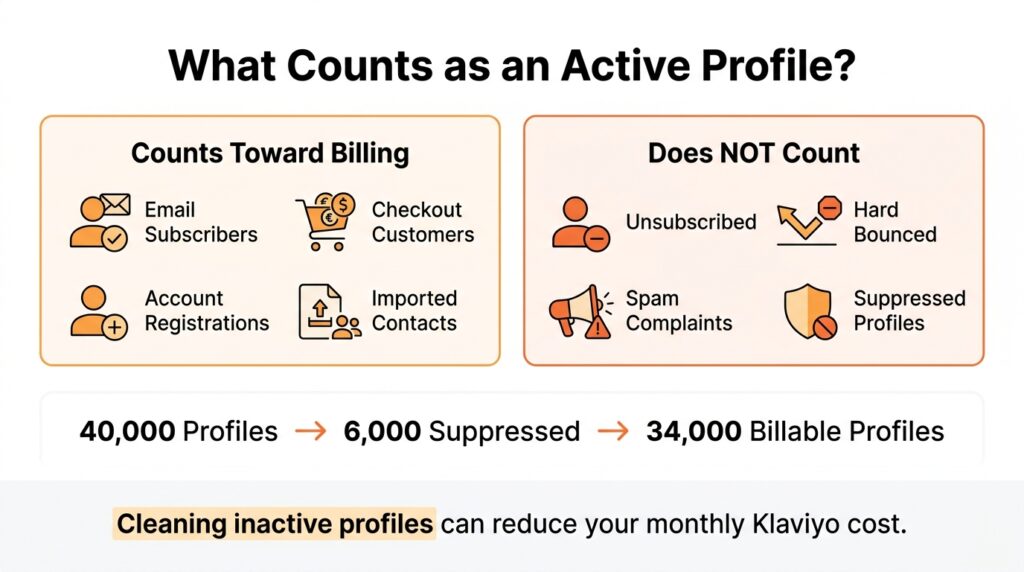
An active profile is any profile in your Klaviyo account that can be emailed, regardless of consent status. That includes email subscribers, but also people added through checkout, account creation, or other activity, even if they never joined your newsletter.
Suppressed profiles are different. They stay in your account for historical reporting, but they no longer count toward your billable total once Klaviyo has finished processing them, which takes up to 72 hours. Profiles can be suppressed automatically (hard bounces, spam complaints, unsubscribes) or manually by you.
Here’s a simple example. A Shopify apparel brand has 40,000 profiles. Of those, 6,000 have unsubscribed or bounced and are already suppressed, and another 9,000 haven’t opened or clicked an email in over two years. The brand pays for 34,000 active profiles. If it decides, after a re-engagement attempt, to suppress the long-inactive group, its billable count falls to about 25,000, which may move it into a lower tier.
Profile count matters because it’s the main driver of your email bill. Every import, popup, checkout, and integration that adds emailable profiles can push you into a new tier, even if your sending habits haven’t changed.
Klaviyo SMS Pricing in 2026
Klaviyo SMS pricing works on dollar-based, per-message rates. You choose a monthly Mobile Messaging plan, which is a dollar amount you pay upfront, and each SMS, MMS, WhatsApp, or RCS message you send draws down that balance at a rate set by the channel, the recipient’s country, and, for US and Canada SMS, the type of number you send from.
This is a recent change. According to Klaviyo’s Mobile Messaging pricing update, Klaviyo moved Mobile Messaging from credits to per-message dollar rates starting July 13, 2026. New customers moved to the new model right away, and existing paid customers switch on their next billing cycle after August 13, 2026. If you’ve read older articles that explain Klaviyo SMS in terms of credits per message, that describes the legacy model, not the current one.
The main changes to know about:
- Rates are shown in dollars per message, so it’s easier to see what a campaign will cost before you send it.
- Carrier and provider fees are built into the rate, rather than listed as separate charges.
- There are more plan sizes, roughly 70 tiers, and larger monthly plans get volume discounts. Existing negotiated discounts carry over.
- Klaviyo says it won’t automatically move you to a higher-cost Mobile Messaging tier.
- Every Klaviyo customer gets $5 of Mobile Messaging dollars each month, per Klaviyo’s billing documentation, which is enough for light testing but not a real SMS program.
For US brands, number type matters. A toll-free number and a dedicated short code have different rates, setup requirements, and throughput. Short codes are typically chosen by brands sending higher volumes that need faster delivery, while toll-free numbers are a common starting point for smaller programs. Message type also matters: an MMS with an image costs more than a plain-text SMS, and long SMS messages can be split into multiple segments.
How Much Does a Klaviyo SMS Cost?
There is no single universal price per Klaviyo SMS. The cost of each message depends on the channel (SMS, MMS, WhatsApp, or RCS), the country you’re sending to, your US or Canada number type, and the size of your Mobile Messaging plan, since larger plans get volume discounts.
To see your exact rates, go to Settings > Billing > Overview in your Klaviyo account. The pricing page also lets you estimate costs for your expected volume. A practical habit is to estimate each campaign’s cost before sending: multiply the number of recipients by the per-message rate for that channel and number type, and remember that MMS or multi-segment messages cost more.
Is Klaviyo Free?
Yes, Klaviyo has a free plan, but it’s designed for very small lists. According to Klaviyo’s comparison of free and paid plans, the free plan allows up to 250 active profiles and 500 emails per month. When you hit either limit, sending stops until the next month or until you upgrade.
So, is Klaviyo free for a real ecommerce business? Usually only at the very beginning. The free plan also has other limits:
- Support: email support for the first 60 days only, then the community forum and help resources.
- Branding: Klaviyo branding appears in email footers and signup forms, and you can’t customize the footer.
- Features: no custom hosted pages and fewer marketing capabilities. Shopify merchants using Klaviyo’s free starter setup are also limited to 3 live automations and 1 live signup form, per Klaviyo’s free plan limits for Shopify.
Most stores outgrow the free plan quickly. A welcome popup alone can add 250 profiles in a few weeks, and a single campaign to a 400-person list plus a welcome series can use the 500-email allowance. Once you’re running regular campaigns and core flows such as abandoned cart and post-purchase, a paid plan is normally needed.
Klaviyo Pricing Tiers Explained
Klaviyo pricing tiers are bands of active profiles. Each tier has a monthly price and an email send allowance, and when your active profile count passes the top of your tier, you move to the next one. Mobile Messaging has its own tiers based on the monthly dollar amount you commit to.
Businesses usually move between tiers for three reasons. First, list growth: popups, giveaways, checkout opt-ins, and new sales channels add profiles every month. Second, sending growth: more campaigns, more flows, and bigger seasonal pushes can use up the email allowance even if profiles stay flat. Third, list cleanup, which can move you down a tier if you suppress profiles that shouldn’t be marketed to.
Seasonal peaks are where tier changes are most likely. Black Friday, Cyber Monday, and holiday campaigns often mean daily sends and large list imports from ads. Without planning, that can trigger an auto-upgrade you didn’t expect, or stop sending at the worst time if no overage option is set.
The numbers worth watching each month are your active profile count compared with your tier ceiling, email sends compared with your allowance, Mobile Messaging spend compared with your plan, and the growth rate of new profiles.
What Can Increase Your Klaviyo Cost?
Your Klaviyo cost usually rises because usage rises, not because Klaviyo changed your price. If your bill jumped, one of these is the most likely cause:
- Active profile growth. New popups, lead-gen ads, giveaways, or a large import can push you into a higher profile tier.
- Extra email capacity. Flexible sending or an auto-upgrade during a busy month adds cost for that cycle, or permanently.
- SMS volume. Bigger SMS lists and more frequent texts draw down your Mobile Messaging plan faster and may require a larger plan.
- MMS and richer channels. Image-based MMS, WhatsApp, and RCS can have different rates from plain SMS.
- Seasonal campaigns. BFCM and holiday sends increase both email and SMS volume in a short window.
- Additional products. Reviews, Marketing Analytics, Customer Hub, Helpdesk, and Customer Agent each add their own line item.
- Data needs. The Advanced Klaviyo Data Platform is priced on total profiles, including suppressed ones, so it scales differently from your email plan.
- Support volume. Helpdesk and Customer Agent are priced on tickets and resolved conversations, so more customer contact means a higher tier.
Klaviyo Flexible Sending, Overages, and Upgrades
When you reach your plan’s profile or email limit, Klaviyo does one of three things, depending on the setting you’ve chosen in your billing preferences:
- Flexible sending: a one-time add-on of the profiles and emails included in the next tier up, charged at your current plan’s unit rate. You return to your base plan the next cycle. It’s useful for a short peak, but Klaviyo notes it’s typically more expensive than simply upgrading if you need the capacity regularly.
- Auto-upgrade: your account moves to the next plan tier automatically when you hit your limits, and stays there.
- None: sending stops until your next billing cycle or until you change plans manually.
Klaviyo also offers auto-downgrade for email plans that use flexible sending. If your active profiles drop, for example after list cleanup, your plan can move down to the lowest tier that covers your profile count. Auto-downgrade can’t run at the same time as auto-upgrade.
The practical advice is simple: check this setting before a major campaign period. A brand with “None” selected can have its Black Friday sends stopped halfway through the weekend, while a brand on auto-upgrade may stay on a larger plan after the peak has passed. If you’re planning holiday campaigns now, our BFCM 2026 retention guide covers how to prepare your sending calendar.
How to Estimate Your Klaviyo Cost
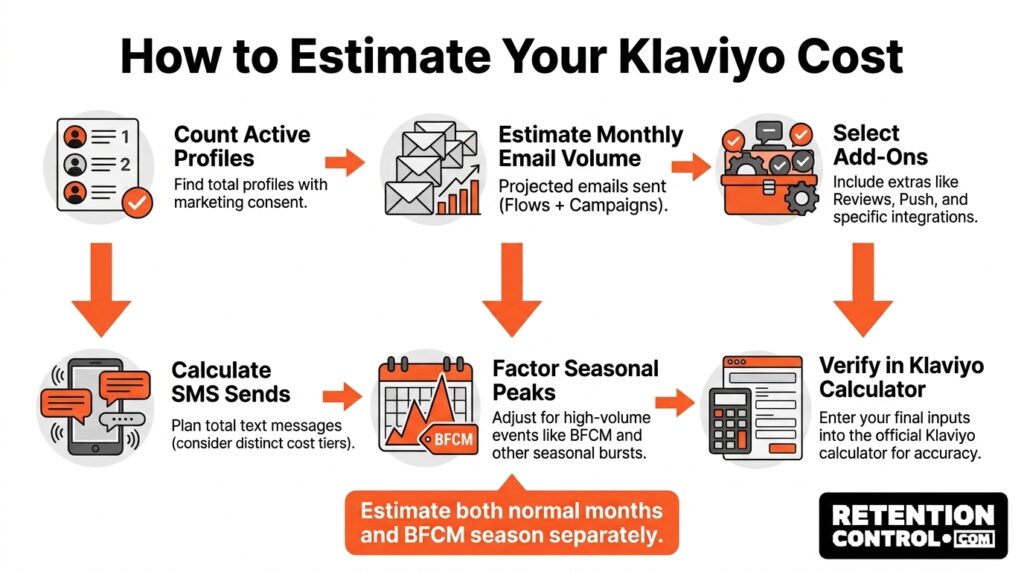
There’s no single formula for Klaviyo cost, but you can build a reliable estimate in six steps.
- Find your active profile count. Look at emailable profiles, not total profiles. If you’re migrating from another platform, exclude unsubscribed and bounced contacts.
- Estimate monthly email volume. Multiply your list size by your campaign frequency, then add flow sends such as welcome, abandoned cart, and post-purchase emails. Compare that total with the allowance for your profile tier.
- Estimate SMS and mobile messaging usage. Multiply your SMS subscribers by the number of texts per month, then apply the per-message rate for your channel and number type.
- List the extra products you actually need. Only add Reviews, Marketing Analytics, Customer Hub, Helpdesk, or Customer Agent if you’ll use them.
- Account for seasonal peaks. Estimate November and December separately, since send volume and list growth are often much higher.
- Confirm in Klaviyo. Use the Klaviyo pricing calculator or your account’s billing view to see the exact plan price for your numbers.
Hypothetical example: A store has 12,000 active profiles and sends eight campaigns a month to its engaged list of about 7,000, plus around 15,000 flow emails. That’s roughly 71,000 emails. The store checks whether its 12,000-profile tier allowance covers that volume. It also has 2,500 SMS subscribers receiving four texts a month, so 10,000 SMS messages, which it multiplies by its per-message rate to choose a Mobile Messaging plan.
Klaviyo Pricing Example for an Ecommerce Brand
The scenarios below are hypothetical. They show how the cost logic works, not what any specific brand will pay.
Small ecommerce brand. A new Shopify store with 1,500 active profiles, one weekly campaign, and core flows. Its bill is mostly the Profile & Email tier for 1,500 profiles. It may test SMS using the free monthly Mobile Messaging dollars before committing to a plan. The main cost driver to watch is list growth from its popup.
Growing ecommerce brand. A brand at 25,000 active profiles, growing by 1,500 a month, sending two campaigns a week plus an SMS program for 5,000 subscribers. It’s likely to move up profile tiers every few months, and its Mobile Messaging plan becomes a meaningful share of the bill. Its biggest decisions are how often to text, whether to use MMS, and which overage setting to use during peak season.
Larger DTC brand. A brand with 200,000 active profiles, 40,000 SMS subscribers, Reviews, Marketing Analytics, and Helpdesk. Here, the email plan, Mobile Messaging, and several add-ons are each significant. Cost management means reviewing each product’s tier, the number type used for SMS, and whether every add-on is earning its place.
Klaviyo Cost Beyond the Subscription
Your actual Klaviyo cost can include much more than the software. The subscription gives you the tools; someone still has to plan, build, write, design, send, and improve everything that goes out.
Running Klaviyo well usually involves:
- Strategy: deciding which segments, offers, and channels matter for your customers.
- Account setup: integrations, data hygiene, sender authentication, and SMS number registration.
- Flow development: welcome, abandoned cart, browse abandonment, post-purchase, replenishment, and win-back sequences.
- Campaign management: planning the calendar, building sends, and scheduling.
- Segmentation: building audiences by purchase behavior, engagement, and lifecycle stage.
- Copywriting and design: emails, SMS messages, and signup forms that fit your brand.
- Deliverability management: monitoring inbox placement, bounces, and spam complaints.
- Analytics and testing: A/B tests, attribution checks, and reporting.
- Ongoing optimization: improving flows and campaigns month after month.
Brands cover this in different ways: a founder doing it themselves, an in-house retention marketer, freelancers, or an email and SMS retention marketing agency; our guide to the best Klaviyo agencies for Shopify brands compares eleven, with prices where they publish them. Each option has a cost in money or time, and that cost should be part of any honest comparison of email marketing platforms. If you’d rather have specialists run the platform day to day, our Klaviyo management team handles strategy, flows, campaigns, and optimization.
Klaviyo Pricing vs. the Cost of Not Using Retention Marketing Properly
The Klaviyo price is easy to see on an invoice. The cost of weak retention marketing is harder to see, but it’s often larger. Every shopper who abandons a cart without a reminder, every first-time buyer who never gets a well-timed post-purchase message, and every lapsed customer who’s never invited back is revenue a business may be leaving behind.
That’s why software cost is best judged alongside what the platform is used for: customer retention, repeat purchases, abandoned-cart recovery, post-purchase communication, lifecycle automation, segmentation, and customer lifetime value. Klaviyo doesn’t increase revenue automatically. Its value depends on how well the business sets up its automated flows, segments its audience, and keeps improving. A well-run account on a mid-size plan can be worth more than a neglected account on a cheaper one. If you want to model the numbers for your store, RetentionControl’s retention ROI calculator is a useful starting point.
Is Klaviyo Worth the Cost for Your Ecommerce Business?
Whether Klaviyo is worth it depends on what your business needs and how well you’ll use it. There isn’t one answer for every store.
Klaviyo tends to make more sense for businesses that need:
- advanced segmentation based on purchase and browsing behavior
- lifecycle automation across many flows
- deep ecommerce integrations, especially with Shopify
- email and SMS in one platform with shared customer data
- behavior-based messaging, such as price-drop or back-in-stock alerts
- detailed retention reporting
A simpler, cheaper tool may be enough if you send a basic monthly newsletter, have a small catalog with little repeat purchasing, don’t plan to use SMS, or don’t have the time to build and maintain segments and flows. Paying for advanced features you won’t use is rarely a good trade.
Klaviyo Pricing for Shopify Stores
Klaviyo is widely used by Shopify merchants because its Shopify integration syncs customers, orders, products, and on-site behavior. That data powers the flows most Shopify stores rely on: welcome series, abandoned cart, browse abandonment, post-purchase, and win-back, along with segmented email campaigns and SMS.
The integration doesn’t mean retention happens on its own, though. Connecting Shopify to Klaviyo gives you the data. Turning it into results still takes strategy, flow setup, segmentation, testing, and regular optimization. Many Shopify stores pay for Klaviyo but run only a handful of default flows and occasional campaigns, which means they’re paying for capability they don’t use.
If you want help building Shopify and Klaviyo retention properly, from flows and segmentation to campaigns and SMS, RetentionControl offers email and SMS retention marketing for ecommerce brands.
Get a Klaviyo retention plan for your store →
Common Klaviyo Pricing Mistakes
Looking only at the starting price. The entry price covers a small number of active profiles and no SMS. Budgeting from it leaves out profile growth, Mobile Messaging, and add-ons.
Ignoring active profile growth. Popups, giveaways, and imports keep adding emailable profiles. Brands that don’t track this often discover a tier change only when the invoice arrives.
Misunderstanding SMS pricing. Treating every text as costing the same leads to bad estimates. MMS, multi-segment messages, number type, and destination country all change the rate. If SMS is a growing channel for you, planning frequency and content with an SMS retention marketing approach helps keep spend tied to results.
Ignoring seasonal volume. November and December sending can be several times a normal month. Without a plan, that means unexpected upgrades or stopped sends.
Keeping unnecessary profiles active. Profiles that bounce, complain, or haven’t engaged in years still count if they’re emailable. They add cost and can hurt deliverability.
Forgetting additional products. Each add-on has its own tier. A few small products together can add a meaningful amount to the monthly bill.
Not reviewing billing preferences. Flexible sending, auto-upgrade, and “None” lead to very different outcomes at your limit. Many brands have never checked which one is active.
Assuming software alone creates retention revenue. Klaviyo provides the tools. Revenue depends on strategy, execution, and testing.
How to Reduce Unnecessary Klaviyo Costs
The goal is to stop paying for things you don’t use, not to cut corners on customers who matter. A few habits help:
- Review active profiles monthly and compare them with your tier ceiling.
- Suppress profiles that shouldn’t be marketed to, such as long-term non-engagers who didn’t respond to a re-engagement flow. Run that flow first, so you don’t lose customers who might still buy.
- Monitor email and SMS usage against your allowances and Mobile Messaging plan.
- Check plan size after cleanups; auto-downgrade can help if you use flexible sending.
- Plan seasonal peaks and choose your overage setting in advance.
- Audit flows and campaigns to remove duplicate or low-value sends.
- Drop add-ons you don’t use, and review each product’s tier.
- Watch SMS frequency and format, using MMS only where it adds value.
List hygiene should balance cost with legitimate marketing needs. Removing recent buyers or engaged subscribers just to save money usually costs more in lost revenue than it saves.
Klaviyo Pricing FAQ
How much does Klaviyo cost in 2026?
Klaviyo cost in 2026 depends on your active profile count, email volume, SMS spend, and any add-ons. There’s a free plan for up to 250 active profiles and 500 emails a month. Paid email plans scale by active profiles, and Mobile Messaging plans are a monthly dollar amount used at per-message rates. Check the official pricing page for your exact numbers.
What is Klaviyo pricing based on?
Klaviyo pricing is based mainly on active profiles, meaning profiles that can be emailed, with an email send allowance included in each tier. SMS and other mobile messages are billed separately, and add-ons such as Reviews or Helpdesk use their own metrics.
Is Klaviyo free?
Yes, for very small lists. The free plan covers up to 250 active profiles and 500 emails per month, includes Klaviyo branding, and offers email support only for the first 60 days.
How does Klaviyo SMS pricing work?
Since July 13, 2026, Klaviyo SMS pricing uses dollar-based per-message rates. You choose a monthly Mobile Messaging plan, and each message draws it down at a rate based on channel, country, and, in the US and Canada, number type. Your exact rates are under Settings > Billing > Overview.
Does Klaviyo charge based on contacts or emails?
Both, in different ways. Your plan price is set by active profiles (contacts), and each tier includes a monthly email allowance. Going past that allowance triggers flexible sending, an upgrade, or a pause, depending on your settings.
Does Klaviyo have different pricing tiers?
Yes. Profile & Email plans are tiered by active profiles, Mobile Messaging has around 70 spend-based tiers, and add-ons have their own tiers.
Can Klaviyo pricing increase as my ecommerce business grows?
Yes. As you add active profiles, send more email, expand SMS, or add products, you move into higher tiers. Reviewing usage monthly helps keep increases predictable.
Conclusion
Klaviyo pricing is easier to manage once you see it as several parts rather than one number: an email plan priced by active profiles, a separate Mobile Messaging budget priced per message since July 2026, optional products with their own metrics, and usage settings that decide what happens at your limits. On top of that sits the cost of actually running the platform well.
The brands that get the most from Klaviyo are usually the ones that understand their profile count, plan for peak season, keep their list healthy, and invest in strategy rather than just the subscription. If you’d like help turning your Klaviyo account into a working retention program, RetentionControl’s ecommerce retention marketing team can review your setup and costs.