
Most Shopify brands can tell you their ad spend down to the dollar, but ask them what a single customer is worth over time and the answer gets vague fast. That gap is exactly why customer lifetime value (CLV), also called CLTV or LTV, deserves more attention than it usually gets. It is not a vanity number for a slide deck. It is the metric that decides whether your marketing budget is building a real business or just refilling a bucket with a hole in it.
What Is Customer Lifetime Value (CLV)?
Customer lifetime value is the total revenue a single customer brings to your store across the entire time they keep shopping with you. Instead of judging success order by order, CLV looks at the full relationship, from a customer’s very first purchase to their last.
Two ideas sit underneath this number. Customer lifespan is how long the average customer keeps buying from your brand before they churn. Purchase frequency and average order value (AOV) together describe how often they buy and how much they spend each time. Combining these gives a far more complete picture of a customer’s worth than any single order ever could.
Why CLV Matters for Shopify Brands
For a Shopify or DTC brand, this distinction matters more than almost anywhere else. Rising ad costs mean a brand that only looks at first-order profit will often look like it is losing money, even when those same customers become genuinely profitable after a second or third purchase. CLV is what reveals that hidden profitability, and it also feeds directly into marketing ROI, since knowing what a customer is worth tells you how much you can afford to spend to acquire one.
CLV vs. CAC: The Numbers That Actually Matter
Every Shopify founder tracks customer acquisition cost (CAC) closely. Far fewer track CLV with the same discipline, even though neither number means much without the other. A CAC of 35 dollars sounds fine until you realize the average customer only ever spends 40 dollars in total. Now imagine that same customer’s CLV is actually 150 dollars once repeat orders are counted. Suddenly the acquisition budget has real room to grow.
How to Calculate Customer Lifetime Value for Shopify
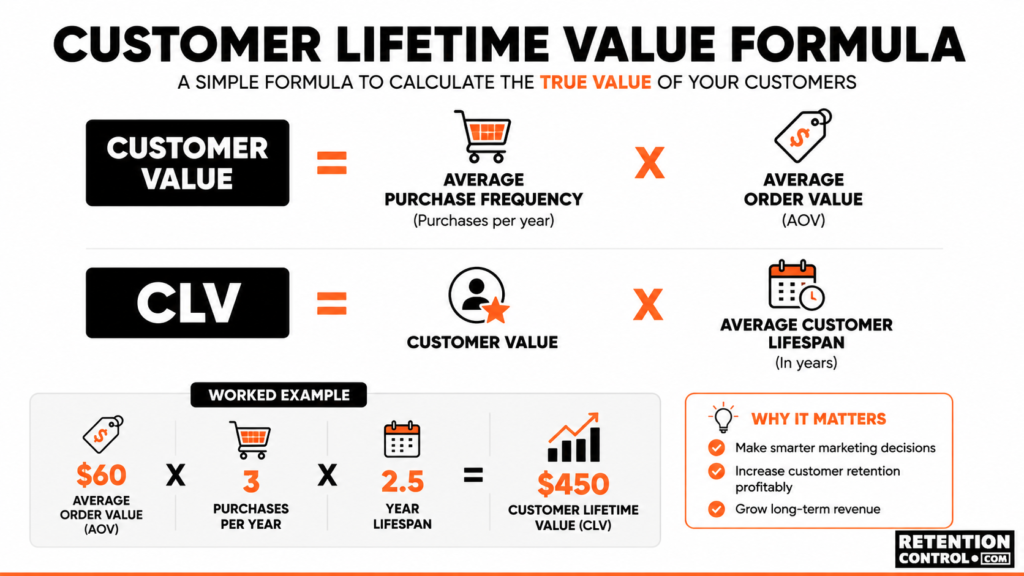
The most practical formula for an ecommerce brand is:
Customer Value = Average Purchase Frequency x Average Order Value (AOV)
CLV = Customer Value x Average Customer Lifespan
Here is how that looks for a real Shopify store. Say the average order value is 60 dollars, the customer buys 3 times per year, and the average customer lifespan is 2.5 years.
Customer Value = 60 x 3 = 180 dollars per year
CLV = 180 x 2.5 = 450 dollars
That $450 estimate gives the brand a useful baseline for evaluating acquisition costs and retention performance. It is not automatically the ceiling for what the brand can spend to acquire a customer, since gross margin, fulfillment costs, and other expenses still need to be factored in before that comparison is fair.
CLV vs. LTV: Is There a Difference?
In ecommerce, CLV, CLTV, and LTV are almost always used interchangeably, and a Shopify brand comparing tools or reading different reports will run into all three terms describing the same underlying idea. Some businesses, particularly in SaaS and subscription models, use LTV a bit more broadly to include projected future value beyond just historical spend. For a Shopify or DTC store, the practical takeaway is the same regardless of which term a given article or tool uses: it is the total value a customer brings over their relationship with the brand.
What Is a Good CLV to CAC Ratio?
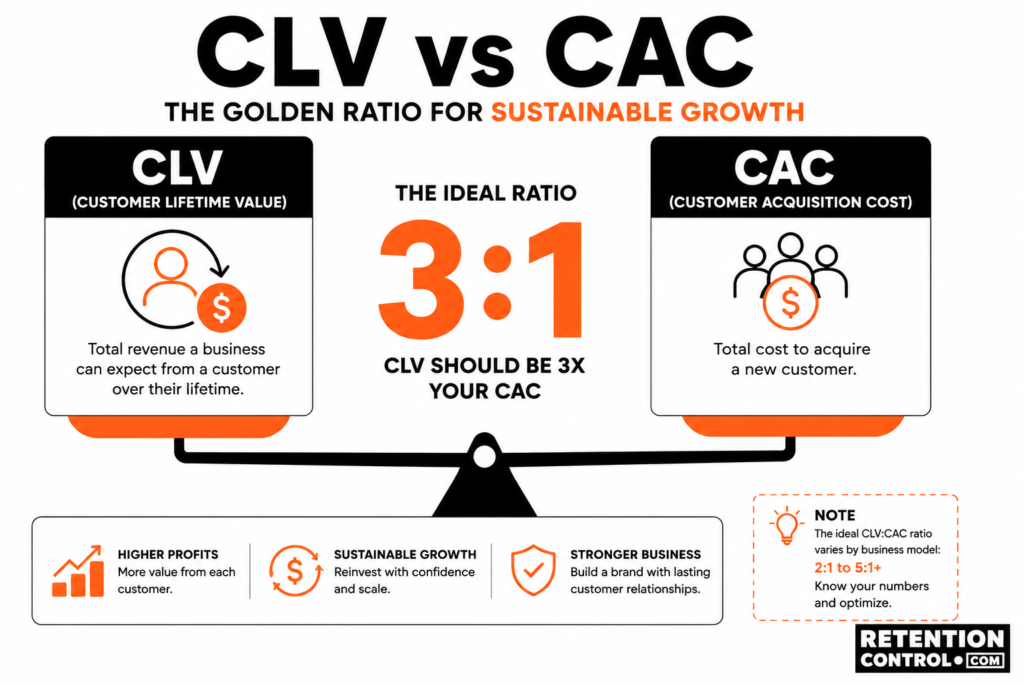
A 3 to 1 CLV to CAC ratio is often used as a useful benchmark, but the right target varies by business model, gross margin, payback period, and customer retention. A subscription skincare brand with thin margins and monthly repurchases will look very different from a furniture brand with a high average order value and a multi-year buying cycle. The ratio is most useful as a directional signal. Brands sitting well below it usually have a retention problem quietly disguised as an acquisition problem.
See how a retention-first strategy can raise your CLV — book a free audit call
How to Increase Customer Lifetime Value
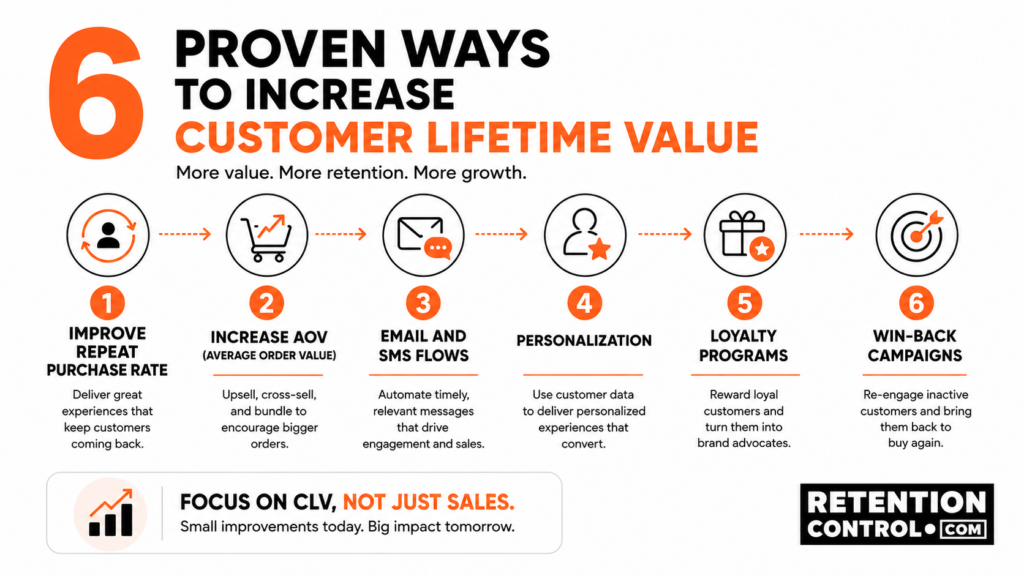
Raising CLV rarely comes from one dramatic change. It comes from tightening several parts of the post-purchase experience so customers naturally return more often and spend more each time they do.
Improve Repeat Purchase Rate
Repeat purchase rate is one of the most direct levers connected to CLV, since every additional order from an existing customer adds pure lifetime value without a fresh acquisition cost attached. Replenishment reminders timed to how often a customer typically reorders, post-purchase flows that introduce complementary products, and simple check-in emails after delivery all nudge that repeat rate upward.
Increase Average Order Value
Raising how much a customer spends per order compounds directly into CLV. Free shipping thresholds, bundling complementary products, and well placed upsell offers at checkout all push AOV higher without needing a single new customer.
Use Email and SMS Retention Flows
Automated flows built in Klaviyo are consistently one of the highest leverage tools for improving CLV on Shopify. A welcome series, post-purchase sequence, browse abandonment flow, and replenishment reminder all work together to keep a brand present at exactly the moments a customer is most likely to buy again.
Personalize Product Recommendations
Personalization based on past purchase behavior and browsing history helps customers discover products they are genuinely likely to want, rather than generic promotions. This kind of targeted customer segmentation consistently outperforms one-size-fits-all campaigns because it matches the offer to where a customer actually sits in their lifecycle.
Build Loyalty Programs
A simple points based loyalty program gives customers a reason to keep spending with one brand instead of splitting purchases across competitors. Rewarding repeat behavior reinforces exactly the pattern that drives CLV upward.
Create Win-Back Campaigns
A win-back flow, triggered after a defined period of inactivity, recovers customers who are drifting toward churn before they are lost for good. Catching this early is far cheaper than trying to reacquire the same customer later through paid channels.
Turn BFCM Buyers Into Repeat Customers
Black Friday and Cyber Monday bring in a wave of new, often price sensitive customers. Without a dedicated BFCM retention plan, most never return once the discount period ends. A structured 90 day sequence focused on product education and a second purchase incentive can meaningfully lift the lifetime value of that entire BFCM cohort.
How to Track CLV and Repeat Purchases in Shopify and Klaviyo
Shopify’s native analytics give a basic view of customer value over time, but pairing this with Klaviyo’s customer profiles paints a far more actionable picture, since flows, segments, and campaign performance can all be tied back to how a given cohort’s value changes. Reviewing repeat purchase rate and CLV monthly, rather than only at quarter end, makes it possible to catch a dip early enough to fix with a flow adjustment or a new segment before it shows up in revenue.
Common Shopify CLV Mistakes
Many Shopify brands suppress their own CLV without realizing it. Leaning too heavily on discount codes trains customers to wait for a sale instead of buying at full price, which drags down average order value over time. Weak or nonexistent post-purchase communication leaves customers with no reason to think about the brand again after their first order. And treating every customer identically, regardless of purchase history, wastes the opportunity to nurture the highest value segment with more relevant offers.
CLV by Customer Segment: Why Averages Can Mislead You
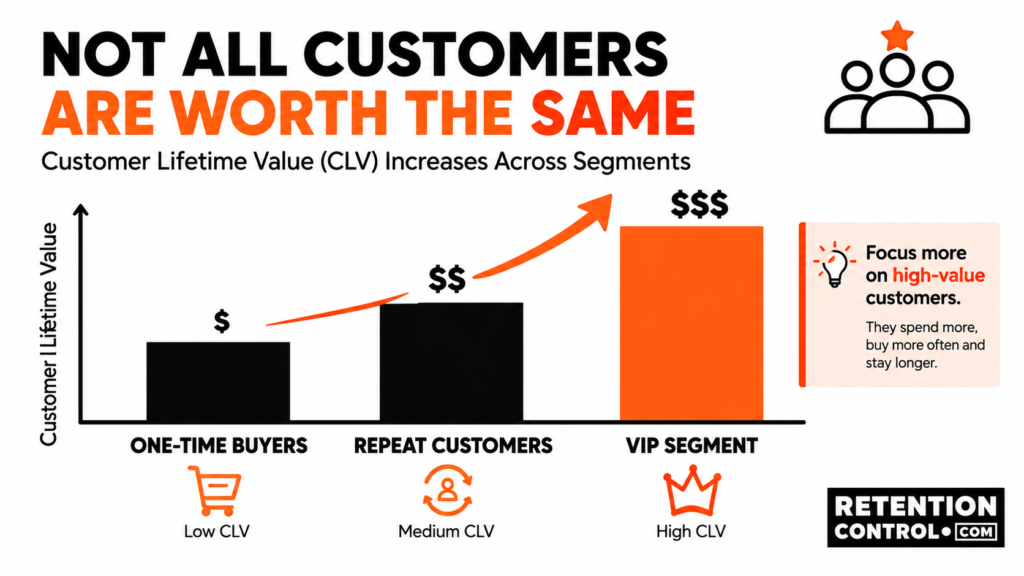
A single average CLV number can hide more than it reveals. A brand might have one segment of highly loyal repeat buyers with a CLV several times the store average, sitting alongside a much larger group of one-time purchasers dragging the overall number down. Breaking CLV out by acquisition channel, first purchase category, or customer segment shows where retention efforts will actually move the needle, instead of applying the same strategy to every customer regardless of their real value. This is also where a research backed view of retention economics is worth keeping in mind: Bain & Company’s research found that a 5 percent increase in customer retention can increase profits by 25 to 95 percent, depending on the industry, which is exactly why segment level CLV deserves more attention than a single blended average.
FAQs
How do you calculate customer lifetime value for a Shopify store?
Multiply average purchase frequency by average order value to get customer value, then multiply that by the average customer lifespan. A customer spending 60 dollars per order, buying 3 times a year, over a 2.5 year lifespan has a CLV of 450 dollars.
Is there a difference between CLV, CLTV, and LTV?
In ecommerce these terms are generally used interchangeably. Some SaaS and subscription businesses use LTV slightly more broadly, but for a Shopify store they all describe the same underlying idea of total customer value over time.
What is a good CLV to CAC ratio for a Shopify store?
A ratio of around 3 to 1 is a commonly used benchmark, but the right target depends on gross margin, payback period, and the business model, so it should be treated as a guide rather than a fixed rule.
How does repeat purchase rate affect customer lifetime value?
Repeat purchase rate is one of the strongest direct drivers of CLV, since every additional order from an existing customer adds revenue without a new acquisition cost attached.
How often should CLV be reviewed?
Monthly tracking works best for fast growing DTC brands, since it allows retention issues to be caught and corrected before they meaningfully affect revenue.
Conclusion
Customer lifetime value is not a dashboard vanity metric. For Shopify and DTC brands, it is the clearest signal of whether the business is building repeatable growth or simply spending its way into a corner. Brands that pair a clear CLV calculation and CLV to CAC ratio with focused retention work, from flows to segmentation to loyalty programs, consistently outperform those chasing acquisition alone. What would even a small lift in your repeat purchase rate do to your store’s bottom line this year?