
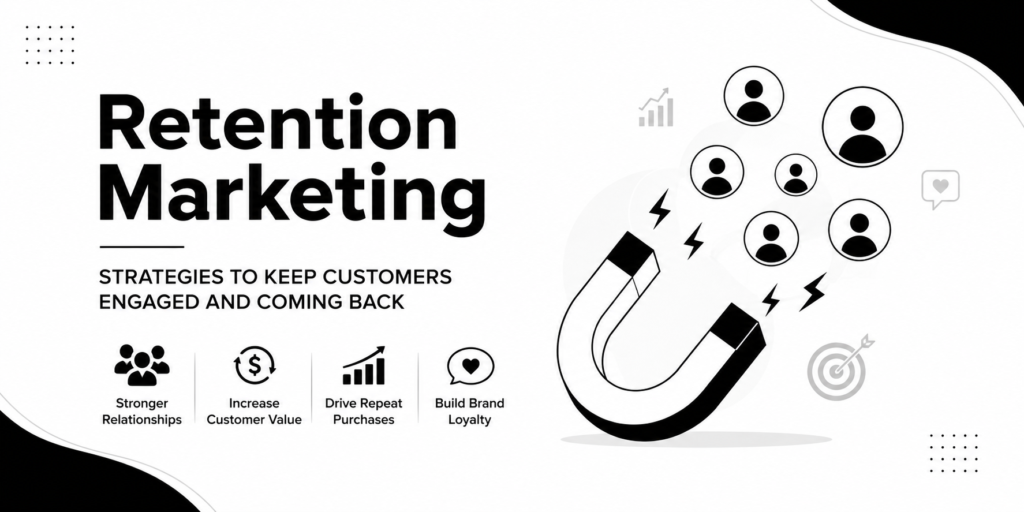
Getting a customer to make a first purchase is an important achievement, but it is only the beginning of the customer relationship. Businesses that want sustainable growth also need to encourage existing customers to return, remain engaged, and continue finding value in their products or services. This is where retention marketing becomes important.
Retention marketing focuses on building long-term relationships with existing customers rather than concentrating only on attracting new ones. Through relevant communication, personalized experiences, loyalty initiatives, customer education, and timely follow-ups, businesses can encourage customers to continue buying or using their products.
A strong retention strategy can help businesses reduce customer churn, increase repeat purchases, improve customer lifetime value, and build stronger relationships with their audience.
What Is Retention Marketing?
Retention marketing is the process of using marketing activities to keep existing customers engaged with a business and encourage them to continue purchasing, renewing, subscribing, or using its products and services. For how that works for Shopify brands, and the five service lines it breaks into, see our retention marketing overview.
Unlike acquisition marketing, which focuses on attracting new customers, retention marketing begins after a customer has already interacted with a business. The goal is to give customers compelling reasons to stay.
For example, an online store might send personalized product recommendations based on previous purchases. A SaaS company may provide onboarding emails that help users discover important features. A subscription business could send renewal reminders and explain the benefits customers receive by continuing their membership.
Retention marketing is not simply about sending more promotional messages. Effective retention depends on understanding customer behavior and delivering useful communication at the right stage of the customer journey.
How Does Retention Marketing Work?
Retention marketing works by creating ongoing interactions between a business and its existing customers. The process usually starts with understanding who the customers are, what they have purchased, how they interact with the business, and where they are in the customer lifecycle.
Businesses can then divide customers into different groups based on factors such as purchase frequency, product usage, engagement, subscription status, or recent activity.
Once these segments are identified, businesses can create relevant campaigns for each group. A recently purchased customer may receive product education, while an inactive customer might receive a re-engagement campaign.
The objective is to make every interaction useful and relevant instead of treating every customer in exactly the same way.
Why Is Retention Marketing Important?
Customer retention can have a major impact on business growth. Acquiring new customers often requires advertising, sales activity, content marketing, promotions, and other investments. Once someone has already become a customer, businesses have an opportunity to build on that existing relationship.
Retention marketing helps businesses generate additional value from those relationships.
One major benefit is increased repeat business. Customers who have already purchased from a company may be more likely to buy again when they have had a positive experience.
Retention can also improve customer lifetime value. When customers stay with a business for a longer period, they have more opportunities to purchase products, upgrade services, renew subscriptions, or recommend the company to others.
Another important benefit is customer loyalty. Consistent communication, useful support, and personalized experiences can make customers feel more connected to a brand.
Retention Marketing vs. Acquisition Marketing
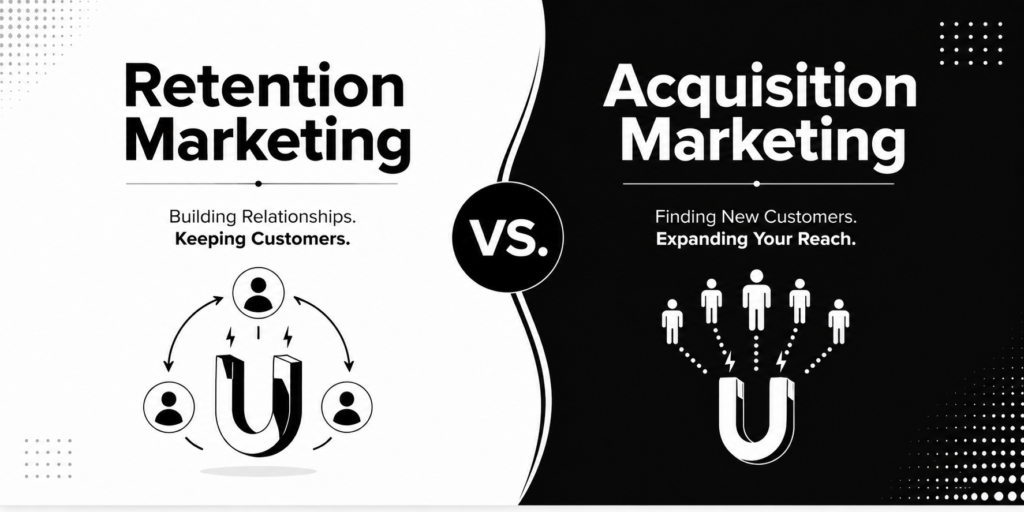
Retention marketing and acquisition marketing have different objectives, although both are important for business growth.
Acquisition marketing focuses on reaching people who have not yet become customers. Search advertising, social media advertising, SEO, content marketing, and lead generation campaigns are common acquisition activities.
Retention marketing focuses on people who have already purchased, subscribed, registered, or interacted with a business.
The difference can be summarized simply: acquisition brings customers in, while retention gives them reasons to stay.
A healthy marketing strategy usually needs both. Continuously acquiring customers without retaining them can create a cycle where the business has to replace customers who leave. Retention helps create a more stable customer base.
Key Retention Marketing Strategies
There are several ways businesses can build effective retention campaigns. The best approach depends on the industry, customer lifecycle, business model, and customer expectations.
Personalized Email Marketing
Email remains an effective channel for communicating with existing customers. However, sending the same email to every customer may produce limited results.
Personalized email marketing uses information such as previous purchases, browsing behavior, product usage, and customer preferences to create more relevant communication.
For example, an ecommerce business can recommend products related to a customer’s previous purchase. A software company can send feature tips based on how the customer uses its platform.
The objective is to make the message useful rather than simply promotional.
Customer Onboarding
The period immediately after a customer signs up or makes a purchase is important. Customers need to understand how to use the product and where they can get value from it.
A well-planned onboarding process can include welcome emails, tutorials, product guides, videos, setup instructions, and helpful reminders.
Good onboarding reduces confusion and can help customers reach the value of a product faster.
Loyalty Programs
Loyalty programs encourage customers to continue purchasing by providing benefits for ongoing engagement.
These benefits may include points, discounts, exclusive products, early access, special offers, or membership benefits.
A loyalty program works best when the rewards are easy to understand and provide genuine value to customers.
Re-Engagement Campaigns
Not every customer remains active forever. Some customers stop purchasing, stop opening emails, or reduce their use of a product.
Re-engagement campaigns are designed to bring these customers back.
A business might send a helpful reminder, introduce a new product, provide relevant recommendations, or ask inactive customers for feedback.
The key is to understand why customers became inactive instead of immediately relying on discounts.
Renewal and Subscription Campaigns
Businesses with recurring revenue models need to pay close attention to renewals.
Subscription companies can use automated communication to remind customers about upcoming renewals, explain product benefits, highlight new features, or provide assistance before the renewal date.
These campaigns can help reduce accidental cancellations and give customers an opportunity to resolve concerns before leaving.
Upselling and Cross-Selling
Existing customers can also be introduced to products or services that are relevant to their needs.
Upselling encourages a customer to move to a higher-value option, while cross-selling introduces complementary products or services.
For example, a customer who purchases a laptop might receive recommendations for a compatible accessory. A software customer might be shown an advanced plan when their current usage reaches certain limits.
The recommendations should be relevant rather than excessive.
Customer Education
Education can play an important role in customer retention, especially for products that require learning.
Businesses can provide tutorials, guides, webinars, knowledge bases, product tips, and educational content to help customers get more value.
When customers understand how to use a product effectively, they may be more likely to continue using it.
Retention Marketing Channels
Businesses can use multiple channels to communicate with existing customers.
Email is commonly used for onboarding, product updates, recommendations, and re-engagement campaigns. SMS can be useful for time-sensitive reminders and notifications. Push notifications can encourage users to return to an app.
In-app messaging is particularly useful for SaaS and mobile applications because communication can happen while the customer is actively using the product.
Social media can also support retention by keeping existing customers connected to the brand and providing educational or community-focused content.
The best channel depends on customer preferences and the type of message being delivered.
How to Build a Retention Marketing Strategy?
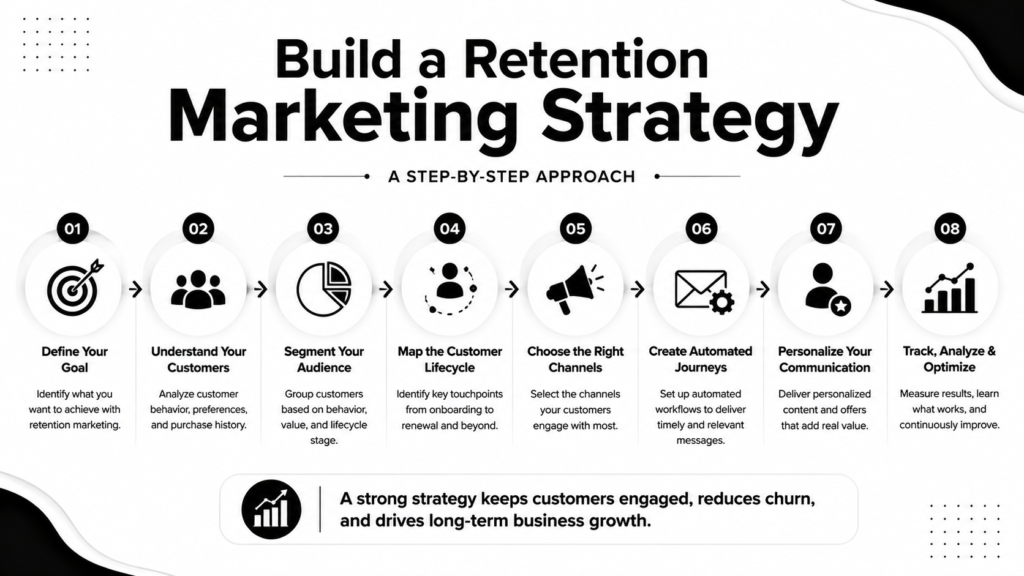
A successful retention strategy should begin with clear goals.
First, identify what you want to improve. This could be repeat purchases, subscription renewals, product usage, or customer engagement.
Next, analyze your existing customers. Look for patterns in purchasing behavior, engagement, cancellations, and customer activity.
After that, segment customers into meaningful groups. Different customers may require different communication depending on their relationship with the business.
The next step is to map important customer lifecycle stages. Consider what customers need immediately after purchase, after becoming regular users, when their activity declines, and before renewal.
Once the lifecycle is mapped, create campaigns for the most important stages. Automation can help deliver messages based on customer behavior and timing.
Finally, measure the results and improve campaigns over time. Retention marketing should be treated as an ongoing process rather than a one-time campaign.
Retention Marketing Metrics to Track
Measuring retention performance helps businesses understand whether their campaigns are actually improving customer relationships.
Customer Retention Rate measures the percentage of customers a business keeps during a specific period.
Customer Churn Rate measures the percentage of customers who stop purchasing, subscribing, or using a service.
Repeat Purchase Rate shows how frequently customers return to make additional purchases.
Customer Lifetime Value estimates the total value a customer may generate throughout their relationship with a business.
Renewal Rate is particularly important for subscription and membership businesses because it shows how many customers continue their plans.
Reactivation Rate measures how successfully a business brings inactive customers back.
These metrics should be reviewed together because a single number rarely provides a complete picture of customer retention.
Retention Marketing Examples
Consider an ecommerce company that notices customers who purchase skincare products often return within several months. The company could send personalized reminders and relevant product recommendations based on previous purchases.
A SaaS company might identify users who have created an account but have not used important features. It could send educational emails or in-app messages showing customers how to use those features.
A subscription company could communicate with customers several weeks before renewal, explain upcoming benefits, and offer assistance if they have encountered problems.
These examples show that retention marketing does not have to rely on constant discounts. Providing value and making the customer experience easier can be just as important.
Common Retention Marketing Mistakes
One common mistake is contacting customers only when the business wants another purchase. Customers are more likely to remain engaged when communication provides useful information throughout their relationship with the brand.
Another mistake is treating every customer identically. A new customer, loyal customer, and inactive customer may have completely different needs.
Businesses should also avoid excessive messaging. Too many emails, notifications, or promotional offers can create frustration and increase the likelihood of customers disengaging.
Poor onboarding is another problem. If customers do not understand how to use a product or service, they may leave before experiencing its full value.
Finally, businesses should not ignore customer feedback. Complaints and survey responses can reveal problems that directly affect retention.
Retention Marketing and Customer Lifetime Value
Retention marketing and customer lifetime value are closely connected. When customers remain with a business longer and continue purchasing, their potential lifetime value generally increases.
For example, consider two customers who each make an initial $100 purchase. If one customer purchases only once while the other continues purchasing over several years, their total value to the business will be very different.
Retention marketing aims to strengthen that long-term relationship by keeping customers engaged and helping them continue receiving value.
Final Thoughts on Retention Marketing
Retention marketing is about much more than convincing customers to make another purchase. It is a long-term approach to building relationships, improving customer experiences, and giving existing customers meaningful reasons to continue with a business.
From personalized email campaigns and onboarding to loyalty programs, re-engagement campaigns, customer education, and renewal strategies, businesses have many opportunities to improve retention.
The most effective strategy starts with understanding customers. When businesses use customer behavior, feedback, and lifecycle information to deliver relevant experiences, they can create stronger relationships and improve the long-term value of their customer base.
For businesses focused on sustainable growth, retention marketing should work alongside customer acquisition. Bringing new customers into the business is important, but keeping those customers engaged can help turn one-time transactions into long-term relationships. Our retention marketing services page shows how we run each part of it for Shopify and DTC brands.