
Beauty email marketing works when it runs on the product’s clock rather than the promotion calendar. A cleanser, serum or foundation runs out, so the second order has a natural date, and the brands that keep customers are the ones that reach them just before that date with the right reason to come back: a refill reminder, the next step in the routine, or a member perk instead of a discount. The examples in this guide are published results from beauty brands’ own platform case studies, checked on 13 October 2026.
Retention Control is a retention marketing agency for Shopify and DTC brands, and it wrote this guide. The playbook below is the one we would build for a beauty brand; the results belong to the brands named, taken from the case studies their email, loyalty and subscription platforms published.
- Why beauty retention is different: products run out, routines have steps, and loyalty programmes are more common here than in any other category.
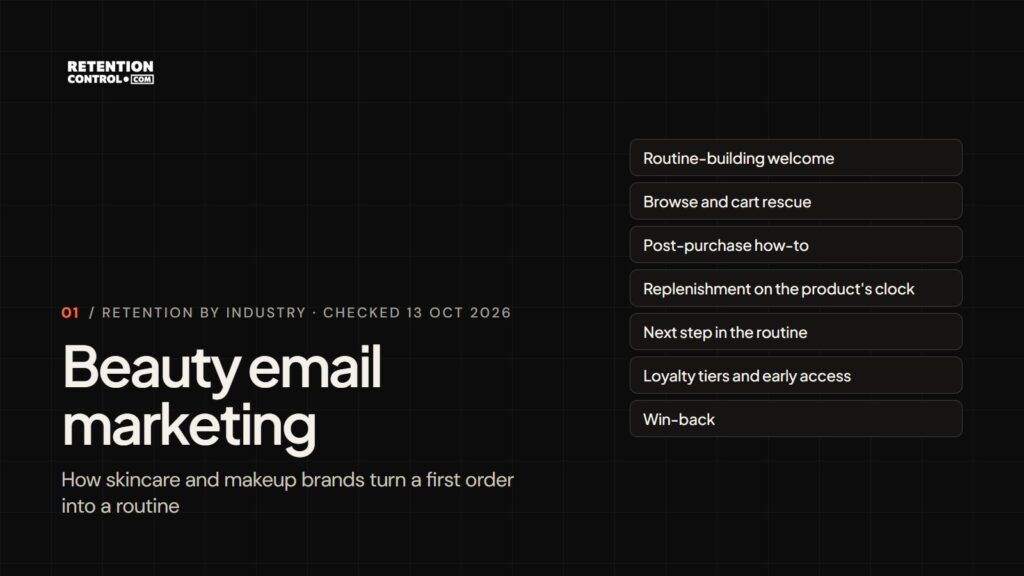
- The lifecycle map: seven stages, each with the beauty-specific trigger and timing.
- Six brands’ results: Medik8, Patrick Ta Beauty, Kitsch, POV Beauty, Rae Morris and Tatcha, each with its source.
- What BFCM 2025 showed: repeat buyers grew faster than new ones, and the smallest discounts grew fastest.
Why retention works differently for beauty brands
Three things make beauty unlike most ecommerce categories, and each one changes what a retention programme should send.
The product runs out. Yotpo’s loyalty benchmarks put it plainly: “Beauty products are consumables; consumers run out, and they’ll need to make repeat purchases.” (Yotpo). That gives every first order a built-in second-order date, which most categories do not have. The job is to reach the customer before the bottle is empty, not after they have bought a replacement somewhere else.
Routines have steps. A customer who buys a serum already owns a cleanser and a moisturiser, often from other brands. Each step is a chance for the next sale, but only once the first product has had time to work. Pitching the second step while the first is still in its box feels like pressure, not advice.
Loyalty is already expected. Smile.io’s 2026 study of Shopify Plus stores found that “Beauty & Fitness leads at 24% adoption” of loyalty programmes, ahead of every other category it measured (Smile.io). Yotpo’s benchmarks add that “On average, beauty brands see a 66.3% increase in revenue per redeeming customer within 90 days.” (Yotpo). That figure is from Yotpo’s 2023 report, so treat it as a direction rather than a forecast. A beauty customer compares your perks with the ones they already get from other brands.
The beauty lifecycle map
Every flow below exists in a general ecommerce stack. What changes for beauty is the trigger and the timing. Each stage links to our guide for that flow.
| Stage | What to send | The beauty-specific part |
|---|---|---|
| Welcome | A skin, hair or shade quiz, then education before any offer | Save the answers as profile properties: skin type, concern, shade |
| Browse and cart | Reviews from customers with the same skin type or shade | Shade and suitability doubts stop more beauty baskets than price |
| Post-purchase | How to use it, and what to expect in week one and week four | Results take weeks; say so before the customer decides it does not work |
| Refills | A refill reminder a few days before the product runs out | Time it to the size bought and the daily dose, per product |
| Next step | The product that sits before or after the one they bought | Wait until the first product has had time to show results |
| Loyalty and VIP | Tier status, early access, gifts with purchase | Members expect access and gifts more than percentage discounts |
| Win-back | A reason to return before the customer replaces you | Send it around when the product should have run out, not months later |
The replenishment timing is the step most beauty brands get wrong. One timer for the whole catalogue sends a reminder about a 15 ml eye cream on the same day as a 200 ml body wash. Work out the days of use for each product and size, then send a few days before that. Once you have enough order history, your email platform can predict each customer’s next order date instead; our replenishment flow guide has the data Klaviyo needs before that works.
Six beauty brands and what their retention programmes produced
Each result below comes from the case study the brand’s email, loyalty or subscription platform published. Where the source does not say which year a result is from, we say so.
Medik8: loyalty tiers get Black Friday first
Medik8, the science-led skincare brand, runs tiered loyalty through LoyaltyLion and treats Black Friday as a members-first event. Its team describes the mechanic directly: “We give our members a three-day head start on the BFCM sale, and we stagger that by what tier they’re in.” (LoyaltyLion).
The result, in LoyaltyLion’s words: “89% of revenue on the UK early access day was driven by loyalty”, and the members-only gift with purchase sold out before Black Friday itself. The tiers also do work outside the sale: “Lifetime value in the top tier is 3.8x higher than bottom tier.” (LoyaltyLion). The case study does not say which year’s Black Friday these figures come from.
Patrick Ta Beauty: a gift instead of a discount (BFCM 2024)
Patrick Ta Beauty’s team describes it as a non-promotional brand, so for BFCM 2024 it offered a gift with purchase above a $150 spend rather than a discount, and spent the month before the sale promoting its loyalty programme and early access, according to Klaviyo’s case study.
Email then “drove 30% of ecommerce revenue, a 3x larger slice than in 2023”. The brand sent nearly six times as many emails as the year before, yet “unsubscribe rates dropped 37% YoY”. One detail worth copying: email and SMS went out at different times of day “so dual subscribers never got two notifications at once” (Klaviyo).
Kitsch: a cancel flow that asks why
Kitsch sells hair accessories and beauty essentials, with a subscription run on Skio. Instead of one cancellation path for everyone, it built paths by reason: “cadence adjustments for subscribers getting too much product, SKU swaps for those wanting variety, targeted discounts for price concerns” (Skio).
Comparing 2025 with 2024, Skio reports: “45% churn reduction year-over-year changed subscription economics entirely.” (Skio). The lesson for any replenishable beauty product is that “too much product” is a cancellation reason you can fix with a later delivery, not a discount.
POV Beauty: keep the subscriber to order three
POV Beauty, a skincare brand founded in 2025, noticed that “if the team could keep a subscriber through three orders, that subscriber was likely retained long-term”. So it put a free sample in the first recurring order, and offered subscribers who tried to cancel between their second and third orders a free best-selling mini “in place of a discount, allowing POV to keep the subscriber without training them to expect a lower price” (Recharge).
Recharge reports the outcome: “In their first year, POV Beauty crossed $1M in subscription sales.” It adds that “Churn fell 54% over the same period, even as the subscriber base grew.” (Recharge).
Rae Morris: teach first, sell twice a year
Rae Morris, the Australian makeup-brush brand, replaced a discount-led welcome series with an educational one, “transforming it from a standard discount offer to a rich, educational journey” (Klaviyo). Every month it sends a non-promotional tip-of-the-month email, and it keeps its major sales to two a year.
The list stays warm because of it. Klaviyo reports that “In the first half of 2025, the average open rate was 42%” and that “Their 2025 end-of-financial-year campaigns drove 70% revenue growth compared to the previous year.” (Klaviyo). For a beauty brand, the education emails are what make the rare sale land.
Tatcha: one signature event a year
Tatcha, the skincare brand built on Japanese ingredients, runs Fukubukuro, a New Year mystery-bag event tied to spend thresholds: “Spending more than $100 gets you a mystery bag valued at $100; spending more than $200 unlocks a bag valued at $200.” (Klaviyo). It runs the event across email, SMS, sign-up forms and automated flows.
For the January 2025 event, Klaviyo reports: “Ecommerce revenue jumped 20% YoY, and their revenue from flows jumped 70%.” (Klaviyo). An annual event customers wait for is a retention asset in its own right, and it does not have to be Black Friday.
What BFCM 2025 showed beauty brands
Klaviyo’s recap of Black Friday and Cyber Monday 2025 lists beauty among the strongest categories: “Powerhouse categories: Health & Beauty sales rose 14% YoY, Apparel increased 11% YoY” (Klaviyo).
Two other findings from the same season matter more for planning. Across all Klaviyo brands, “At BFCM 2025, revenue from repeat buyers grew 13.6% year over year across Klaviyo, while revenue from new buyers grew 9%.” (Klaviyo). And on discounting: “In fact, brands offering the smallest discounts saw the highest growth (+14% YoY) across BFCM.” (Klaviyo).
Read together with the examples above, the pattern is consistent. Medik8 and Patrick Ta built their Black Friday on members, early access and gifts rather than deeper discounts, and Patrick Ta spent the month before the sale growing its list and loyalty sign-ups. Black Friday rewards the programme you ran all year; it does not replace it. Our BFCM retention marketing guide covers the calendar.
We looked for a beauty brand that has published its own BFCM 2025 results. As of 13 October 2026, none of the beauty case studies we checked state 2025 figures, so each example above is labelled with the year its source gives.
Email, SMS and loyalty: which does what for beauty
Email carries the routine. Education, how-to content, results timelines and the next step all need space and images. This is where Rae Morris’s monthly tips and Medik8’s tier messages live.
SMS carries the moment. A refill reminder, an early-access opening, a restock of a sold-out shade. Keep it for messages with a deadline or a trigger, and do not send the same message on both channels at once.
Loyalty carries the reason to stay. Tiers, early access and gifts with purchase give a beauty customer a reason to buy from you rather than from the retailer that stocks you. Our comparison of loyalty marketing agencies covers who builds these programmes.
Five mistakes beauty brands make in retention
- Selling the next product before the first has worked. A serum bought on Monday has not changed anything by Friday. Lead with how to use it and what to expect.
- One replenishment timer for every product. Sizes and daily use differ, so the reminder dates should too.
- Discount-led win-backs. A win-back that always carries a code teaches customers to wait for it. POV used a free mini instead.
- Ignoring the quiz. If the welcome quiz captured skin type or shade, every later email should use it. Recommendations that ignore it look careless.
- The same Black Friday offer for everyone. Your top-tier members, your one-time buyers and people who bought last week need different messages, or none at all.
The numbers to watch
- Second-order rate within the product’s use window: the share of first-time buyers who reorder before the product should have run out.
- Time to second order by product: if it is much longer than the days of use, customers are buying the refill elsewhere.
- Revenue from flows versus campaigns: a healthy beauty programme earns a large share from automations that run every day.
- Subscription churn and save rate: how many subscribers leave, and how many the cancel flow keeps.
- Loyalty members’ share of revenue: the clearest sign the programme is doing more than handing out points.
- Unsubscribe rate in heavy weeks: Patrick Ta’s fell while it sent more, which is the test of relevant sending.
Where to start
If you sell beauty or skincare and most customers buy once, start with two flows: a post-purchase series that teaches the product, and replenishment reminders timed per product. Then add loyalty early access before your next big sale. Retention Control builds and runs this on Klaviyo, Omnisend, Brevo and Attentive. Book a free 60-minute retention audit and we will show you where your second orders are being lost, or read how the full lifecycle fits together in our guide to retention marketing.