
A win-back email flow is the automated sequence sent to customers who have stopped buying, to bring them back before they are gone for good. It sits at the end of the automated flows every DTC brand runs, and it is the one most often built on the least thought.
Most win-back flows begin with a number somebody picked: 90 days, or six months. Everyone who crosses it gets the same email, usually a discount and a line about missing them. But 90 days means completely different things to different customers. Someone who reliably bought every fortnight is long gone by day 90; you missed them by two months. Someone who buys twice a year is not lapsed at all, and you have just implied they should have been shopping more. One rule, two wrong messages.
- Lapsed is relative: roughly twice a customer’s own normal gap between orders.
- One-time buyers are a separate group with a separate job: turning a trial into a habit.
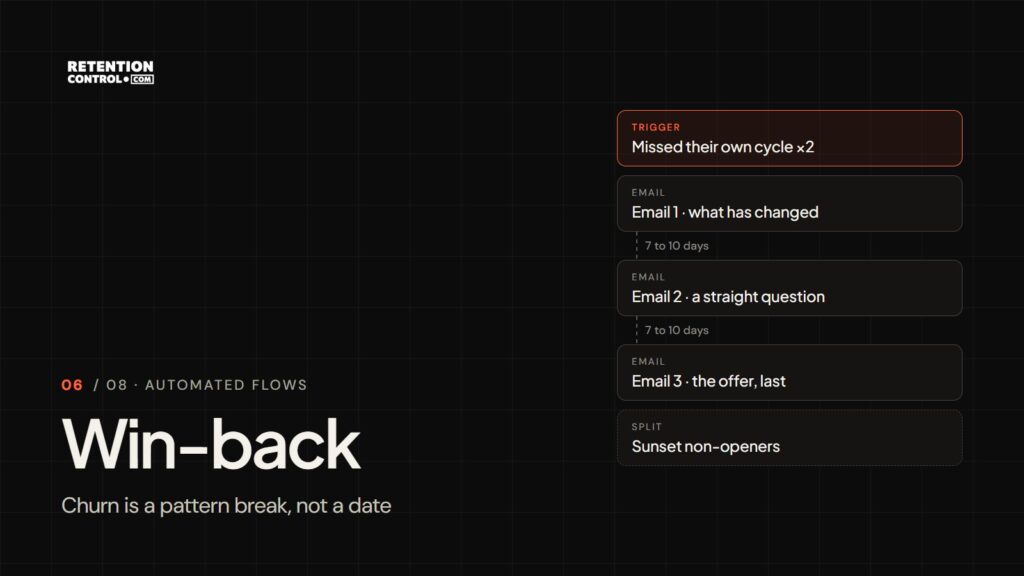
- Lead with a reason, not a discount. What has changed, a straight question, or fewer emails.
- End with a sunset. Contacts who never open stop receiving campaigns.
- The sunset protects deliverability for every other flow, which makes it the most underrated part of win-back.
Define lapsed against their cycle, not the calendar
The workable definition is relative: a customer is lapsed when they have gone meaningfully past their own established gap between orders. Roughly twice their normal cycle is a reasonable starting point, because it is long enough to rule out ordinary variation and short enough that they have not fully moved on.
| Customer | Usual gap between orders | Lapsed at roughly |
|---|---|---|
| Fortnightly coffee buyer | 14 days | 4 weeks |
| Monthly supplement buyer | 30 days | 2 months |
| Seasonal apparel buyer | 5 months | 10 months |
A single 90-day rule would be two months late for the first customer and seven months early for the third.
One-time buyers do not have a personal cycle yet, so treat them as a separate group, timed from your typical first-to-second order gap. That flow is doing a different job: converting a trial into a habit rather than restarting one.
If your account qualifies for Klaviyo’s predictive analytics, each customer already has an expected date of next order. A segment of customers whose expected date passed a set number of days ago, with no order since, is this logic built for you. The requirements are set out in Klaviyo’s documentation: at least 500 customers with orders, 180 days of order history with recent orders, and some customers with three or more orders.
What to send that is not a discount
The reflex is money off. It is also the weakest opening, because it tells someone whose only problem was that they got busy that your product was overpriced all along. Stronger openings, roughly in order:
- What has changed. New products, a restock of what they used to buy, a reformulation, a genuine improvement. It gives a reason to look now that is not pressure.
- A straight question. “Is this still right for you?”, asked plainly without a coupon attached, gets real answers, and some of them will tell you things about your product no survey will.
- Control over frequency. Many quiet customers are not unhappy; they are overwhelmed. Offering fewer emails rather than more is counterintuitive, and it retains people.
- Then, if needed, the offer. Last, once the cheaper explanations have been ruled out.
The sequence
| When | What it says | |
|---|---|---|
| 1 | When the customer crosses their lapse point | What is new since they last ordered, starting with what they used to buy |
| 2 | 7 to 10 days later | A straight question: is this still right for you? Include a frequency choice |
| 3 | 7 to 10 days later | The offer, if you use one, with a real expiry |
| Sunset | 2 to 4 weeks later, if nothing has been opened or clicked | A last “do you want to keep hearing from us?” before they stop receiving campaigns |
Win-back email examples that are not discounts
Each of these gives a lapsed customer a reason to look again without telling them the product was overpriced:
- The restock: “The Tuesday blend is back” to someone whose last three orders were that blend.
- The improvement: “We changed the formula you used to buy. Here is what is different”, when something genuinely changed.
- The straight question: “Is this still right for you?”, with three reply buttons: yes, not right now, and less often, please.
- The frequency offer: “Want to hear from us once a month instead?”, which keeps a quiet customer who was simply overwhelmed.
- The honest last call: “Should we stop emailing you?”, which often gets more clicks than anything else in the sequence.
The best of these use what you know about the customer’s history. “We miss you” says nothing; “the blend you ordered four times is back” says you noticed.
The sunset decision
At some point you have to stop. That is a feature, not an admission of defeat.
Set the condition explicitly when you build the flow: if there has been no open, no click and no order across the full win-back sequence, that contact stops receiving campaigns. Do not delete them. Keep them for triggered flows in case they come back on their own, but take them off the regular send.
Teams resist this because the list gets smaller, and the list feels like an asset. The list is not the asset. The people who read it are.
What win-back really does for you: deliverability
The largest contribution of a well-built win-back flow is often not the customers it recovers. It is the customers it correctly identifies as gone.
Every send to an address that never opens teaches mailbox providers something about your sending. Enough of them and your inbox placement slips for the whole list, including the engaged customers who would have bought. The bar is explicit now. Google’s sender guidelines ask anyone sending more than 5,000 messages a day to Gmail to keep the spam rate reported in Postmaster Tools below 0.30%, and to support one-click unsubscribe on marketing email. Mailing people who stopped reading long ago is how brands drift towards that line.
So judge win-back on two numbers: what it recovered, and how much dead weight it let you retire. Most reporting only ever shows the first.
How to build it in Klaviyo
- Segment: customers who have Placed Order at least once over all time and zero times in the last N days, where N is about twice the typical cycle for that product group. Use the expected date of next order instead if predictive analytics are available.
- Trigger: a segment-triggered flow on that segment, or a Placed Order trigger with a long time delay and a flow filter of Placed Order zero times since starting this flow.
- Separate branch for one-time buyers: Placed Order equals 1 over all time, with timing based on your first-to-second order gap.
- Exit: any order ends the flow immediately.
- Sunset: a final step that adds non-engagers to a suppression or “unengaged” list excluded from campaigns, but not from triggered flows.
How to judge it
- Reactivation rate: the share of lapsed customers who order within 60 days of entering the flow, against a holdout that received nothing.
- Contacts retired: how many non-engagers the sunset removed from campaign sends.
- Spam complaint rate on campaigns before and after the sunset goes live.
If you want to size what reactivation is worth before building anything, the retention ROI calculator gives a quick estimate from your order volume and repeat rate.
Where to go next
Win-back picks up where replenishment leaves off, when a customer misses their reorder window entirely. At the other end of the scale are your best customers, covered in the VIP customer flow. For the numbers behind it, our guide to customer lifetime value on Shopify shows why a recovered customer is worth more than one order.
If you are not sure whether your quiet contacts are lapsed or simply on a longer cycle than you assumed, that distinction is worth getting right before you email any of them, and it is the first thing we check as a retention marketing agency. Book a free 60-minute audit, or see how we run customer retention and win-back.