
If you’ve started researching email marketing agency pricing, you’ve probably seen quotes ranging from a few hundred dollars a month to five figures. That spread isn’t random. Agencies are often selling very different scopes of work under the same “email marketing” label.
An agency that sends four promotional campaigns a month is doing a different job from a partner that manages your full customer lifecycle across email and SMS. Your email platform’s subscription (Klaviyo, Omnisend, Mailchimp) is also a separate bill from the agency’s management fee. And strategy, copywriting, design, automation, segmentation, deliverability, testing, and reporting each add to the scope.
This guide covers what you’re paying for, why prices vary, how agencies structure fees, and how to work out the right budget for your business.
Key Takeaways
- Published agency prices start at $500 a month. Among agencies that publish prices on their own websites, checked on 8 October 2026, campaign-only plans start at $500 to $1,400 a month, and managed retention programs that include flows start at about $2,000 to $4,000. Our guide to affordable retention marketing agencies lists eleven of them, with what each price covers.
- Agency fees and software fees are separate costs. Most agencies bill Klaviyo, Omnisend, or Mailchimp subscriptions separately, and platform costs rise as your contact list grows.
- Agencies charge in five main ways: monthly retainers, project fees, hourly rates, performance-based fees, and hybrid models. Retainers are the most common for ongoing work.
- The biggest cost drivers are the number of campaigns and automated flows, custom copy and design, segmentation depth, SMS, testing, and reporting requirements.
- Setup is often billed separately. Account audits, flow builds, template design, and platform migrations are usually one-time costs on top of the retainer.
- Compare proposals by deliverables, not price. A cheaper quote with no strategy, testing, or flows may cost more in missed revenue than a higher quote that covers your full lifecycle.
How Much Does an Email Marketing Agency Cost?
Most US businesses hiring an email marketing agency in 2026 should expect monthly fees from roughly $1,000 to $10,000+, depending on scope. Basic campaign execution sits at the lower end. Full lifecycle and retention programs with strategy, automation, testing, and SMS sit in the middle to upper range. Enterprise programs can go well beyond $10,000 a month.
These ranges are indicative, not universal. Pricing varies by agency expertise, team seniority, your business size, and exactly what’s included. Platform fees are usually extra. Any agency that quotes a firm price before asking about your list size, current flows, and goals is guessing. For named examples, our guide to affordable retention marketing agencies lists eleven agencies that publish their prices, from $500 to $4,000 a month.
Email Marketing Agency Pricing Models
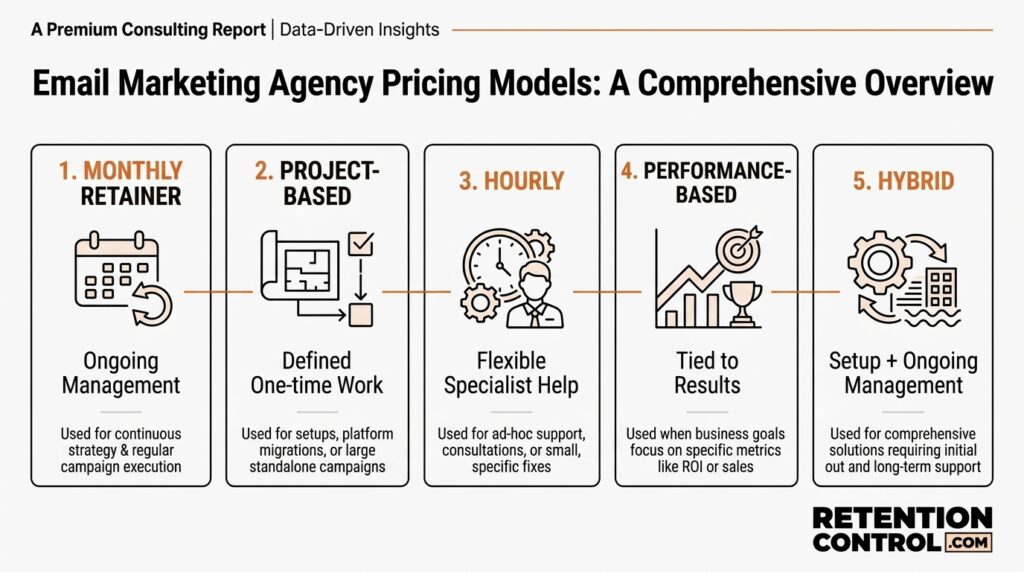
Agencies use a handful of pricing structures. Understanding them makes it much easier to compare quotes.
Monthly Retainers
A retainer is a fixed monthly fee for an agreed scope of ongoing work. It’s the most common model for email campaign management because email is continuous: campaigns go out every week, flows need maintenance, and results need review.
A retainer typically covers a set number of campaigns per month, flow management, segmentation, reporting, and strategy calls. The fee rises with campaign volume, the number of channels (email only vs. email + SMS), and how much custom creative and testing is involved.
Best for: Brands that want consistent, ongoing management and a single accountable partner.
Project-Based Pricing
Project pricing is a one-time fee for a defined deliverable. Common projects include:
- Email account audits
- Strategy and customer journey mapping
- Platform migrations (for example, Mailchimp to Klaviyo)
- Email template systems
- Building core automated email flows
- One-time onboarding and setup
Best for: Brands that have an in-house team to run day-to-day email but need expert help with a specific build or fix.
Hourly Pricing
Some consultants and agencies bill by the hour. Of the agencies we checked for our affordable agencies guide on 8 October 2026, three publish an hourly rate: Click Thru charges $75 an hour for work outside its plans, BS&Co $95 an hour, and Medito Digital $80 to $95 an hour, with the rate falling as you buy more hours each month. Hourly billing works well for small, unpredictable tasks like troubleshooting a flow or reviewing deliverability.
The downside is predictability. Ongoing management billed hourly is hard to budget and hard to compare, because two agencies may take very different amounts of time to produce the same result.
Performance-Based Pricing
Performance models tie part or all of the fee to results, usually a percentage of email-attributed revenue or a bonus for hitting targets. The appeal is obvious: the agency shares the risk.
The catch is attribution. Email platforms credit revenue to emails using attribution windows (for example, a purchase within a few days of a click or open). That can overstate email’s true incremental impact, especially for brands with heavy paid advertising. Before you agree to any revenue share, settle on exactly how revenue will be measured, which attribution window applies, and whether a minimum base fee applies.
Hybrid Pricing
Many agencies combine models: a one-time setup fee, then a monthly retainer, sometimes with a performance bonus. For example, a brand might pay a project fee to audit its account and rebuild core flows, then move to a monthly retainer for campaigns and optimization. This structure is common and often the most transparent, because setup and ongoing work are priced separately.
What Determines Email Marketing Agency Pricing?
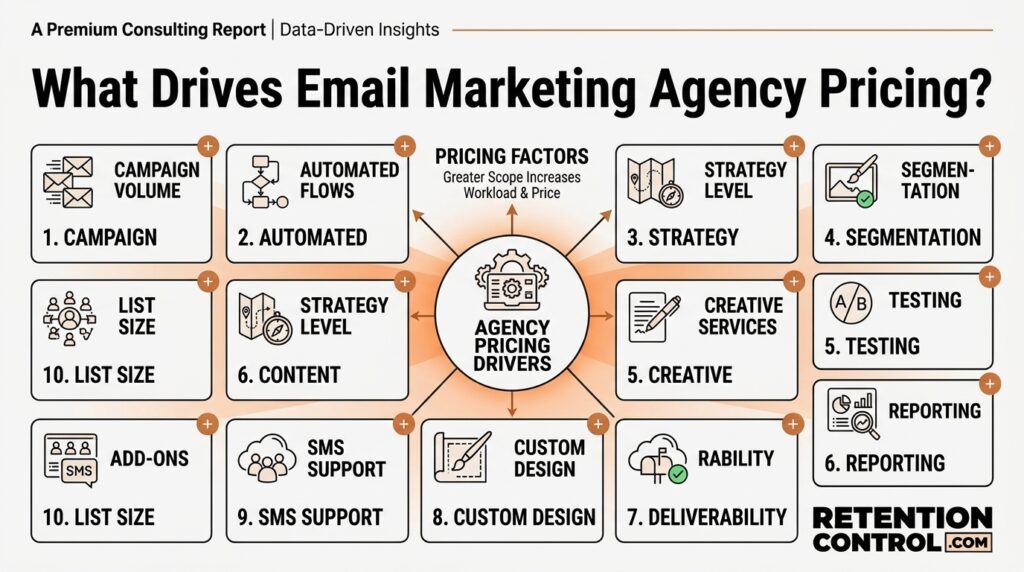
Email marketing agency pricing is driven mainly by scope: how many campaigns and flows are managed, how much custom work is produced, how advanced the segmentation is, and whether SMS, testing, and in-depth reporting are included.
Here’s how each factor affects the quote:
- Business size: Larger brands usually have more products, more customer segments, more stakeholders, and more approval layers. All of that takes time.
- List size: Bigger lists need more careful segmentation, list hygiene, and deliverability management. They also increase your platform costs.
- Email volume: Two campaigns a month and three a week are very different workloads.
- Number of flows: A welcome series and an abandoned cart flow are a starter setup. A full lifecycle system with browse abandonment, post-purchase, replenishment, cross-sell, VIP, and win-back flows, often with variations by segment, is far more work.
- Platform: Klaviyo, Omnisend, Mailchimp, and other ESPs have different features and integration requirements. Migrations add one-time cost.
- Strategy level: An agency that only executes your plan costs less than one that builds the strategy, calendar, and testing roadmap.
- Copy and design: Custom-designed, custom-written emails take more production time than reusing a template.
- Segmentation and personalization: Dynamic content, behavior-based segments, and product recommendations add strategic and technical work.
- Deliverability: Fixing inbox placement problems, authentication (SPF, DKIM, DMARC), or sender reputation can require specialist work, particularly since Google and Yahoo tightened their bulk sender requirements.
- Reporting: Standard dashboards cost less than custom reporting, cohort analysis, or incrementality testing.
- Testing and optimization: Ongoing A/B testing needs extra copy, design, and analysis every month.
- SMS integration: Adding SMS brings more strategy, more campaigns, compliance requirements, and coordination between channels.
What Is Included in an Email Marketing Agency Retainer?
A complete retainer typically includes strategy, campaign planning, copywriting, design, automation management, segmentation, deliverability monitoring, testing, reporting, and regular strategy calls. Not every agency includes all of these, which is why two quotes for “email management” can differ so much.
A strong retainer usually covers:
- Strategy and planning: A monthly or quarterly campaign calendar tied to your promotions, product launches, and seasonal moments like BFCM.
- Copywriting and design: Writing and designing each email, ideally in a consistent, mobile-friendly template system.
- Development and QA: Building emails in your platform, testing links, rendering, and personalization tags.
- Automated email flows: Building, maintaining, and improving your welcome series, abandoned cart, post-purchase, and win-back flows.
- Segmentation and personalization: Sending the right message to the right customers based on behavior, purchase history, and engagement.
- Deliverability and list hygiene: Watching bounce rates, spam complaints, and engagement, and suppressing inactive subscribers when needed.
- A/B testing: Testing subject lines, offers, content, and send times.
- Reporting and analytics: Monthly reports on revenue, engagement, and list growth, with recommendations.
- Account management: A dedicated point of contact and regular check-ins.
Always define these deliverables in writing before comparing price.
Email Marketing Agency Pricing by Service Level
The table below shows how pricing changes as scope grows. Ranges reflect pricing commonly published by US agencies in 2026 and are indicative only. Platform fees are separate.
| Service Level | Typical Scope | Best For | Pricing Structure | Indicative Monthly Range | What Usually Drives Cost |
|---|---|---|---|---|---|
| Basic campaign management | A few campaigns per month, template-based design, light reporting | Small brands that need consistent sends | Retainer or per-email | ~$1,000–$2,500 | Campaign volume, design customization |
| Strategy + campaign management | Campaign calendar, custom copy/design, segmentation, monthly reporting | Growing brands with a solid list | Retainer | ~$2,500–$5,000 | Strategy involvement, segmentation depth |
| Lifecycle and automation management | Campaigns plus full flow management, personalization, testing | Brands that want more revenue from automation | Retainer + setup fee | ~$4,000–$8,000 | Number of flows, testing cadence |
| Full retention marketing (email + SMS) | Cross-channel strategy, flows, campaigns, SMS, deliverability, advanced reporting | Established DTC and ecommerce brands | Retainer, sometimes hybrid | ~$5,000–$10,000+ | Channels, volume, reporting depth |
| Enterprise programs | Multi-brand or high-volume programs, custom data work, dedicated team | Large brands and multi-store operations | Custom retainer | $10,000+ | Team size, complexity, integrations |
One-time setup work, such as audits, flow builds, template systems, and migrations, is often priced separately, from a few hundred dollars for a simple audit to $5,000 or more for a full build.
Email Marketing Agency Cost vs. Email Platform Cost
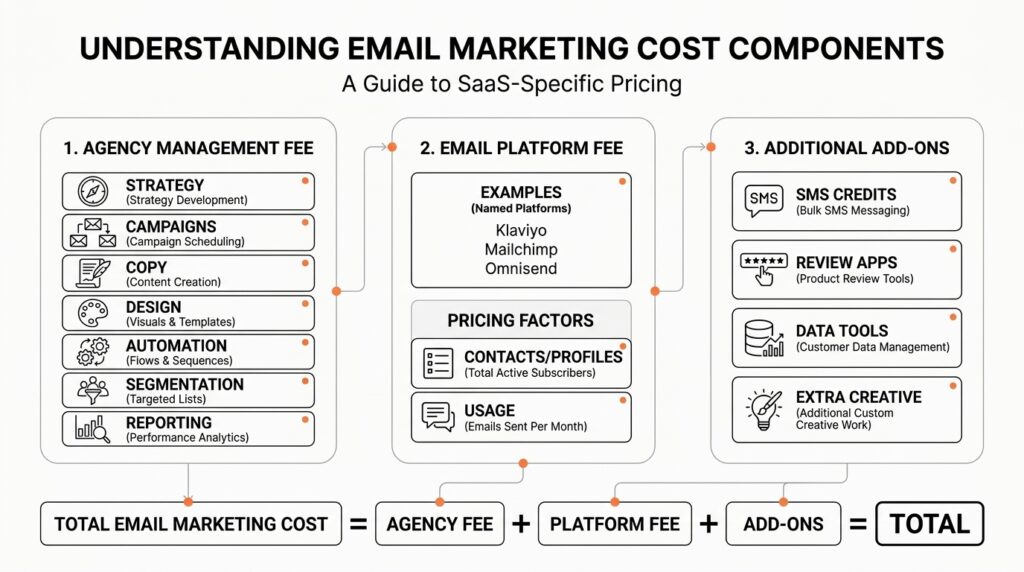
In most cases, email marketing software is not included in agency pricing. You pay the agency for management and pay your email service provider (ESP) for the platform separately.
Platforms like Klaviyo, Mailchimp, and Omnisend generally price by the number of contacts or profiles, with extra charges for SMS credits and advanced features. As your list grows, your platform bill can move from a modest monthly fee into the hundreds or thousands of dollars, separate from what the agency charges.
So your true monthly email marketing cost usually equals:
Agency fee + platform fee + any add-ons (SMS credits, review apps, data tools, or extra creative).
Always ask an agency whether platform costs, SMS credits, and third-party tools are included or billed separately. Also confirm that the platform account is in your company’s name, so you keep your data and flows if you ever change agencies.
How Much Should an Ecommerce Business Budget?
There’s no single right number. Your budget should reflect your revenue, list size, how mature your automation already is, your internal team’s capacity, and how much email currently contributes to revenue. These examples show how needs change as a business grows.
Example: Small Ecommerce Brand
A newer Shopify brand with a small but growing list might have only a basic welcome email and a default abandoned cart flow. Its biggest opportunity is usually getting the core automated flows built properly and sending a few well-planned campaigns each month. A one-time flow setup project, followed by a lighter retainer or in-house sending, is often a sensible starting point.
Example: Growing Ecommerce Brand
A brand with steady sales and a growing customer base often has flows in place but no segmentation, no testing, and campaigns that go out irregularly. At this stage, a retainer covering strategy, a consistent campaign calendar, segmentation, and ongoing flow optimization usually makes sense. Many brands also start considering SMS here.
Example: Established Ecommerce Brand
A mature DTC brand with a large list and significant repeat revenue needs more: advanced segmentation, lifecycle strategy across email and SMS, regular testing, deliverability management, and detailed reporting. Its scope and budget will be higher, because small percentage gains on a large customer base can matter a lot.
To estimate what email could be worth before setting a budget, try RetentionControl’s retention ROI calculator.
How Much Does a Klaviyo Email Marketing Agency Cost?
A Klaviyo agency’s fee depends on what it manages inside Klaviyo, not on Klaviyo itself. Your Klaviyo subscription is billed by Klaviyo based on your profile count and SMS usage. The agency fee covers the work done in the account.
A Klaviyo-focused agency may manage:
- Account setup and audit: Integrations, tracking, list imports, and fixing existing problems.
- Flows: Welcome, abandoned cart, browse abandonment, post-purchase, replenishment, and win-back.
- Campaigns: Planning, building, and sending.
- Segments: Engagement-based and behavior-based segments built from Klaviyo’s customer data.
- Templates: Brand-consistent, mobile-friendly template systems.
- Testing: A/B tests on campaigns and flows.
- Deliverability: Sending domain setup, authentication, and list hygiene.
- Reporting: Using Klaviyo’s analytics to track performance and guide decisions.
Klaviyo agency pricing generally follows the same tiers as the table above. A one-time Klaviyo audit or flow build is a project fee, while ongoing management is usually a retainer. If you’re on Klaviyo, see RetentionControl’s Klaviyo email and SMS management. Brands on other platforms can explore Omnisend management or the full list of supported platforms.
What Does Email + SMS Management Cost?
Adding SMS to an email retainer usually raises the monthly fee, because it expands the work across strategy, campaigns, automation, segmentation, compliance, and reporting.
SMS isn’t just shorter email. It needs its own content calendar, its own flows (such as SMS abandoned cart), careful frequency control to avoid opt-outs, and coordination with email so customers don’t get the same message twice in an hour. SMS platforms also charge per message, which adds to software costs.
Compliance matters too. US marketing texts are subject to rules such as the Telephone Consumer Protection Act, which the FCC oversees, and commercial email must follow the CAN-SPAM Act. An experienced agency builds consent collection and opt-out handling into the program, but you should still get your own legal advice on compliance.
For brands ready to combine channels, RetentionControl offers SMS retention marketing alongside email retention marketing, and works with dedicated SMS platforms such as Attentive.
Email Campaign Management vs. Lifecycle Retention Marketing
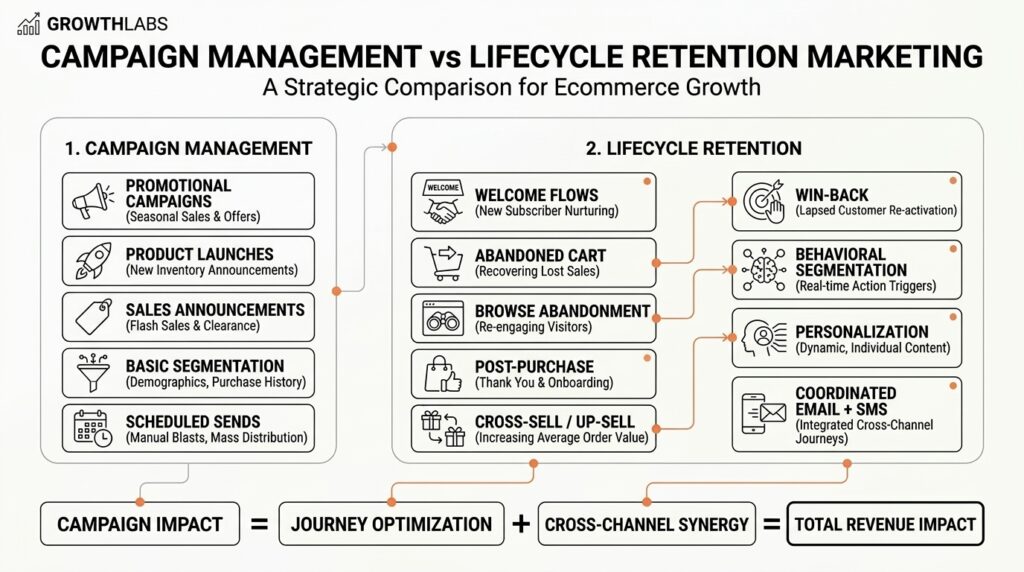
This difference explains a large share of the price variation.
Email campaign management focuses on sending promotional emails: new arrivals, sales, and announcements. It’s valuable, but it mostly reaches people who are already paying attention.
Lifecycle retention marketing manages the whole customer journey, from first sign-up to repeat purchase and beyond. It covers:
- Welcome flows that turn new subscribers into first-time buyers
- Abandoned cart and browse abandonment flows
- Post-purchase flows that onboard, educate, and request reviews
- Cross-sell and upsell flows based on what customers bought
- Win-back flows for lapsed customers
- Segmentation and personalization based on behavior and value
- Coordinated email and SMS messaging
Lifecycle work takes more strategy and setup, so it costs more. It also targets the metrics that compound over time: repeat purchase rate and customer lifetime value. To learn more, read about RetentionControl’s approach to retention marketing, ecommerce retention marketing, and DTC retention marketing. If you’re new to automation, this guide to automated flows for DTC brands is a useful primer.
How to Compare Email Marketing Agency Proposals
To compare email marketing agency proposals fairly, line up the deliverables side by side, not just the monthly price. Two quotes only compare if they cover the same work.
Check each proposal for:
- Scope: Email only, or email + SMS?
- Campaign volume: How many campaigns per month?
- Flows: Which flows are built, and which are maintained or optimized?
- Copywriting and design: Custom or template-based? How many revision rounds?
- Strategy: Is there a campaign calendar and a testing roadmap?
- Segmentation: Basic lists or behavior-based segments?
- Testing: How many A/B tests per month?
- Reporting: How often, and what metrics?
- Meetings: Weekly, biweekly, or monthly calls?
- Deliverability: Monitoring and fixes included?
- Platform management: Is the agency managing the account or only sending?
- Fees: Setup or onboarding fees? Charges for extra work?
- Contract: Length, notice period, and cancellation terms.
- Communication: Who’s your point of contact, and how fast do they respond?
A simple way to do this is a spreadsheet with each agency in a column and each line item above in a row. Gaps usually become obvious quickly.
Questions to Ask Before Hiring an Email Marketing Agency
- What exactly is included in the monthly fee?
- How many campaigns are included each month?
- Are automated flows included, and which ones?
- Is strategy included, or only execution?
- Are copywriting and design included?
- Are platform and SMS fees billed separately?
- Is there a setup or onboarding fee?
- How is performance measured, and which attribution window do you use?
- How often will we get reports, and what will they include?
- Who owns the email account, templates, and data?
- What happens if we need work outside the agreed scope?
- What’s the contract length and cancellation policy?
Is Hiring an Email Marketing Agency Worth It?
Hiring an email marketing agency can be worth it when the extra revenue and retention it drives exceed its cost, but results are never guaranteed. The value depends on your starting point, your product, your list quality, and how well the agency executes.
Measure value with metrics such as:
- Email- and SMS-attributed revenue
- Revenue per recipient
- Repeat purchase rate
- Customer lifetime value
- Flow conversion rates
- Engagement (clicks, not just opens, since Apple Mail Privacy Protection inflates open rates)
- Deliverability, unsubscribe, and spam complaint rates
Be careful with attribution. Platform-reported revenue counts purchases made within an attribution window after an email interaction, but some of those customers would have bought anyway. Agree on a measurement method before the engagement starts. Where possible, compare against a baseline period or use holdout groups to estimate true incremental lift. Cross-checking with GA4 and your Shopify sales data gives a fuller picture.
Also compare the cost with building in-house. A capable email marketer, plus design support, plus strategy, can easily cost more than an agency retainer. They’ll also bring less cross-brand experience.
How the Email Marketing Agency Implementation Process Works
Most agency engagements follow a similar path:
- Discovery: Understanding your brand, products, customers, and goals.
- Account audit: Reviewing your current flows, campaigns, segments, and deliverability.
- Data and customer analysis: Looking at purchase behavior, repeat rates, and engagement.
- Strategy: Setting priorities, a channel plan, and KPIs.
- Segmentation: Building audiences based on behavior and value.
- Flow planning: Mapping the automated customer journey.
- Campaign planning: Creating the calendar.
- Copy and design: Producing emails and templates.
- Implementation: Building everything in your platform.
- Testing: QA for rendering, links, and logic.
- Launch: Turning on flows and sending campaigns.
- Reporting: Tracking results against KPIs.
- Optimization: Ongoing testing and improvement.
Steps 1 through 10 are a lot of upfront work, which is why many agencies charge a separate onboarding or setup fee before the retainer starts. If peak season is close, start early. RetentionControl’s BFCM 2026 guide explains why preparation weeks in advance matters.
Choosing the Right Partner
If you want an agency that manages the full customer lifecycle and not just campaign sends, RetentionControl provides customer retention marketing across email and SMS for ecommerce and DTC brands. You can review the pricing options, explore all retention services, or contact the team to talk through what scope fits your business.
Conclusion
Email marketing agency pricing varies widely because scope varies widely. A basic campaign service and a full retention program are different products at different price points. Before you compare quotes, separate agency fees from platform fees, define the deliverables you need, and agree on how results will be measured. Then choose the partner whose scope, expertise, and expected value best match your business, not just the lowest number.
FAQs
How much does an email marketing agency cost per month?
In 2026, most US email marketing agencies charge roughly $1,000 to $10,000+ per month. Basic campaign management sits at the lower end, while full lifecycle programs with SMS, testing, and advanced reporting cost more. Platform fees are usually extra.
How do email marketing agencies charge?
Agencies typically use monthly retainers, project fees, hourly rates, performance-based fees, or a hybrid. Retainers are most common for ongoing management, while audits, migrations, and flow builds are usually project-based.
Is email marketing software included in agency pricing?
Usually not. Platforms like Klaviyo, Omnisend, and Mailchimp bill you directly based on list size and usage. Always confirm in writing whether software and SMS credits are included.
Do email marketing agencies charge setup fees?
Many do. Setup fees cover the audit, strategy, flow builds, templates, and integrations needed before ongoing management begins. Some agencies roll this into the first months of the retainer instead.
How much does a Klaviyo agency cost?
A Klaviyo agency’s fee follows the same ranges as general email agencies and depends on how many campaigns, flows, and segments it manages. Your Klaviyo subscription is billed separately by Klaviyo.
Is it cheaper to hire an agency or an in-house email marketer?
For many small and mid-sized brands, an agency costs less than hiring a full-time strategist plus design and copy support. Larger brands with very high volume sometimes find in-house teams more cost-effective, often alongside an agency for strategy.
Is hiring an email marketing agency worth it?
It can be, if the agency drives more incremental revenue and retention than it costs. Agree on how revenue will be measured upfront, and judge results over several months, not just the first few sends.