
Every Shopify brand plans for Black Friday traffic. Almost none of them plan for what happens to that traffic after the order confirmation email goes out.
Shopify merchants generated $14.6 billion in sales over BFCM 2025, a 27% jump from the year before, according to Shopify’s own BFCM data. That number gets celebrated every year. What rarely gets celebrated, or even measured, is how many of those buyers ever came back.
This is where a BFCM retention audit earns its place. It is not another list of discount ideas or countdown timers. It is a channel by channel check of the exact places retention quietly breaks, covering segmentation, flows, SMS, checkout, post-purchase, and the weeks after the sale when most brands go silent.
Key Takeaways
- A BFCM retention audit checks whether Black Friday buyers actually come back, not just whether they buy once.
- Automated flows drive close to 41% of email revenue from only 5.3% of sends, and most stores still run un-updated, non-seasonal flows into BFCM.
- Retaining an existing customer costs 5 to 25 times less than acquiring a new one, which makes win-back and post-purchase gaps the most expensive items on this list.
- Segmentation, not one blanket offer, is what separates retention-focused BFCM from a normal discount weekend.
- Tracking should follow the BFCM cohort for 30, 60, and 90 days, not stop the moment the weekend ends.
- This audit covers 15 checks across segmentation, email, SMS, checkout, post-purchase, repeat-purchase journey, win-back, VIP, offer strategy, tracking, and KPIs.
Go through the 15 checks below honestly. Most Shopify stores fail more of these than they expect.
What This BFCM Retention Audit Covers
Before jumping into the fixes, here is the roadmap. This audit walks through 11 areas of your store, in the order they actually affect a customer’s journey, from the first segment they land in to the KPI that eventually proves whether BFCM was worth it.
- Customer segmentation, so the right message reaches the right buyer
- Email flows, the automated backbone behind BFCM revenue
- SMS, a channel that needs warm up time before it works
- Abandoned checkout, where BFCM traffic leaks the fastest
- Post-purchase, the moment that decides if a buyer becomes a customer
- Repeat-purchase journey, the path to a second order
- Win-back, catching the discount cohort before it goes cold
- VIP customers, protecting your highest value segment
- BFCM offer strategy, protecting margin while still converting
- Tracking, following the cohort past the weekend
- Retention KPIs, the numbers that actually prove success
Each section below covers one or two specific fixes, numbered 1 through 15, so you can work through them in order or jump straight to whichever area is weakest in your store.
Customer Segmentation
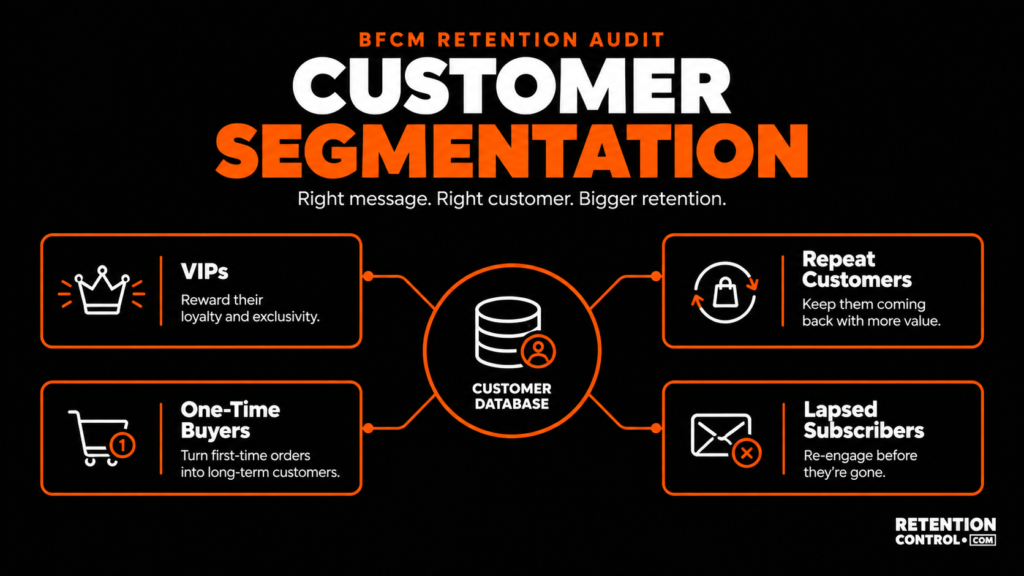
Segmentation is where most BFCM retention problems start, long before a single email gets sent.
1. Stop sending one blast to your whole list
A first time visitor, a lapsed customer from 2024, and your top 5% VIP all get the exact same subject line and the exact same offer. That is not a BFCM strategy. It is a mail merge.
Segments to build before October ends:
- VIPs, based on spend and order frequency
- Repeat customers with two or more past orders
- One time buyers who have not returned
- Cold or lapsed subscribers who have not opened in 90 days
RetentionControl’s customer retention marketing services work starts here for exactly this reason.
2. Build the VIP segment before the sale, not during it
Plenty of brands only think about VIP treatment once the sale is already live. By then it is too late to build genuine early access.
What to check:
- VIP criteria defined by spend, order count, or tenure
- VIP tag applied at least three weeks before Black Friday
- Early access messaging drafted and scheduled separately from the public sale
Email Flows
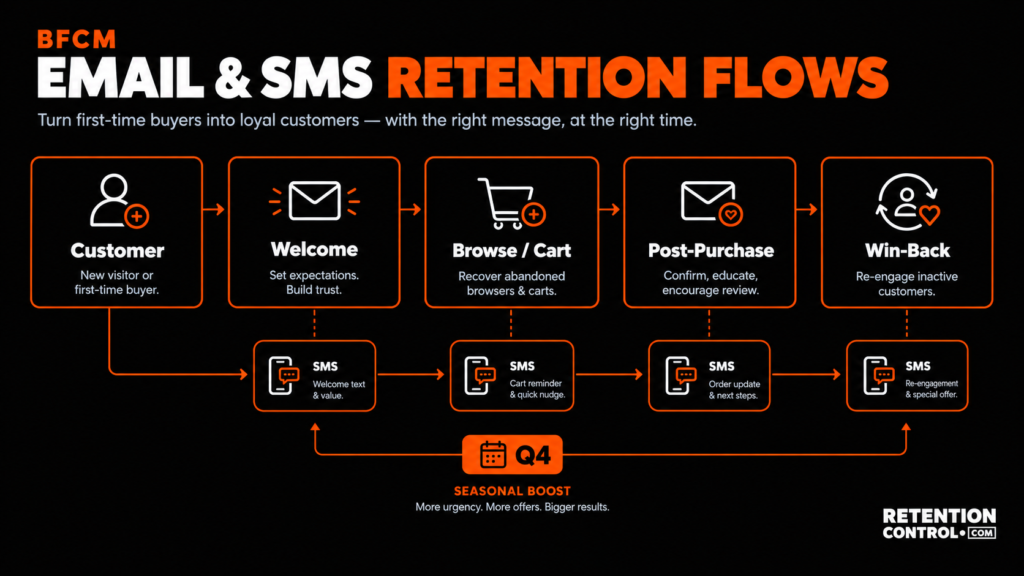
Flows are the backbone of BFCM retention, and they are usually the most neglected part of the account.
3. Automated flows with no Q4 branch
A generic welcome series or abandoned cart flow written in March is not built for a shopper who signed up specifically for a Black Friday deal. The message, the urgency, and the offer all need a seasonal version.
Automated flows carry more weight than most brands realize. Klaviyo’s own January 2026 benchmarks, drawn from more than 183,000 customers, found that flows generate close to 41% of total email revenue from only 5.3% of sends, with revenue per recipient nearly 18 times higher than one-off campaigns.
Flows that need a Q4 branch:
- Welcome series
- Cart and browse abandonment
- Post-purchase
- Win-back
4. A list that has not been warmed before the send spike
Sending six times your normal email volume to a list you have ignored since summer is one of the fastest ways to land in the Promotions tab, or worse, spam.
Warm-up checklist:
- Consistent sending cadence for at least the prior 60 to 90 days
- Dead subscribers sunset before the volume increase
- Spam complaint rate and sender reputation checked, not assumed
SMS
5. SMS turned on for the first time in November
A channel with no consent history and no sending reputation gets filtered by carriers exactly when you need it most. Omnisend’s 2026 ecommerce marketing report, based on 321 million SMS sends across 150,000 brands, found automated SMS reaching a 20.32% click-to-sent rate, well above standard broadcast performance, the same automation gap seen in email.
Before Black Friday, confirm:
- SMS consent is being collected, not just planned
- The channel has real sending history, not a cold start
- Compliance basics (opt-in language, opt-out handling) are in place
RetentionControl’s SMS retention marketing services are built around exactly this warm up period.
Abandoned Checkout
6. One generic three email abandonment sequence for everyone
BFCM traffic can significantly increase cart and checkout volume, but many brands still run the same flat sequence they use in a normal month.
Segment abandonment flows by:
- Cart value, high intent carts get faster follow up
- New versus returning shopper
- Product category, where relevant
7. No browse abandonment coverage
Someone looked at the same product three times and still did not buy. That is hesitation, not disinterest, and it is one of the most overlooked retention signals during BFCM.
If checkout itself is the leak, not just the follow up email, that is a conversion problem sitting upstream of retention. Aqsa Shahzad’s Shopify CRO service is worth a look if your checkout has not been audited for friction recently.
Post-Purchase
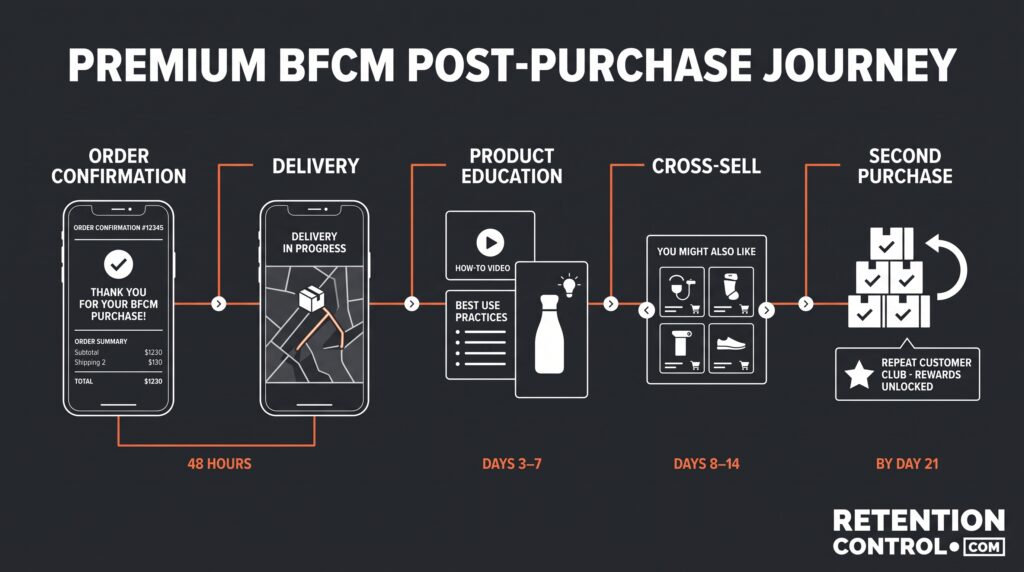
The moment right after checkout does more to shape retention than almost anything that follows it.
8. Silence after the receipt
The order confirmation email goes out, and then nothing happens for weeks. That gap is exactly where a first time BFCM buyer decides whether your brand was a one time deal or a real relationship.
A working post-purchase sequence covers:
- Order reassurance and delivery expectations in the first 48 hours
- Product education and brand story in days 3 to 7
- Cross-sell of genuinely complementary products in days 8 to 14
- A specific second-purchase incentive by day 21
Need help fixing your BFCM retention gaps before the traffic arrives? RetentionControl runs a free 60 minute BFCM retention audit that shows exactly where revenue is leaking in your current setup, and what to fix first. Book your free audit here.
9. No plan for gift buyers
Gift buyers require different post-purchase messaging from customers buying for themselves. Post-purchase flows written only for the person who will use the product miss this segment completely, and it shows in weak engagement from what looked like a strong sale.
Repeat-Purchase Journey
10. No clear path to a second order
Second-purchase rate is one of the clearest signals of whether a BFCM cohort was worth acquiring.
Build a second-order path around:
- Replenishment timing based on actual reorder cycles
- Cross-sell sequences tied to the first purchase
- A time-bound second-order incentive, not a generic discount
Win-Back
11. No January plan for the discount cohort
A huge portion of BFCM buyers convert once at a steep discount and then go quiet. Most brands notice this in February and scramble.
Research from Harvard Business Review and Bain & Company, widely cited across the retention industry, puts the cost of acquiring a new customer at 5 to 25 times more than retaining an existing one. Bain’s separate research found that a 5% improvement in retention can lift profits by 25% to 95%. A skipped win-back sequence is not a small miss, it is one of the most expensive gaps on this entire list.
A January win-back sequence should include:
- Clear identification of when a BFCM buyer starts going cold
- A message that feels personal, not a knee-jerk discount
- A distinct offer from the one used to acquire brand-new shoppers
VIP Customers
12. Treating VIPs like everyone else once the sale starts
Even brands that identify their VIPs often forget to keep treating them differently once BFCM week actually begins. Early access that arrives at the same time as the public sale is not early access.
VIP treatment during BFCM week should include:
- Early access measured in hours or days, not minutes
- Stackable perks, such as bonus points or a gift with purchase
- Recognition visible in the message itself, not just a tag in your ESP
BFCM Offer Strategy
13. Discounting without protecting margin or loyalty
Sitewide percentage discounts are the easiest offer to run and the most damaging to both margin and long term loyalty.
Offer types that protect margin better than a blanket discount:
- Bundles
- Spend and save thresholds
- Free shipping
- Loyalty only perks and early access
Tracking
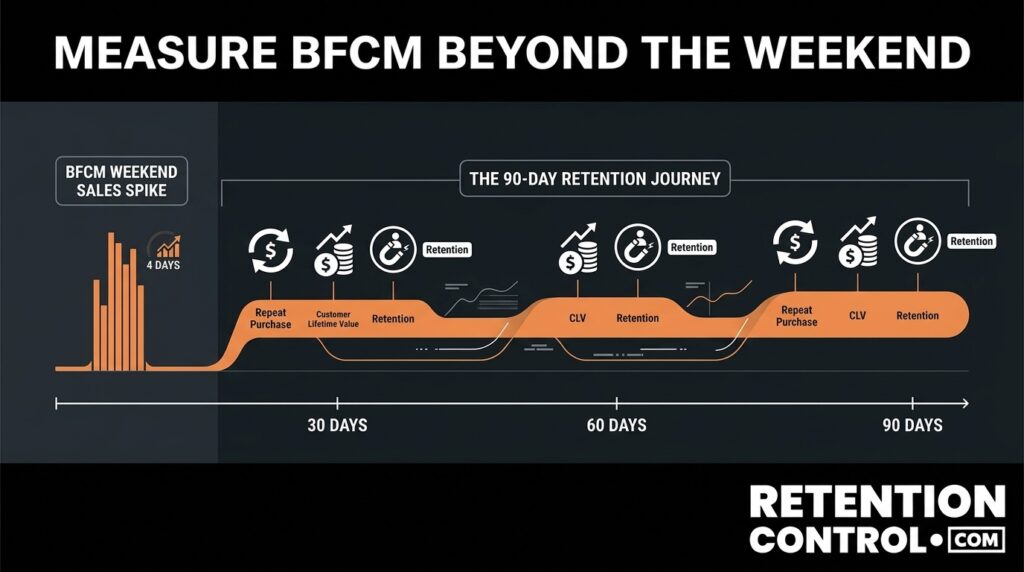
14. Measuring the weekend and stopping there
Revenue from Friday through Monday tells you almost nothing about whether the customers you acquired were worth acquiring.
Track the BFCM cohort at:
- 30 days
- 60 days
- 90 days
RetentionControl’s broader ecommerce retention marketing services build this kind of cohort tracking into monthly reporting by default, rather than treating it as a special BFCM project.
Retention KPIs
15. No retention scorecard at all
Most Shopify dashboards are built around weekend revenue, conversion rate, and average order value.
A real BFCM retention scorecard should surface:
- Repeat purchase rate
- Customer lifetime value
- Discount dependency by segment
Without these numbers, you genuinely cannot tell whether BFCM built your business or just borrowed from next year’s.
BFCM Retention Audit vs Traditional BFCM Marketing
The mindset shift behind all 15 fixes above comes down to one table.
| Traditional BFCM Marketing | Retention-Focused BFCM |
|---|---|
| Measures weekend revenue | Measures 30, 60, and 90 day revenue |
| Optimizes for new customers | Optimizes for repeat customers |
| Leads with discounts | Leads with loyalty and bundles |
| Tracks AOV | Tracks customer lifetime value |
| Treats BFCM as one weekend | Treats BFCM as a 90 day system |
Most Shopify stores are still running the left column without realizing it.
How Ready Is Your Store, Actually
Reading through 15 fixes is one thing. Knowing where your own store actually stands is another. RetentionControl built a 60 second scorecard covering exactly these gaps, as part of their BFCM 2026 readiness check. It takes less time than this article did to read.
For the full 90 day planning timeline behind these fixes, including what to build in September, October, and the week of the sale itself, the BFCM 2026 retention marketing guide breaks down each phase in detail.