
Most brands lose more BFCM revenue to a spam folder than to a bad discount. Inboxes are more crowded during Black Friday and Cyber Monday than at any other point in the year, and Gmail and Yahoo have both tightened what they’ll actually deliver. A brand can write a great subject line, build a generous offer, and still watch open rates collapse because a sender score slipped in October.
BFCM email marketing is the practice of planning, sending, and automating the emails that carry a Shopify or DTC brand through the Black Friday and Cyber Monday period — from the teaser that builds anticipation in early November to the flow that follows up with someone who bought once and needs a reason to buy again in December. Done well, it’s still one of the highest-return channels a brand has. Done as an afterthought, it’s a week of effort that inflates a discount code and does little else.
This guide is built for US-based Shopify and ecommerce teams who already have a list and a platform (Klaviyo, Omnisend, or similar) and want a BFCM email marketing plan that actually holds up under holiday volume — the deliverability groundwork, the flows, the segmentation logic, and what to do with all of it once the sale ends.
BFCM Email Marketing by the Numbers
A few current numbers explain why this channel gets this much attention going into BFCM.
- Email marketing returns roughly $36 to $42 for every dollar spent, one of the highest returns of any marketing channel, and that multiple tends to hold up or improve during BFCM, when purchase intent is already high.
- Email revenue during peak season is projected to grow faster than ecommerce overall. Klaviyo’s 2025 BFCM data put email growth at roughly 15% year-over-year, ahead of the 12% growth projected for ecommerce as a whole.
- Repeat customers carry a disproportionate share of BFCM revenue. The same Klaviyo research found repeat shoppers driving GMV growth 45% higher than new shopper GMV — meaning the list a brand already owns often outperforms new customer acquisition during the sale itself.
- Mobile is where most BFCM emails get read. More than half of all email opens now happen on a phone, by most current industry estimates, which makes subject line length and mobile rendering a real factor in whether an email gets opened at all.
Key Takeaways
- BFCM email marketing works best as a system built weeks in advance, not a week of last-minute campaigns — deliverability, segmentation, and flows all need lead time.
- Google and Yahoo’s bulk sender rules make list hygiene and authentication (SPF, DKIM, DMARC) a requirement, not an optional step, before BFCM volume hits.
- The flows that matter most are the ones already running before the first campaign sends: welcome, abandoned cart, browse abandonment, and post-purchase.
- Segmentation should be based on purchase and engagement behavior, not just “everyone on the list,” or the biggest sale of the year sends the same generic email to a first-time browser and a five-time VIP.
- The highest-leverage part of BFCM email marketing isn’t the day-of campaign — it’s what happens in the 30 days after, when a one-time holiday buyer either becomes a repeat customer or disappears.
What Is BFCM Email Marketing?
BFCM email marketing covers every email a brand sends around Black Friday and Cyber Monday: pre-sale teasers, early access invitations, day-of campaigns, extended-sale reminders, and the automated flows running underneath all of it, like abandoned cart and post-purchase sequences. It sits inside the broader discipline of retention marketing, because the same list, segments, and automations that drive the BFCM sale are the ones that determine whether that customer buys again. It is the seasonal peak of the year-round email retention marketing that keeps customers buying after the sale.
The distinction that matters is between a campaign and a flow. A campaign is a one-time send — the Black Friday announcement, the Cyber Monday final-hours email. A flow is automated and behavior-triggered — it fires when someone abandons a cart or completes a purchase, regardless of whether a campaign went out that day. A strong BFCM email plan needs both working together, not a calendar full of campaigns sitting on top of flows that haven’t been touched since last year.
Why Email Still Drives the Most BFCM Revenue
Paid acquisition costs spike hard during BFCM as every brand bids on the same shoppers at once. Email doesn’t have that problem — it’s a channel a brand already owns, sent to people who’ve already opted in, and it scales with list size rather than ad spend. That’s why industry estimates commonly put email’s average return somewhere in the $30–$40 range for every dollar spent, a multiple most paid channels can’t touch during the most competitive shopping week of the year.
The catch is that email’s ROI depends entirely on deliverability and relevance. A list that hasn’t been cleaned, or a segment strategy that sends the same message to everyone, drags that return down fast and during BFCM, a bad send doesn’t just underperform, it can suppress a sender’s reputation for the rest of the season.
BFCM Email Marketing for Shopify Stores
Shopify handles the store and the order data; the email platform handles what happens with that data. For BFCM specifically, the integration between Shopify and whichever platform a brand runs Klaviyo or Omnisend, most commonly — is what turns raw purchase and browsing events into the segments and flows covered throughout this guide.
Both platforms sync natively with Shopify, pulling in customer tags, order history, product collections, and browsing behavior in real time. Klaviyo tends to be the deeper option for brands that want granular flow logic and predictive segmentation, while Omnisend is often the simpler starting point for smaller catalogs that don’t need that level of complexity. Either way, the underlying strategy a clean list, tight segmentation, tested flows doesn’t change; only the interface does.
Shopify’s own customer tagging system is worth using deliberately going into BFCM, not just for internal organization. Tags like vip, first-time-bfcm, or gift-buyer, applied automatically through the email platform’s Shopify integration, can double as segment triggers without needing a separate data layer. That’s also what makes Shopify-specific flow triggers useful: a first-order-placed trigger, a specific-collection-purchased trigger, or a tag-added trigger all fire directly off Shopify’s own order and customer events, which is faster and more reliable than trying to infer the same signals from email engagement alone.
Email Deliverability Before BFCM: What Google and Yahoo Actually Require
This is the part most BFCM guides skip past, and it’s the reason otherwise well-written campaigns land in spam during the exact week they need to convert. Since 2024, Gmail and Yahoo have enforced bulk sender requirements for anyone sending more than roughly 5,000 emails a day to their users. That covers the overwhelming majority of Shopify brands sending BFCM campaigns.
The requirements break down into a few concrete pieces. SPF and DKIM authentication need to be correctly set up on the sending domain, and DMARC needs to be in placewith at minimum a monitoring policy. Spam complaint rates need to stay under 0.3% anything higher and Gmail starts routing mail to spam automatically, regardless of content quality. One-click unsubscribe has to be supported in every commercial email, and unsubscribe requests need to be honored within two days. Google’s own sender guidelines lay out the full technical requirements, and they’re worth reading directly rather than relying on a summary, since enforcement details have continued to evolve.
List hygiene is the other half of this. Sending BFCM campaigns to contacts who haven’t opened or clicked in 90 to 120 days is one of the fastest ways to trigger spam-rate problems, because inactive addresses are disproportionately likely to mark a message as spam instead of unsubscribing. The brands that hold up best during BFCM send volume are the ones that suppressed or re-engaged their cold list in October, not the ones that mailed everyone and hoped engagement would sort itself out. For brands sending both email and SMS, the same hygiene principle applies to SMS retention marketing lists carrier filtering during high-volume periods works on similar logic.
Compliance is worth taking seriously beyond deliverability, too. The FTC’s CAN-SPAM compliance guide covers what’s legally required in commercial email accurate header information, a physical postal address, and a working opt-out mechanism. Most Shopify email platforms handle this by default, but it’s worth confirming before BFCM volume goes out, since violations are assessed per email, not per campaign.
Building a BFCM Email Calendar That Holds Up
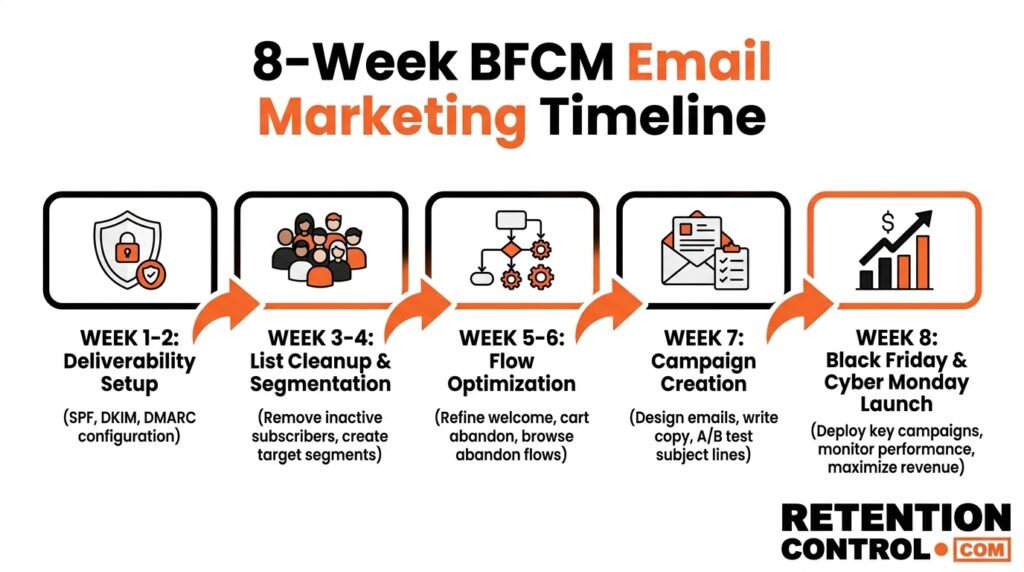
The calendar matters less than the order of operations. Deliverability and list hygiene need roughly eight weeks of lead time, because sender reputation builds gradually and can’t be fixed the week before Black Friday. Segmentation and flow updates need four to six weeks, since they depend on having clean data to segment against. Campaign creative and offer structure can be finalized closer to the sale, but the offer architecture what’s discounted, what’s not, how it steps down over the weekend should be locked well before the first teaser goes out, so every subsequent email reinforces the same structure instead of contradicting it.
A reasonable timeline for a mid-sized Shopify brand looks like: deliverability and list cleanup in early-to-mid October, segmentation and flow audits through late October, campaign calendar and creative finalized by mid-November, and the actual send window running from the week before Thanksgiving through the following Monday, with a shorter extended-sale window into early December. Brands planning further out can use our 2026 BFCM guide for the fuller seasonal timeline, including how this connects to paid and SMS planning.
The BFCM Email Flows That Actually Drive Revenue
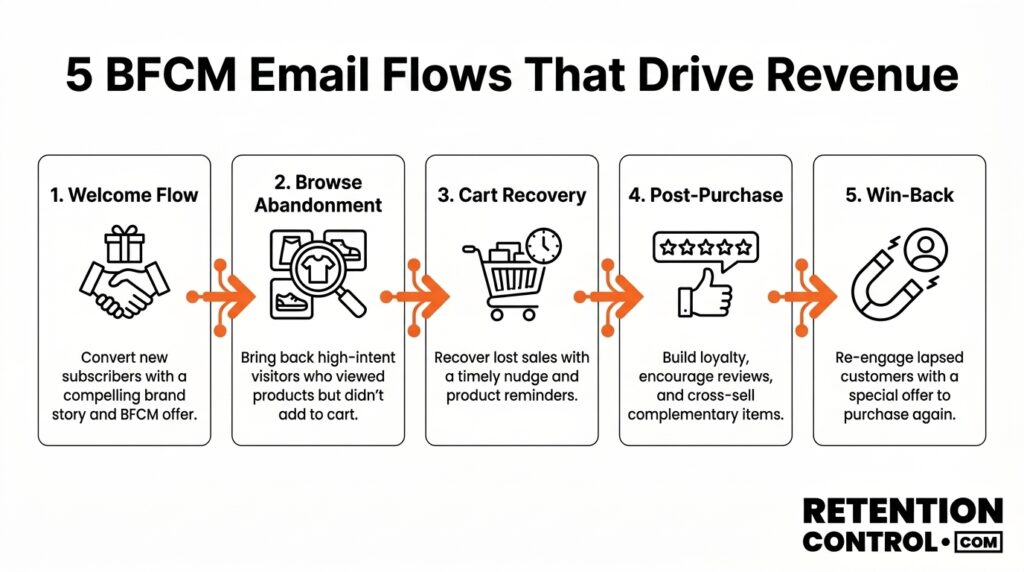
Campaigns get the attention, but flows do a disproportionate share of the actual revenue, because they’re triggered by real intent instead of a blast send. Five flows matter most.
The welcome flow needs to be live before any paid traffic or teaser campaign sends, since it’s what turns a new BFCM subscriber into someone who trusts the brand enough to buy at full attention rather than just chasing the discount. Abandoned cart is the highest-converting flow most brands run, and during BFCM it needs tighter timing than usual the first message within an hour rather than the standard same-day window, since cart abandonment during peak traffic often means someone is comparison shopping in real time. Browse abandonment catches the much larger group who looked but never added to cart, and during BFCM this list grows fast as more people window-shop sales they don’t commit to immediately.
The fourth flow is the one most BFCM guides treat as an afterthought: post-purchase. It should trigger immediately after checkout, confirm the order, and begin setting up the relationship for what comes after the sale not just tracking information. A fifth flow, win-back, catches anyone who bought once and hasn’t returned. A brand running Klaviyo can build all five of these as connected, behavior-triggered sequences rather than isolated automations; our Klaviyo retention marketing agency page covers how that setup typically works, and the same flow logic applies for brands running on Omnisend.
| Flow | Trigger | Goal |
|---|---|---|
| Welcome | Signup | First purchase |
| Browse abandonment | Product viewed, no cart | Recover interest |
| Cart abandonment | Item added, checkout not completed | Recover revenue |
| Post-purchase | Order placed | Repeat purchase |
| Win-back | No purchase in 60–90 days | Reactivation |
How to Set Up BFCM Email Marketing in Klaviyo
Since Klaviyo is the platform most Shopify brands run BFCM on, it’s worth covering the specific settings that separate a clean send from a messy one at volume.
Segments should be built as dynamic, not static, lists a VIP segment defined by “two or more orders OR top 20% by spend” updates automatically as new orders come in, rather than needing to be manually refreshed before every send. That matters specifically during BFCM because customers move between segments fast; someone who wasn’t a VIP in October can qualify with their first BFCM order, and a dynamic segment catches that shift in time for the next campaign.
Smart Sending is Klaviyo’s built-in frequency cap, and it’s one of the most underused settings during BFCM specifically. Left at default, it can block a legitimate flow email from sending to someone who just received a campaign, which sounds helpful but can also suppress a time-sensitive cart abandonment message. It’s worth reviewing Smart Sending thresholds specifically for the BFCM window rather than leaving them at year-round defaults.
Flow suppression works in the other direction: it’s what prevents someone who just purchased from also receiving a cart abandonment email for the same cart, or a customer already in a win-back flow from getting pulled into a new-subscriber welcome series. During BFCM, when several flows are firing off the same customer base at once, suppression logic needs to be checked across all active flows together, not flow by flow, since it’s the overlap between flows that usually causes the awkward double-send.
Dynamic content lets a single campaign template serve different product blocks or copy to different segments without building a separate email for each one — useful for showing a VIP segment early-access messaging and a colder segment a more assertive offer, from the same send. And for brands running SMS alongside email, Klaviyo’s SMS coordination settings are worth checking so both channels aren’t messaging the same person in the same short window; a cart abandonment sequence that sends an email and a text ten minutes apart usually converts worse than one that spaces them out.
Segmentation That Makes BFCM Emails Convert
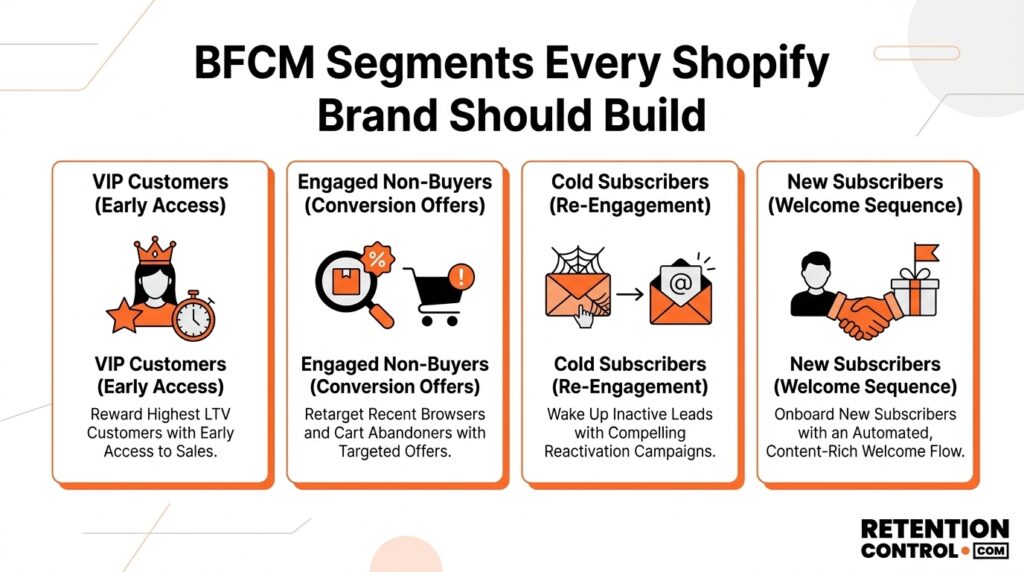
Sending one version of a BFCM email to an entire list is the single most common reason campaigns underperform. A five-time repeat customer and someone who signed up for a discount code yesterday should never see the identical email, because they need different things from the brand.
A workable starting structure splits the list into a handful of groups. VIP or repeat customers — generally the segment with two or more past orders, or spend in the top decile — should get early access and loyalty framing rather than a generic markdown, since another blanket discount code just trains a brand’s best customers to wait for the next one. Engaged non-buyers, meaning contacts who’ve opened or clicked in the last 60 to 90 days but haven’t purchased, are worth a more assertive offer, since they’re warm but not yet converted. Cold or lapsed contacts, inactive for 90-plus days, should either be excluded from the main BFCM send entirely or isolated into a separate, lower-frequency re-engagement track, since mailing them at full BFCM volume is what tends to push spam complaint rates over the threshold discussed above. New subscribers who joined specifically for a BFCM offer need to be tagged as a distinct group too, since how they’re treated in the weeks after the sale determines whether the list grows sustainably or just gets bigger and less engaged.
BFCM Subject Line Examples
Subject lines during BFCM compete against dozens of other brands running the exact same sale in the exact same inbox at the exact same time, so specificity tends to beat cleverness. A few examples, organized by where they fit in the sequence:
For early access and VIP sends: “Early Access Starts Now” or “VIP Access: Shop Before Everyone Else.” For the day-of announcement: “Black Friday Is Live” or “Cyber Monday: Today Only.” For the final hours: “Last Chance: Sale Ends Tonight.” And for cart abandonment specifically, tying urgency to the product rather than the sale tends to perform better than a generic nudge: “Your Cart Is About to Expire,” or naming the actual item left behind.
The pattern across all of these is specificity — a time frame, a named audience, or a named product — rather than a generic line that could belong to any brand’s BFCM send.
Common BFCM Email Mistakes That Cost Revenue
A few patterns show up across nearly every brand that underperforms during BFCM. The most common is leading every single email with the discount instead of the product, which trains subscribers to open only for the number in the subject line and ignore everything else. Close behind it is treating list hygiene as optional — sending full BFCM volume to a list that hasn’t been cleaned since last year, then being confused when deliverability craters mid-week.
Underbuilt flows are another recurring issue: a welcome series and a cart abandonment flow exist, but there’s no post-purchase sequence and no plan for what happens to a new subscriber after December 1st. And segmentation gets skipped under time pressure more often than it should — with the calendar tight, it’s tempting to send one email to everyone rather than build out the two or three versions a proper segmentation strategy requires, even though that single shortcut is usually what costs the most revenue. Running a structured BFCM retention audit checklist before the season starts catches most of these gaps while there’s still time to fix them.
Turning a BFCM Email Campaign Into Long-Term Retention
This is where most BFCM email advice stops short. The campaigns and flows above are built to drive the sale, but a BFCM buyer who never hears from the brand again after their order confirmation is a wasted acquisition, not a win. The same email infrastructure built for BFCM — segmentation, automated flows, and a list that’s actually clean — is exactly what a BFCM retention marketing strategy runs on afterward.
At RetentionControl, one of the most common issues we see going into BFCM is brands that build their whole plan around campaign sends and treat the flows running quietly in the background as an afterthought. In practice, it’s usually the abandoned cart and post-purchase sequences — not the day-of campaign — that carry a disproportionate share of BFCM email revenue once they’re actually tuned for the season instead of left on default settings.
Practically, that means the post-purchase flow shouldn’t stop at a shipping update. It should carry a first-time BFCM buyer through product education, into a cross-sell or replenishment offer once they’ve had time to actually use what they bought, and eventually into a win-back sequence if they go quiet. The segments built for BFCM — VIP, engaged non-buyer, first-time buyer — don’t need to be rebuilt in January; they’re the same segments a retention program uses year-round. Our guide to post-BFCM customer retention walks through that 30-day window in more depth, including what should happen week by week after the sale ends.
Metrics to Track During and After BFCM
Open rate and click rate still matter, but they’re early indicators, not outcomes. Spam complaint rate deserves daily attention during BFCM specifically, since it’s the metric that determines whether Gmail and Yahoo keep delivering to the inbox at all — a rate creeping toward 0.3% is a signal to pull back volume immediately, not wait for the campaign to finish. Revenue per email and revenue per recipient show whether segmentation is actually working, since a well-targeted send to a smaller, more relevant list often outperforms a blast to the full file. Beyond the sale itself, repeat purchase rate among BFCM buyers is the number that shows whether all of this converted into retained customers instead of one-time transactions — and it’s worth measuring separately from the brand’s normal repeat purchase rate, since BFCM buyers behave differently than organic ones.
A Practical BFCM Email Checklist
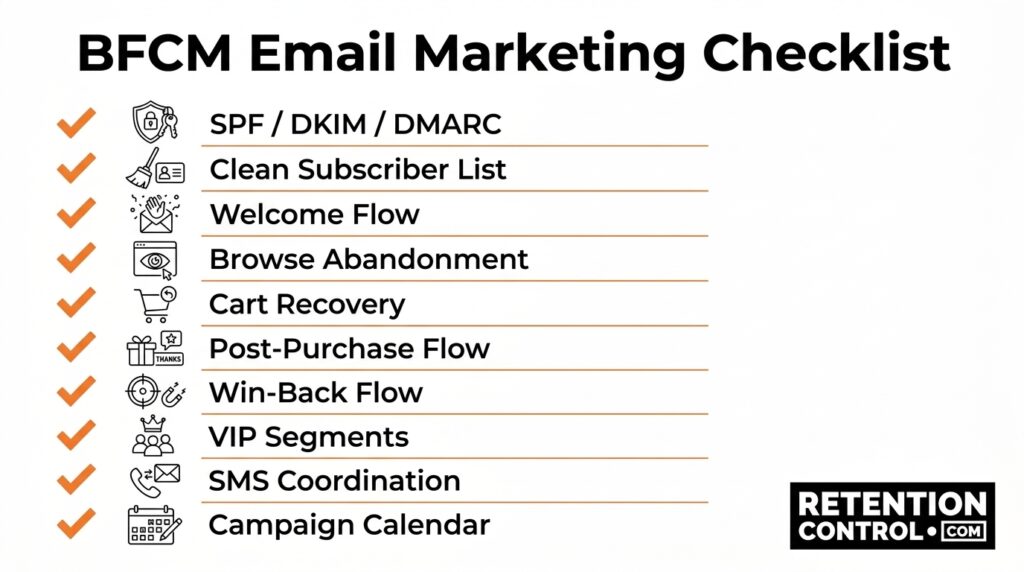
Before committing to a full send calendar, it’s worth confirming the basics are actually in place rather than assumed. Brands that run this against a written checklist, rather than from memory, tend to catch the gaps that cost the most revenue before they become a problem mid-sale.
Pre-BFCM checklist:
✓ SPF, DKIM, and DMARC configured and verified
✓ Contacts inactive for 90-plus days suppressed or isolated
✓ Welcome flow live and tested
✓ Browse abandonment flow live and tested
✓ Cart abandonment flow live and tested, with BFCM-specific timing
✓ Post-purchase flow live and carrying customers past the shipping update
✓ Win-back flow ready for the 60–90 day mark
✓ VIP, engaged non-buyer, and new-subscriber segments built
✓ SMS synced with email send times to avoid overlap
✓ Campaign calendar and offer structure approved before the first teaser sends
Final Thoughts
The brands that win BFCM email marketing aren’t usually the ones sending the most emails. They’re the ones with the strongest deliverability, the cleanest segmentation, and the most complete automation — welcome, abandoned cart, post-purchase, and win-back all working together instead of one campaign carrying the whole week. Treating BFCM as a complete email system rather than a weekend promotion is what lets a Shopify store generate more revenue during the sale and retain more of the customers it earned once the sale ends.
Brands that want a clearer picture of where their own BFCM email setup has gaps, particularly around flows, segmentation, and what happens after the sale, can run our ecommerce retention marketing audit or check the numbers directly with our ROI calculator.