
Fashion email marketing is mostly a timing problem. A shopper does not run out of jeans the way they run out of shampoo, so the next order has no natural date; it comes when a new drop lands, a sold-out size returns or a season turns. Apparel brands that keep customers build their programme around those moments, know each customer’s size and style before they send anything, and give their best buyers first access rather than a deeper discount. The six brand results below come from case studies published by each brand’s email, SMS or loyalty platform, and we re-checked every one on 23 October 2026.
This guide is written by Retention Control. Retention Control is a retention-only marketing agency for Shopify and DTC brands. It builds and runs email and SMS flows, campaigns, segmentation and loyalty on Klaviyo, Omnisend, Brevo and Attentive. The playbook is our own view; the figures belong to the brands named, and none of those brands is described here as a client of ours.
- What makes apparel different: no refill date, size-driven buying, returns, and a calendar of drops and seasons.
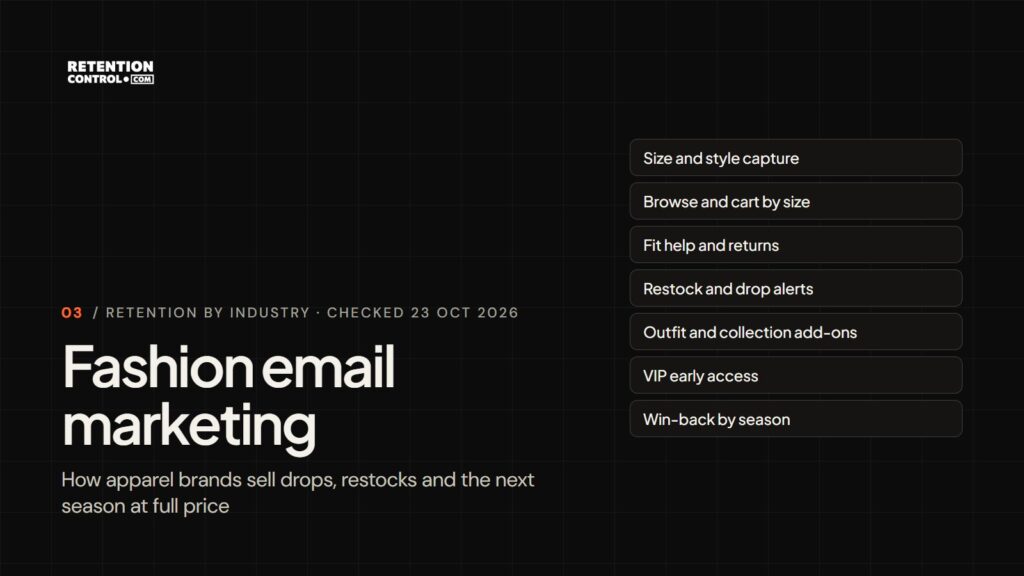
- The lifecycle map: seven stages from size capture to seasonal win-back, each with the apparel-specific trigger.
- Six brands’ numbers: Scuffers, Lucchese, Princess Polly, Pashion Footwear, Marc Fisher Footwear and Tecovas, each linked to its source.
- Black Friday 2025: what Klaviyo’s apparel data and three brands’ results say about leading with existing customers.
Why apparel retention runs on drops, sizes and seasons
Four features of the category shape what a fashion retention programme should send, and when.
There is no refill date. A beauty brand can predict the second order from the size of the bottle. A clothing brand cannot, so its reasons to come back have to be made: a new collection, a restock, a seasonal edit, a member event. That is why launch and restock messages carry more weight in fashion than in most categories.
Campaigns convert poorly on their own. Omnisend’s 2025 benchmarks place apparel near the bottom for campaign conversion: “Apparel converted at 0.05%, and both Home & Garden and Consumer Electronics converted at 0.04%.” (Omnisend). For a fashion brand, the automations are where the revenue is, and the newsletter is the reminder.
Size decides the basket. A shopper who wears a medium does not care that the large is back. Size, fit and style preferences are the data that make every later message relevant, and they are the data most apparel brands never ask for.
Loyalty is common but not universal. Smile.io’s 2026 review of Shopify Plus stores counts “Apparel and Food & Drink at 17%” for loyalty adoption (Smile.io), so most fashion brands on Plus still run none. Where they do, Yotpo’s benchmarks report that “Apparel & Accessory brands see, on average, a 50.2% increase in revenue per redeeming customer within 90 days.” (Yotpo). Yotpo last updated that report in 2023, so read it as a signal rather than a target.
The fashion and apparel lifecycle map
Each stage links to our full guide for that flow. The right-hand column is where clothing differs from other ecommerce, and most of it comes down to size, stock and season.
| Stage | What to send | For apparel |
|---|---|---|
| Welcome | Ask for size, fit and style, then show the best sellers in that size | Store each answer on the profile so every later email filters by it |
| Browse follow-up | The item viewed, in the shopper’s size, with fit notes and reviews | Never promote an item that is sold out in their size |
| Cart rescue | A reminder, then fit help, then low-stock news if true | Fit doubt stops more carts than price; answer it before any code |
| After the order | Delivery, a fit check, the exchange route, care tips | Make exchanges easy so a wrong size becomes a swap, not a refund |
| Next purchase | Items that complete the outfit, or the same piece in a new colour | Wait until the return window has closed |
| VIP and loyalty | Early access to drops, tier rewards, member-only events | First access is the perk; keep the discount for those who need it |
| Win-back | The new season, a restock of what they bought before | Time it to the season they last shopped, not a fixed 90 days |
Back-in-stock alerts matter more in fashion than almost anywhere: the shopper has already chosen the item and only lacks the size. Build them as a flow, by email first and SMS for those who opted in.
Six apparel brands and what their programmes delivered
Each result below is stated for the period its source names. Where a case study does not date a figure, we say so.
Scuffers: VIP early access beat the open sale (BFCM 2025)
Scuffers is a streetwear brand founded in Spain in 2018, with stores in Spain, pop-ups across Europe and an online store. It relies on weekly product drops and restocks, and several months before Black Friday 2025 it moved SMS onto Klaviyo so both channels ran from one platform.
For the 2025 sale, Klaviyo’s case study describes an email and SMS early-access journey for subscribers and loyal customers, who were then left out of the later sends announcing the sale was open. The payoff: “One early-access email generated around 400% more revenue than the equivalent ‘open to all’ email—a clear payoff for leading with loyal customers.” Over the whole year, Klaviyo reports “3.7x YoY growth in ecommerce revenue in 2025” (Klaviyo).
Scuffers also tests by market, before peak season, whether shoppers would rather opt in to email or SMS.
Lucchese: email previews, text on the day (BFCM 2025)
Lucchese has made cowboy boots since 1883 and now sells Western apparel online and through more than 30 stores. Its head of retention brought email and SMS onto one platform and gave each channel a job: email for the wider message, text for VIPs and high-intent moments.
The Black Friday rhythm is simple. A limited-edition holiday boot is previewed by email on Thanksgiving, with full imagery, and a text goes out the next day when it goes on sale. Klaviyo reports that “A 2025 Black Friday text was Lucchese’s all-time highest-revenue text message.” Across the second half of the year, the brand saw “43% YoY growth in SMS revenue in H2 2025” (Klaviyo). Its abandonment flows add a closing text only for carts over $500.
Princess Polly: automations carry the revenue (Q3 2025)
Princess Polly began online in Australia in 2010 and now also runs stores in the US and Australia. In 2025 it brought its retail and online data, and its email, SMS and app channels, onto Klaviyo, so VIPs could be spotted by spend and engagement wherever they shopped and offered early access and event invitations.
The result Klaviyo highlights is how much of the revenue now comes from automations: “In Q3 2025, revenue from flows grew 4× YoY in Australia and the US, and accounted for more than 60% of Princess Polly’s global Klaviyo revenue.” (Klaviyo). For a brand that sends frequent launch campaigns, that shows the everyday triggers doing most of the work.
Pashion Footwear: tiers that move customers up
Pashion Footwear makes convertible heels, and its drops often sell out within minutes. Customers build collections from heel kits, accessories and uppers, which gives the brand a built-in reason for a second order. It moved its loyalty programme to LoyaltyLion in mid-October 2025, ahead of Black Friday.
The programme has Bronze, Silver and Gold tiers, and the top two get early access to drops, up to a two-day head start for Black Friday. LoyaltyLion reports: “Gold members outsell Bronze and Silver combined, with a lifetime value 2.3x higher than non-members.” (LoyaltyLion). The case study does not date that figure. To fill the quiet weeks after the holidays, the brand ran tiered points multipliers from 16 to 21 January.
Marc Fisher Footwear: full price for the best customers (H2 2025)
Marc Fisher Footwear runs a portfolio of owned and licensed footwear brands rather than a single DTC label, so read it as a tactic rather than a like-for-like comparison. After moving six brands to Klaviyo, the team began segmenting by purchase recency, frequency and value, and changed who sees a discount.
In Klaviyo’s words, the team takes “a more full-price, brand-first position with” its best segments while “reserving discounts for customers at risk of churn” (Klaviyo). During BFCM 2025 it sent a targeted offer to its win-back segment, and its director of ecommerce reported that the segment shrank because those customers engaged. The case study gives no number for that, so we do not either. The measured result is “46% YoY growth in SMS revenue across the portfolio in H2 2025” (Klaviyo).
Tecovas: a reward instead of a discount (BFCM 2022)
Tecovas, the Western boots and apparel brand, is the oldest example here, and we include it because the tactic still applies. It does not run sitewide markdowns, so for its 2022 Black Friday sale it offered $20 towards a next purchase for every $100 spent. Its email manager explained: “As a premium brand we try to offer other ways to reward our customers instead of traditional discounts.” (Klaviyo).
The team mailed the full list once, on day one, then targeted people who had clicked but not bought. Klaviyo reports “138.8% YoY growth in revenue from flows during BFCM sale 2022” (Klaviyo). A credit towards the next order is a retention offer by design.
What Black Friday 2025 showed apparel brands
Klaviyo’s recap of the 2025 season lists apparel among its strongest categories: “Powerhouse categories: Health & Beauty sales rose 14% YoY, Apparel increased 11% YoY” (Klaviyo). Its apparel benchmark goes further: “GMV rose 11.2%, with repeat-buyer GMV (+13.9%) climbing faster than new-buyer GMV (+8.3%).” The same benchmark found that “text sends grew 38% year over year while email grew 20%” for apparel and accessories across the five days (Klaviyo).
Put next to the brand results, the pattern is consistent. The growth came from customers brands already had, and the programmes that captured it were set up weeks earlier. Scuffers finished its SMS move months before the sale and gave loyal customers a head start. Lucchese previewed its holiday boot by email and sold it by text. Pashion had its tiers live in October so Gold members could shop two days early. Tecovas, speaking to Modern Retail in December 2025, put its growth over the whole week at about 30%, helped by a weekend doorbuster; that is a merchandising result, not a retention one, but it shows how long the 2025 sale period ran. For a week-by-week plan for this year, see our BFCM retention marketing guide.
What email, SMS and loyalty each do for a fashion brand
Email shows the collection. Clothes are bought on how they look, fit and pair, and email has room for the imagery, the fit notes and the outfit. Launch previews, lookbooks, care guides and the post-purchase fit check belong here.
SMS is for the moment it drops. A restock in the shopper’s size, the minute a drop goes live, the start of member early access. Lucchese and Scuffers both keep text for high-intent moments and their most engaged customers rather than mirroring every email.
Loyalty sells access. For a brand whose best items sell out, first access is worth more to a fan than points. Tiers that unlock earlier entry to drops, as Pashion’s do, reward the customers who already pay full price and give everyone else a reason to climb.
Six retention mistakes fashion brands make
- Sending without size data. A restock or new-arrival email full of sizes the reader cannot wear trains them to ignore you.
- Cross-selling inside the return window. Recommending a matching jacket before the customer has decided to keep the trousers invites a bigger return.
- Discounting the full-price customers. The brands above keep discounts for lapsing customers and give their best buyers access instead.
- Treating back-in-stock as an afterthought. It is often the highest-intent message in the programme; build it as a proper flow.
- One win-back timer for everyone. A customer who only buys swimwear in May should not get a 90-day reminder in August.
- Mailing the whole list every day of the sale. Tecovas sent to everyone once and then to engaged non-buyers; Scuffers left early-access shoppers out of the later sale sends.
The numbers to watch
- Share of profiles with size and style data: the foundation of every relevant send.
- Time from first to second order: apparel has no refill clock, so track how long the gap really is.
- Return and exchange rate by flow: a flow that drives orders that come back is not earning what it reports.
- Back-in-stock conversion: the share of alert recipients who buy within a few days.
- Full-price share of repeat revenue: whether VIP access is replacing discounts or adding to them.
- Revenue from flows versus campaigns: Princess Polly’s flows earn more than 60% of its Klaviyo revenue.
Where an apparel brand should start
Pick the two gaps that cost the most. For most fashion brands that means collecting size and style in the welcome flow, then building back-in-stock alerts that use it. Next, make your best customers’ perk earlier access to drops rather than a bigger code. We run apparel programmes on Klaviyo, Omnisend, Brevo or Attentive, whichever you already use. Our free 60-minute audit pinpoints where repeat buyers fall away between seasons, while the retention marketing guide shows how each stage links to the next.