
Food and beverage email marketing starts with an advantage: the product gets eaten or drunk, so the customer will need more. The catch is a small order, shipping that eats the margin, and a supermarket shelf that sells something similar. DTC food and drink brands that keep customers time each reminder to how fast the product is used, turn the habit into a subscription people want to keep, and offer a new flavour before boredom sets in. Every result quoted here was published by the brand’s own email, SMS, loyalty or subscription platform, and each figure was checked again on 28 October 2026.
Retention Control wrote this guide. Retention Control is a retention-only marketing agency for Shopify and DTC brands. It builds and runs email and SMS flows, campaigns, segmentation and loyalty on Klaviyo, Omnisend, Brevo and Attentive. Our advice is our own; every figure belongs to the brand it is attributed to, and we do not present any of these brands as our clients.
- What sets the category apart: a built-in reorder date, low order values, shipping costs and a pull towards subscription.
- Six brands’ numbers: Jimmy Joy, waterdrop, Bird & Blend Tea Co., HOLY, Harney & Sons and Purity Coffee, with a link to each case study.
- BFCM 2025: what Klaviyo’s discount data and one brand’s WhatsApp early access say about the season.
The economics of a pantry product
Four facts about the category decide what a food or drinks brand should send, and when.
The customer runs out. A bag of beans, a tin of tea or a box of shakes is used up at a rate you can estimate from the pack size and the serving. That gives the second order a date, which fashion and furniture brands do not have. A reminder that lands just before the cupboard is empty earns the reorder.
Orders are small and shipping is not. A single coffee bag or snack box rarely carries enough margin to absorb a delivery charge and a discount on top. That is why bundles, free-shipping thresholds and subscriptions do so much of the work in this category.
Campaigns convert better than in most categories. In Omnisend’s 2025 benchmark table for campaign conversion, food sits near the top: “Food & Drink 0.15%” (Omnisend). Shoppers read food email to see what is new, which suits launch-led and seasonal campaigns.
Loyalty is still the exception. Smile.io’s 2026 review of Shopify Plus stores puts loyalty adoption at “Apparel and Food & Drink at 17%” (Smile.io), so most food and drink brands on Plus run no programme at all. The ones that do tend to tie it to the subscription.
The DTC food and drink lifecycle map
Every stage name opens our detailed guide to that flow. The last column shows the food-and-drink twist, which mostly comes down to timing and order value.
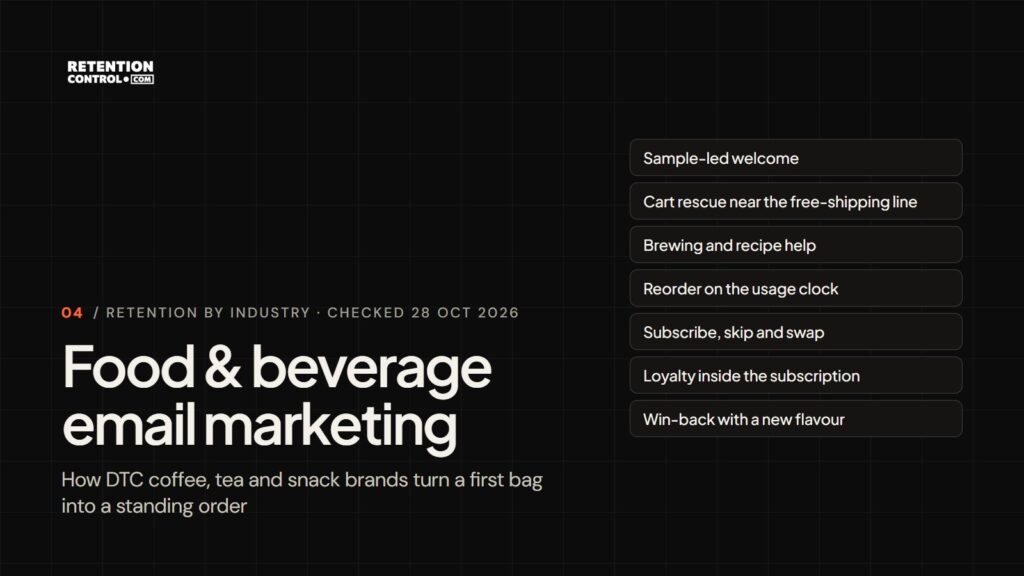
| Stage | What to send | For food and drink |
|---|---|---|
| Welcome | A sample or starter pack, then ask how they brew, cook or snack | Ask about taste and format early; a whole-bean drinker and a pod user need different offers |
| Cart rescue | A reminder, then the gap to free shipping | Suggest a small add-on that clears the threshold before offering any code |
| After the order | Brewing guides, recipes, storage tips | Help them enjoy the first bag so the second one is an easy yes |
| Reorder | A reminder before the pack runs out | Time it from pack size and serving, not from a fixed number of days |
| Subscribe and save | The subscription offer, with skip and swap options | Make pausing easy so nobody cancels just to stop one delivery |
| VIP and loyalty | Early access to new flavours, points that pay for the next box | Let subscribers spend points on the order they already manage |
| Win-back | A new flavour or limited blend, then an offer | Lapsed food buyers often got bored; novelty can work better than a discount |
Six food and drink brands, with their published results
Every figure carries the period its source names, and an undated figure is flagged as undated.
Jimmy Joy: WhatsApp as the loyal customers’ channel (BFCM 2025)
Jimmy Joy, based in the Netherlands, makes plant-based meal replacements: shakes, ready-to-drink meals, bars and powders. With Black Friday 2025 approaching, its customers said WhatsApp was their preferred channel, so the brand switched it on in Klaviyo in late summer 2025 and used pop-ups and email blocks to sign up existing buyers.
For Black Friday, WhatsApp subscribers got an exclusive 30% offer and were left out of the email sends that carried a smaller 25% offer. Klaviyo reports: “Overall, WhatsApp drove nearly 30% of Jimmy Joy’s Klaviyo-attributed revenue during their Black Friday early-access campaign, even though it reached less than 5% of their total marketing list.” In a single campaign, “they achieved a 78x ROI” (Klaviyo). The lesson: give a small, high-intent group a better deal than the broad list.
waterdrop: a gift you can only buy with points (December 2025)
waterdrop, from Vienna, sells sugar-free hydration cubes online in more than 40 countries and through retail stores. Its loyalty club trades points for free products, and subscribers go straight into the higher of its two tiers.
For December 2025 the team wanted a reason to buy that was not another sale. It ran a double-points weekend, then released curated gift boxes that could only be redeemed with points, at four reward levels. LoyaltyLion’s case study reports: “The first batch of gift boxes sold out in just one day, proving the value of loyalty gifting to drive urgent repeat purchases in a short time window.” The page also lists “6.8x higher customer lifetime value from members that redeem rewards vs non-members” (LoyaltyLion), without a date for that figure.
Bird & Blend Tea Co.: samples first, then the right recommendations (2025)
Bird & Blend is an independent UK tea company with an online store and around 30 shops. It moved to Klaviyo so shop purchases, subscriptions and loyalty sat on one customer record, and chose education over constant discounting.
Its welcome series opens with a sample. Klaviyo’s write-up says: “The welcome flow, for example, offers four free sample teabags.” The second email lets the customer choose how often they hear from the brand, and later flows split by what was bought, so a matcha buyer gets matcha guidance. Across 49 flows, the brand reported “42% YoY growth in Klaviyo-attributed revenue from automated flows in 2025”, and “46% YoY growth in Klaviyo-attributed revenue in 2025” overall (Klaviyo).
HOLY: loyalty that turns a flavour drop into a sales day (July 2025)
HOLY is a German brand selling sugar-free energy, iced tea and hydration powders, launched in 2021. New flavours arrive as monthly drops, and members keep earning points between them, so they are ready to spend when something new lands.
LoyaltyLion’s case study puts a date on the effect: “Their July 2025 product launch saw loyalty-attributed revenue almost double, from an average of 24% to 47% that day” (LoyaltyLion). Referrals run through the same programme, and the brand credits “loyalty-driven referrals alone” with “€2 million in revenue” (LoyaltyLion). The case study does not say over what period.
Harney & Sons: lapsing tea buyers came back with bigger baskets (Q4 2024)
Harney & Sons is a family tea company founded in 1983 that sells more than 300 teas through its own store, distributors and two tea shops. We include it for one tactic: segmenting customers by recency, frequency and spend.
A re-engagement campaign to its at-risk segments carried only a modest offer. Klaviyo reports that “the average order value from that one campaign was 21% higher than their overall AOV for ecommerce in 2024.” The brand also replaced a sunset flow that fired at a fixed 180 days with one triggered when a customer becomes inactive by its own pattern, and the case study headlines “114x Klaviyo ROI in Q4 2024” (Klaviyo).
Purity Coffee: loyalty inside the subscription portal (2026)
Purity Coffee is a health-focused coffee company in South Carolina, and subscriptions make up 77% of its orders. Its points used to sit in a separate widget that issued codes, so subscribers earned them and rarely spent them. On 1 April 2026 it moved loyalty into its Skio subscription portal, where a subscriber applies points with one click on the order they are already editing.
Skio compared matched 76-day windows before and after the switch: “redeeming orders climbed from 43.9 a day on Smile to 87.0 a day on Skio”. The retention link is the bigger finding: “Subscribers who use their loyalty credits hold a 94.3% active subscription rate, against 44.9% for those who don’t” (Skio). Engaged subscribers stay; the gap does not prove points cause it, but it makes points worth surfacing where orders are managed.
Black Friday 2025 for food and drink brands
Klaviyo’s analysis of the 2025 season found that shoppers did not need deep cuts, and food was a clear case: “Food & beverage, however, saw some of the steepest YoY declines in discounting.” (Klaviyo). Its season recap credits existing customers with the growth: “BFCM this year saw same-site sales rise 11% YoY, with repeat buyers driving much of the lift.” (Klaviyo).
Among the six brands above, Jimmy Joy is the only one with a published Black Friday 2025 result, and on 28 October 2026 we found no other food or drink brand case study for BFCM 2025 on Klaviyo, Attentive, Postscript, Omnisend, Yotpo, LoyaltyLion, Recharge, Skio or Okendo. What the published material does show is a pattern. Jimmy Joy spent the months before the sale building a small list of loyal customers and gave them the best offer first. waterdrop waited until December and asked members to spend points rather than receive a discount. Nespresso, which belongs to Nestlé and is far from a young DTC label, describes its approach in Attentive’s case study: “BFCM is Nespresso’s highest peak moment”, and it sends a second message a few days after each offer only to subscribers who engaged but did not buy (Attentive). For a week-by-week plan, read our BFCM retention marketing guide.
One pantry-specific step: anyone who stocks up during the sale should have their reorder reminder pushed back.
Email, SMS, WhatsApp and loyalty in a food brand’s programme
Email teaches and tempts. Brewing guides, recipes, origin stories and flavour launches need room and pictures, and most of a food brand’s flows live here.
SMS and WhatsApp carry the timed moments. The reorder nudge when a pack is nearly finished, a limited blend going live, an early-access window opening. Jimmy Joy kept WhatsApp for its most loyal customers and gave them something extra in return, rather than copying every email to a phone.
Loyalty belongs where the reorder happens. For a subscription-heavy brand, points that can be spent on the next box, as at Purity Coffee, or on items only members can get, as at waterdrop, keep the habit going.
Five retention mistakes food and drink brands make
- One reorder timer for every pack size. A 250g bag and a 1kg bag do not run out on the same day; set the timing per product and serving.
- Teaching the first order to wait for a code. Low margins cannot carry a discount on every order, so lead with samples, bundles or a shipping threshold instead.
- Making cancellation the only way to pause. Subscribers who are overstocked or travelling should be able to skip or delay in one click.
- Keeping loyalty apart from the subscription. Points that cannot be spent on a subscription order go unused by the very customers who earn the most.
- Ignoring flavour fatigue. A lapsed buyer may simply be bored; a new blend or a limited edition is a stronger win-back than the same product at a lower price.
Metrics that show whether customers are staying
- Gap between the first and second order: set against the expected life of the first pack.
- Subscription take-up after the first order: the share of one-off buyers who switch to a standing order.
- Skips and pauses versus cancellations: pauses that replace cancellations mean the save flow is working.
- Active subscriptions after three and six months: the churn number that decides lifetime value in this category.
- Points redeemed on subscription orders: Purity Coffee’s gap shows why.
Your first two fixes
For most DTC food and drink brands, start by timing reorder reminders to each product’s real usage, then giving subscribers a one-click way to skip or swap instead of cancelling. After that, decide whether your best customers should get early flavours, member-only items or points they can spend on the next box. We set up food and drink retention on whichever of Klaviyo, Omnisend, Brevo or Attentive you already use. Book the free 60-minute audit to see where your second orders drop away, and use the retention marketing guide to see how the stages fit together. For brands comparing outside help, our list of retention agencies for food and beverage brands compares nine on their own case studies.