
A cart abandonment flow is the automated sequence that follows a shopper who added products to their cart or started checkout, then left without buying. It is the highest-intent automation you will run: of all the automated flows a DTC brand relies on, this is the one where the customer has already told you almost everything except why they stopped.
Open almost any cart abandonment flow and you will find the same three emails: a reminder, a nudge, and a discount. It is the most commonly built sequence in ecommerce and one of the most commonly misbuilt, because it answers one objection, price, when there are three, and price is often not the one you have.
- Abandonment is normal. Baymard Institute’s average across 50 studies is 70.22% of carts.
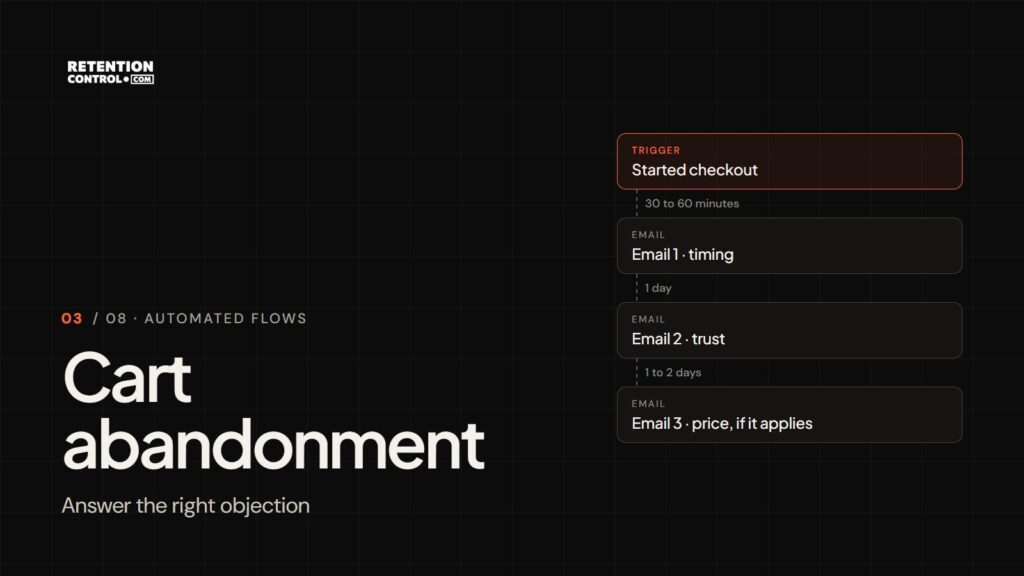
- Three objections, three different emails: timing, trust and price, in that order.
- Email 1 within the hour, with no discount. Interrupted shoppers do not need one.
- The discount, if any, goes last and never to repeat abandoners.
- Some abandonment is a checkout problem. No email fixes shipping costs revealed at the last step.
What is a normal cart abandonment rate?
Higher than most founders expect. The Baymard Institute’s running average of documented online cart abandonment is 70.22%, drawn from 50 separate studies. Roughly seven in ten carts are never completed.
That number is a sector average, not a target, and it varies by category, device and order value. What matters is your own trend: if your rate is rising while traffic quality is steady, something in the checkout or the offer changed.
Cart abandonment vs checkout abandonment
Platforms treat these as two events, and the difference changes how you build the flow.
- Added to cart: the product went into the basket, but the shopper never reached checkout. You only know who they are if they are an identified subscriber or customer.
- Started checkout: they reached checkout and usually entered an email address before leaving. This is the higher-intent event and the one most “abandoned cart” flows actually trigger on.
Run the checkout flow as your main sequence. Add an added-to-cart flow only for identified visitors, with its own shorter sequence, and make sure nobody receives both.
The three objections, and how to tell which you have
The three look identical in your dashboard and behave completely differently.
- Timing. They were interrupted: the train arrived, the meeting started, the phone died. Nothing is wrong at all.
- Trust. They do not know you well enough to hand over a card. Common with first-time visitors and above a modest order value.
- Price. They want it and cannot justify it today, or the total at checkout was higher than they expected.
You can tell them apart with data you already have:
- First-time or returning? Existing customers have already cleared the trust bar, so a repeat customer abandoning is almost never a trust problem.
- Order value against your average. Abandonment concentrated well above your average order value skews towards price and trust. Abandonment spread evenly across values skews towards timing.
- How many come back unprompted. A high share of abandoners completing within a day or two without any email is the signature of interruption, not objection.
Most catalogues have a dominant objection, and it is often not the one the team assumes.
The sequence: three emails, three jobs
| When | Answers | What goes in it | |
|---|---|---|---|
| 1 | 30 to 60 minutes after abandoning | Timing | The basket, a link straight back to it, nothing else. No discount. |
| 2 | About 24 hours later | Trust | Returns, delivery times, reviews, who else bought it, how to reach a person. |
| 3 | 48 to 72 hours later | Price, if it applies | A non-price lever first: free shipping threshold, bundle, payment options. A code only if needed. |
Email 1: assume they were interrupted
At the one-hour mark, interruption is genuinely the most likely explanation. So the first email should be short, plain and close to a service message: here is your basket, here is the link back. No countdown, no pressure, no code. A large share of everything this flow ever recovers comes from this email alone, simply by removing the friction of finding the cart again.
Email 2: earn the trust
This is the email most flows skip, and it does the heavy lifting on higher-value carts. What happens if it does not fit? How do returns work? How long does delivery take? Who else has bought it and what did they say? Put a named person or a real contact route in it. First-time buyers are deciding whether you are a real business.
Email 3: the only place a price lever belongs
If price is your dominant objection, this is where you answer it, and even then a code is not the first tool. Free shipping over a threshold, a clearer returns promise, a bundle that improves value, or a buy-now-pay-later option answers the same felt problem without teaching the customer that waiting is cheaper.
When to stop
Stop when the cart stops being real. If the item sold out, the price changed or they bought something else in the meantime, the sequence should exit. A flow that emails someone about a cart they can no longer buy is worse than no flow.
A discount policy that does not cannibalise
If every abandoned cart reliably produces a code, your customers will learn it. Not all of them, and not consciously, but your most engaged, highest-frequency buyers will notice that adding to cart and waiting is cheaper than buying. You will have built a machine that discounts your best customers.
- Never discount in the first email. Interrupted shoppers convert without one, and every code they get is margin given away for nothing.
- Exclude repeat abandoners. If someone has triggered this flow three times in two months, they have found the pattern. Take them out of the discounted branch.
- Try non-price levers first. Shipping, returns, bundles and payment options.
- Time-box it honestly. If the code expires in 24 hours, it must actually expire. Fake urgency is noticed faster than marketers think.
The checkout problems a flow cannot fix
If your abandonment rate is very high, the flow is a bandage. Baymard’s research on why US shoppers abandon during checkout puts the answer on the page: 40% cite extra costs such as shipping, tax and fees being too high; 20% say delivery was too slow; 19% did not trust the site with their card details; 18% were required to create an account; 17% found the checkout too long or complicated; and 12% could not see the total cost up front.
None of those are objections to your product. They are objections to your checkout, and no email recovers them reliably. Before investing in a fourth email, go through your own checkout on a phone, on mobile data, as a new customer, and pay with your own card. It is a twenty-minute exercise that has redirected more retention budgets than any flow tweak.
How to build it in Klaviyo
- Trigger: the Started Checkout metric from your Shopify integration. Klaviyo’s abandoned cart guide covers the template setup.
- Flow filter: Placed Order zero times since starting this flow. This is the exit when they buy, from any channel.
- Trigger split on value: split on the checkout value against your average order value, so high-value carts get the stronger trust email.
- Conditional split on customer status: Placed Order at least once over all time. Returning customers skip the trust email and go straight to a shorter sequence.
- Repeat-abandoner split before email 3: Started Checkout at least 3 times in the last 60 days sends those profiles down a branch with no code.
- Dynamic cart block: show the actual items and a direct link back to the restored checkout.
If you run SMS, one text within the first hour is the one message in this flow that genuinely benefits from being seen immediately. Our SMS vs email guide covers where each channel belongs, and in Omnisend the equivalent is the Cart Abandonment automation with the same exit rules.
How to judge it
Use revenue per recipient against the market, not open rate. Klaviyo publishes flow benchmarks by revenue band and average order value: for a brand under $1 million in annual revenue with an average order value of $44 to $83, its abandoned cart benchmark runs from $0.86 revenue per recipient at the 25th percentile to $2.91 at the 75th. Then track two numbers of your own: the share of recovered orders that used a discount code, and how that share moves when you change email 3. If you would rather have this flow built and tested for you, see how we run email retention marketing.
Where to go next
Before a cart there is usually a product view, which is where browse abandonment comes in. After the order, the job moves to the post-purchase flow, where the second order is won.
If you would rather have this diagnosed than guessed at, we go through the flows, the checkout and the data together. Book a free 60-minute audit and we will tell you which of the three objections you are dealing with.