
A welcome email flow is the automated sequence a new subscriber receives in the days after they join your list. It is the first of the automated flows every DTC brand runs, and it has the most to lose, because nothing you send later will land as well as what you send in the first fortnight.
Someone has just given you their email address. For the next two weeks they remember who you are, why they were on your site and what they were looking at. That memory fades fast. Most brands answer it with a single automated email containing a 10% code, then silence until the next campaign. The code gets used or it does not, and either way the relationship never starts.
This guide covers what a welcome flow should contain, in what order, when the discount belongs, how to build it in Klaviyo, and how to tell whether yours is working.
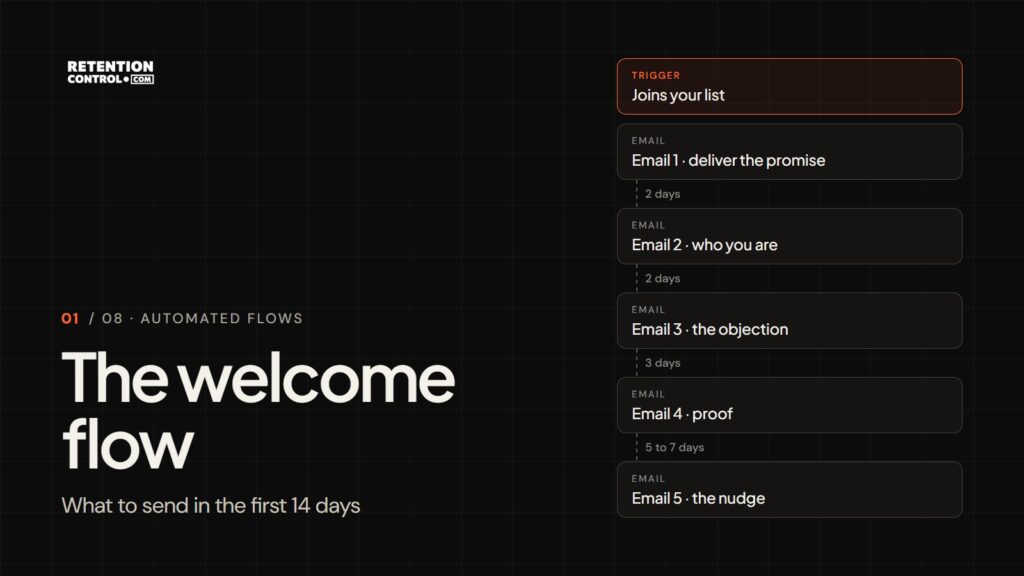
- Length: five emails over roughly fourteen days, each with one job.
- Email 1: delivers exactly what the signup promised, immediately.
- The offer: honoured at once if you promised it, held until the end if you did not.
- Exit rule: anyone who buys leaves the welcome flow and enters post-purchase the same day.
- The metric: revenue per recipient and first orders within the window, not open rate.
Why the welcome window is worth more than any other
Flows as a group are the most efficient email you send. Klaviyo’s 2026 benchmarks put it plainly: flows generate nearly 41% of total email revenue from just 5.3% of sends, with revenue per recipient nearly 18 times higher than campaigns. The same data shows why the welcome flow in particular matters: nearly 48% of flow-driven email revenue comes from new buyers, against 16% for campaigns.
New buyers are exactly who the welcome flow is talking to. It is the one sequence every subscriber sees, which makes it the highest-leverage piece of copy in your account and, in most accounts, the least revisited.
The five emails, and the job of each
Five emails is not a magic number. It is the smallest set that covers the five things a new subscriber needs before they buy: what they were promised, who you are, the answer to their hesitation, proof, and a reason to act now. More than five and you are padding. Fewer and each email is doing two jobs badly.
| When | Its one job | What goes in it | |
|---|---|---|---|
| 1 | Immediately | Deliver the promise | The code, guide or perk they signed up for, in the first line. One link to shop. |
| 2 | Day 2 | Who you are | Why the brand exists, what you refuse to do, who makes it. |
| 3 | Day 4 | Answer the objection | Sizing, ingredients, delivery time, compatibility: whatever stops people buying. |
| 4 | Day 7 | Proof | Specific reviews and results, ideally from a customer who was sceptical. |
| 5 | Days 12 to 14 | The nudge | The offer, a reminder of the offer’s expiry, or your strongest bestseller. |
Email 1: deliver what was promised
If someone signed up for a discount code, the code is the first line, not the fourth paragraph. Everything else in this email is decoration. This is also the email with the highest open rate you will ever see, so keep a single clear link back to the store and resist the temptation to fill it with product grids.
Email 2: the brand, told briefly
Why the company exists, what it will not do, who is behind it. This is the email people actually read, because they have not yet decided what you are. Brands that skip it hand every later email the job of explaining themselves.
Email 3: the objection
Every catalogue has one question that stops people at the product page. For apparel it is fit. For skincare it is whether it works on their skin type. For anything shipped from abroad it is delivery time and returns. Answer it directly, with specifics. Your support inbox and your product reviews already tell you what the question is.
Email 4: proof
Reviews, results, before-and-after, press. Specific beats glowing: “it took two weeks to see a difference and my skin is not sensitive” persuades more than five stars and “love it!”.
Email 5: the nudge
Now the offer can do its work, because the subscriber has had a reason to believe in the product first. If you gave the code in email 1, remind them it exists and when it expires. If you did not promise one, this is where a first-order incentive belongs, if it belongs anywhere.
The discount question
Two rules cover almost every case.
If you promised a code at signup, honour it instantly. Hiding a promised code behind a click, or sending it on day three, is the fastest way to teach a new subscriber that your emails are not worth opening.
If you did not promise one, hold it until the end. Leading with a discount to someone who was going to buy anyway trains your list that waiting pays. You will pay that tax on every future campaign, because subscribers who learn that the first email always contains a code learn to wait for codes.
There is a third option worth testing: no discount at all for categories where the price is not the objection. A strong email 3 often does more for conversion than 10% off.
Split the entry by where people signed up
Not everyone joins the same way, and the welcome flow should know the difference.
- Exit-intent or product-page popup: the warmest signup. They were looking at something specific. Show them that category first.
- Footer or blog signup: interested in the brand, less in a product. Lead with the story.
- Checkout opt-in: already a customer. They should not be in the welcome flow at all; they belong in post-purchase.
- Giveaway or competition entry: the coldest signup. Expect lower engagement and suppress sooner if they never open.
Same flow, different first email. The split is usually worth more than rewriting any of the copy. How you ask for the address matters too: we covered one test in asking for the email last instead of first.
How to build it in Klaviyo
The logic is the same on any platform; Klaviyo is where most Shopify brands run it.
- Trigger: a list trigger on your main newsletter list, so everyone added through a signup form enters. Use a separate list for SMS consent.
- Flow filter: Placed Order zero times since starting this flow. This is the exit rule. The moment someone buys, they leave.
- Conditional split after the trigger: split on the signup source (the form the profile came from) to send the warmer entries their category-specific first email.
- Time delays: 1 day, 2 days, 3 days and 5 to 7 days between emails 1 to 5. Delays count from the previous step, not from signup.
- Smart Sending: turn it off for email 1, so a campaign sent the same day can never block the code someone just asked for. Leave it on for the rest.
- Post-purchase handoff: your post-purchase flow triggers on Placed Order, so an exit from welcome and an entry into post-purchase happen in the same moment.
In Omnisend the equivalent is the Welcome automation triggered by a new email subscriber, with an exit condition on order placed. If you want the full flow set built alongside this one, our guide to Klaviyo flows for Shopify walks through each.
How to tell whether your welcome flow is working
Open rate is the wrong number. It measures your subject lines and sending reputation, not whether the flow sells.
- Revenue per recipient (RPR): the only fair comparison between flows, and between your flow and the market. Klaviyo publishes flow benchmarks by revenue band and average order value. For a brand turning over $1 to 5 million with an AOV of $83 to $112, its welcome series benchmark runs from $0.51 revenue per recipient at the 25th percentile to $3.93 at the 75th. Find your own band and see which side of it you sit on.
- First-order conversion within the window: what share of new subscribers place a first order within 14 days.
- Unsubscribes per email: a spike on one email tells you exactly which message is wrong.
- Time to first order: if most first orders land on email 5, emails 2 to 4 are not doing their job.
Three mistakes that quietly cost revenue
Sending all five emails in five days. The window is fourteen days for a reason. You are trying to be remembered, not to finish a sequence.
Never revisiting it. The welcome flow is the one sequence every new subscriber sees. It should be the most tested thing in your account. In most accounts it has not been touched since it was built.
Letting buyers keep receiving it. A brand still sending “here is why you should try us” to someone who ordered yesterday looks like it is not paying attention, because it is not. The exit filter fixes this in one step.
Where to go next
The welcome flow is the first of eight. Next in the series is browse abandonment, the flow with the largest audience and the weakest signal, and after the first order the relationship moves to the post-purchase flow, where the second order is won.
If your welcome flow is one email and a code, it is the cheapest fix in your account, and the first one we make as a retention marketing agency for Shopify brands. Book a free 60-minute audit and we will map what should sit in those fourteen days for your catalogue, or see how we run email retention marketing end to end.