
Furniture email marketing has two jobs that most ecommerce categories do not. It has to carry a shopper through a decision that can take weeks, because nobody buys a sofa on the first visit, and it has to find the next sale after a purchase the customer may not repeat for years. Home brands that do both well treat the gap between first visit and delivery as the main retention window, and sell accessories, care and referrals after it, rather than asking a sofa buyer to buy another sofa. Every brand result quoted below comes from a case study published by that brand’s email or SMS platform, and we checked each one on 13 October 2026.
We are Retention Control, a retention agency for Shopify and DTC brands. The advice in this guide is ours. The numbers are not: they are the six brands’ own published figures, and none of them is presented here as our client.
- Two kinds of home brand: big-ticket products bought once, and repeatable products bought again. They need different retention programmes.
- The lifecycle map: seven stages, from style quiz to win-back, with the furniture-specific timing.
- Six brands’ results: Bay Gallery Furniture, Laura James, Levenger, Yankee Candle, Made In and Pillow Talk, each with its source.
- What Black Friday 2025 showed: home was the one category where Klaviyo saw deeper discounts were still needed.
Two kinds of home brand, two retention problems
Most home brands sell some of both, and the programme has to know which product a customer bought.
| Big-ticket | Repeat-buy | |
|---|---|---|
| Examples | Sofas, beds, mattresses, outdoor sets, cookware sets | Candles, bedding, towels, diffusers, kitchen staples |
| Where retention is won | Before the purchase, across a long decision | After the purchase, on the product’s replacement cycle |
| What the next sale is | Accessories, care products, the next room, a referral | The same product again, a new scent or colourway |
| Main flows | Browse and cart follow-up, delivery updates, post-delivery cross-sell | Refills, launches, loyalty tiers |
A candle brand can run something close to a beauty brand’s replenishment programme. A sofa brand cannot, and sending it a buy-again email a month after delivery is the most common mistake in the category.
Why retention works differently for furniture
The decision is long. Bay Gallery Furniture, an Australian furniture retailer, says its email flows “have helped them nurture the customer journey in what is often a long sales cycle” (Klaviyo). A shopper may visit, order swatches, measure a room, check delivery dates and come back three times. Each of those steps is a trigger worth a message.
Repeat purchases come slowly. Smile.io’s customer loyalty report, comparing lifetime value by industry, notes: “While all industries experienced growth, Home Goods had the lowest growth increase of 6.46%.” (Smile.io). That is not a reason to skip retention; it is a reason to sell the things a furniture customer does buy again: covers, cushions, care kits, the next room.
Loyalty is still rare, which leaves room. Across Shopify Plus stores, Smile.io’s 2026 research ranks Home & Garden last of the four categories it compared: “Beauty & Fitness leads at 24% adoption, Apparel and Food & Drink at 17%, Home & Garden at 12%.” (Smile.io). A home brand with a referral or tier programme stands out more than a beauty brand with one.
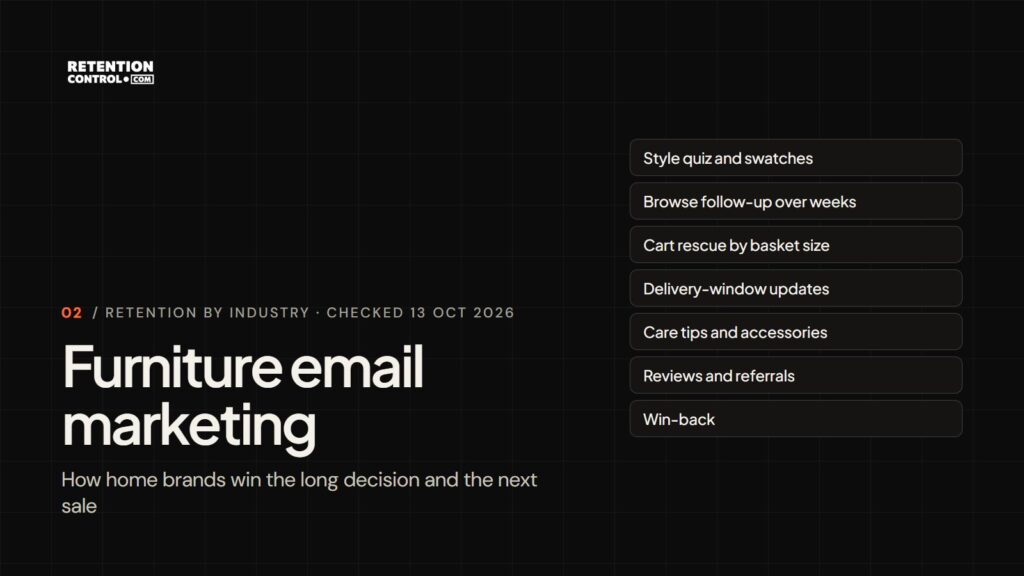
The furniture and home lifecycle map
The first column links to our full guide for each flow. The third column is where furniture differs, and it is mostly about timing and basket size.
| Stage | What to send | The furniture-specific part |
|---|---|---|
| Welcome | A style or room quiz, swatch or sample offers, delivery and returns facts | Answer the delivery, assembly and returns questions before they become objections |
| Browse follow-up | Reviews with customer photos, dimensions, fabric care, financing | Space it over weeks, not days; the decision is slow |
| Cart rescue | Different messages for small and large baskets | A $4,000 sofa cart needs reassurance and a person to talk to, not a code |
| Order to delivery | Delivery-window updates, how to prepare the room, assembly | Delivery can take weeks; silence in that gap leads to cancelled orders and support tickets |
| After delivery | Care tips, then matching extras | Cross-sell only after delivery, starting with what protects the purchase |
| Reviews and referrals | A photo-review request, then a referral offer | Real rooms sell furniture better than studio shots |
| Win-back | New collections, the next room, seasonal ranges | Time it to the category: months for candles, much longer for sofas |
What six home brands actually did, with their results
Every result carries the period its source states. Where a case study gives no year, we say so rather than guess.
Bay Gallery Furniture: flows for a long sales cycle
Bay Gallery Furniture sells indoor and outdoor furniture from showrooms in Sydney and Brisbane and online across Australia. It moved to Klaviyo in 2023 and built a welcome series, abandoned cart and browse abandonment reminders and a customer win-back flow, according to Klaviyo’s case study.
After an outdoor set is bought, the brand sends care tips with “dynamic content blocks sharing complementary products like weather covers, driving the next purchase at a pivotal time in the customer’s lifecycle”. The programme “has led to a 147x Klaviyo ROI in 2024” (Klaviyo). The cover is the right first cross-sell: it protects what the customer just bought.
Laura James: lifecycle automation for a website-only furniture brand
Laura James is a UK home and garden furniture brand sold only through its own website on Shopify Plus. It moved from Shopify’s built-in email to Klaviyo to run full lifecycle automation, and later brought its SMS onto the same platform.
In the first half of 2025, Klaviyo reports “57% of Klaviyo attributed revenue from flows in H1 2025” and “an impressive 254% YoY growth in Klaviyo-attributed revenue for the first half of 2025” (Klaviyo). For a furniture brand, more than half the revenue coming from automations is the clearest sign the long decision is being worked by flows, not by discounts.
Levenger: different paths by basket size (BFCM 2025)
Levenger sells writing instruments, notebooks and journals. Its cart-abandonment journey “coordinates email and SMS while branching according to whether a cart is above or below $75” (Attentive), and a post-purchase branch aims to get first-time buyers to a second order within 90 days, with an SMS reminder at day 15 and offers at 30, 60 and 90 days.
Levenger relaunched SMS on 20 October 2025 to a list of about 26,000 high-intent subscribers. Over Black Friday and Cyber Monday 2025, Attentive reports that SMS returned 53 times its cost, and “The channel represented 32% of revenue during the period.” (Attentive).
Yankee Candle: segment by rewards tier (Holiday 2025)
Yankee Candle is a long-established brand rather than a DTC start-up, but its programme shows how a repeatable home product is run. It segments by rewards status and tier, and for Black Friday coordinated offers across email, SMS and paid media so each shopper saw the offer in their strongest channel.
Attentive reports the result: “That strategy helped Yankee Candle increase Holiday 2025 SMS attributed revenue by 211% YoY compared to Holiday 2024.”. Sign-ups grew too: “In November 2025, Yankee Candle drove 98% YoY signup growth” (Attentive).
Made In: switch the flows off for the sale
Made In, the cookware brand, does something most brands never consider during peak season. In the words of its lifecycle team: “We turn off evergreen flows during the sale and run holiday-specific automations and journeys instead, with a big focus on gifting.” (Attentive). The sale is run as a sequence of chapters, from early bird through Black Friday, Cyber Monday, gifting and last shipping dates.
In a 50/50 test across a peak season, Attentive reports that its AI journeys “drove roughly 180% more conversions than standard flows” (Attentive). The case study does not name the year. The transferable lesson is the switch itself: a welcome flow written for an ordinary Tuesday reads wrong in the week of Black Friday.
Pillow Talk: automations that keep earning (Q4 2025)
Pillow Talk is an Australian bedding and homewares retailer with 73 stores and a growing online business. Its programme leans on always-on automations, such as an SMS welcome flow with an offer, with SMS added alongside email rather than replacing it.
Klaviyo reports: “Automated flows now account for 42% of Klaviyo-attributed revenue in the last 12 months, with flow revenue growing 166% YoY in Q4 2025.” (Klaviyo). Bedding sits between the two kinds of home brand: replaced more often than a sofa, far less often than a candle.
What Black Friday 2025 showed home brands
Klaviyo’s recap of the 2025 season singles out home: “The main exception was Home & Garden, where deeper markdowns were needed to move bigger-ticket items amid softer demand.” (Klaviyo). Across all categories, though, “At BFCM 2025, revenue from repeat buyers grew 13.6% year over year across Klaviyo, while revenue from new buyers grew 9%.” (Klaviyo).
The two findings point the same way. If big-ticket home needs deeper discounts to move, the margin has to come from somewhere else: customers who already trust you, bundles, gifting and accessories. The examples above show the routes. Levenger rebuilt SMS weeks before the sale for its highest-intent subscribers, Yankee Candle grew its list hard in November, and Made In swapped its everyday flows for gifting-led ones. Brooklinen, the bedding brand, told Modern Retail in December 2025 that bundle sales were up 15% year on year and now make up more than a third of its business. For home brands, Black Friday rewards the list and the offers you built before it. For the week-by-week plan, see our BFCM retention marketing guide.
The job of each channel in a home brand’s programme
Email explains. Furniture is bought on dimensions, materials, care and delivery, and email has the space for all of it. Levenger’s case study puts the split well: “Email could help someone understand why a Circa system, five-year journal, or writing instrument belonged in their routine, while SMS could help that customer act when the moment was right.” (Attentive).
SMS times. Delivery-window updates, a back-in-stock alert for a sold-out fabric, the opening of a sale for members. Keep SMS for messages a customer would want on their phone.
Loyalty refers. A furniture customer may not buy again for a long time, but they will show the room to friends. Referral offers and photo-review requests turn one big purchase into the next customer.
Five mistakes home brands make in retention
- Asking a sofa buyer to buy another sofa. Big-ticket buyers need care, accessories and referral asks, not buy-again emails.
- One cart flow for every basket. A $40 throw and a $4,000 sectional need different messages, timing and offers. Levenger branches at $75.
- Going quiet between order and delivery. Weeks of silence create cancellations and support tickets. Send the delivery window, how to prepare and what happens next.
- Cross-selling before the product arrives. Wait until it is in the room, then lead with what protects it.
- Running everyday flows through Black Friday. A welcome offer that undercuts the sale, or a browse reminder with the wrong price, costs trust in the week it matters most.
The numbers to watch
- Time from first visit to first order: if it is long, browse and cart flows need to run for weeks, not days.
- Conversion of browse and cart flows over 30 days: not just the first 24 hours.
- Accessory attach rate within 90 days of delivery: how often a big-ticket buyer adds a cover, cushion or care product.
- Repeat rate for repeatable products: candles, bedding and linens should behave more like consumables.
- Review and referral rate: the share of customers who post a photo review or bring a friend.
- Revenue from flows versus campaigns: Laura James and Pillow Talk both earn a large share from automations.
A first step for home brands
If you sell furniture or home goods, begin by splitting your customers into big-ticket and repeatable buyers, then fix the two flows that matter most for each: a long browse and cart follow-up with basket-size branches for big-ticket items, and replenishment for repeatable ones. Add post-delivery care and accessory emails next. We build and run these programmes on Klaviyo, Omnisend, Brevo and Attentive. A free 60-minute audit shows which of your shoppers go quiet between first visit and checkout, and our retention marketing guide explains how every stage connects.