
Pet email marketing works because the customer is buying for someone they love who eats every day. A dog or cat gets through its food on a predictable schedule, the owner rarely wants to switch brands once the pet is settled, and they will happily tell you the pet’s name, breed and birthday if you ask. The hard part comes early: many trial buyers never reach a second box, and the ones who do will cancel the moment a delivery arrives before the last bag is finished. This guide covers how DTC pet brands handle both problems with email, SMS and loyalty, using results published by six brands’ own platforms and rechecked on 3 November 2026.
A note on who is writing. Retention Control is a retention-only marketing agency for Shopify and DTC brands. It builds and runs email and SMS flows, campaigns, segmentation and loyalty on Klaviyo, Omnisend, Brevo and Attentive. The tactics below are our reading of the published material. The results belong to the named brands and their platforms, and none of these brands is a Retention Control client.
- What makes pet different: a daily-use product, a second customer (the pet) with data of its own, and a steep drop between trial and first full order.
- Six brands’ numbers: HelloPets, Fuzzball, Open Farm, Forthglade, Farm Hounds and Paw.com, each linked to its source.
- BFCM 2025: what the season’s published data covers, and the gap where pet results should be.
How money moves in a pet business
Four traits shape a pet brand’s retention programme more than any template does.
Food runs out on a schedule you can work out. A 10kg bag lasts a set number of weeks for a dog of a given weight. That gives every food order a natural next date. Accessories are the opposite: Paw.com’s dog beds last so long that, in Klaviyo’s words, “there’s no need for customers to regularly replace them” (Klaviyo). A pet brand that sells both needs two retention models.
The first box is where most customers are lost. Fuzzball, a UK cat-food subscription, says plainly what many pet food brands face: “Churn between trial and first full box hovered around 70%, a tough, but common rate for pet food brands.” (Recharge). Fixing that one step is worth more than any later flow.
Owners hand over data willingly. Pet name, species, breed, age, weight and allergies are all useful for personalisation, and owners like being asked.
Campaign email performs slightly above average. Omnisend’s 2025 benchmark table lists campaign conversion at “Pets & Animals 0.10%” (Omnisend), against 0.08% across all categories. The gap is small; flows and the subscription do most of the work.
The pet brand lifecycle map
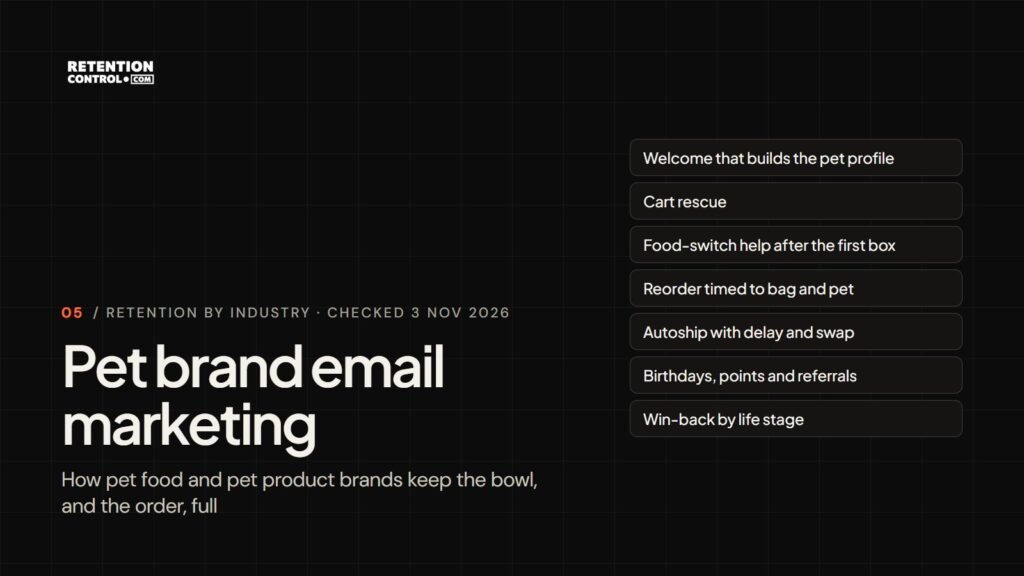
Click a stage name for our step-by-step write-up of that flow. The final column holds the detail that only applies to pets.
| Stage | What to send | The pet twist |
|---|---|---|
| Welcome | An introductory offer, then a short pet profile form | Ask for species, name, age and weight so every later email fits the animal |
| Cart rescue | A reminder, then reassurance on ingredients and fit | Answer the fussy-eater worry before offering money off |
| After the order | Tips for switching the pet onto the new food | A rushed switch can upset a pet’s stomach, and the owner blames the food |
| Reorder | A reminder shortly before the bag is empty | Work the date out from bag size and the pet’s daily portion |
| Autoship save | Delay, skip or swap offers when a subscriber tries to cancel | Overstock is a common reason to cancel; a delay solves it |
| VIP and loyalty | Birthday rewards, points and referral credit | Celebrate the pet’s birthday, not only the owner’s |
| Win-back | A check-in, then a fresh offer | A puppy becoming an adult, or a cat ageing, is a reason to recommend a different recipe |
Six pet brands and what they published
Periods are taken from each source. Where a source gives no date, we say so.
HelloPets (WOOOF): flows built on each dog’s details (2025)
HelloPets is a Dutch pet nutrition group best known for WOOOF, a cold-pressed dog kibble, selling through its own stores in the Netherlands, Belgium, Germany and Austria. It runs on Shopware rather than Shopify, so treat this as a tactic, not a platform recommendation. Before moving to Klaviyo it sent broad newsletters with no automation.
Owners now register their dog’s name, breed, birthday and allergies on the WOOOF site, and that data drives the emails. Reorders run off Klaviyo’s predicted next order date: “This triggers a repeat-purchase email when the algorithm believes that the customer’s supplies are running low.” Birthdays get their own flow: “Ahead of each dog’s birthday, Klaviyo triggers a personalised gift or discount.” The case study reports “138x global Klaviyo ROI in 2025” and “39% YoY growth in The Netherlands store’s revenue from automated flows in 2025” (Klaviyo). The brand also stopped paying to retarget its own customers on social, using Klaviyo segments to exclude them from ads.
Fuzzball: fixing the trial-to-first-box drop (date not stated)
Fuzzball sells fresh cat food by subscription in the UK and was a 2025 winner of a Recharge brand challenge. Trial churn sat near 70%. It rebuilt the store, A/B tested its onboarding and product recommendations, and used cancellation-survey answers to choose what to offer each leaver.
The offers matched the reason. “Customers who simply had too much food were offered delay options”, while long-standing subscribers received small rewards and gifts. Recharge reports: “Trial-to-box-one retention improved by more than 50%, while average customer lifetime value grew by 90%.” (Recharge). The case study was published in December 2025 but does not give the period the figures cover.
Open Farm: a cancellation flow with real alternatives (date not stated)
Open Farm sells ethically sourced dog and cat food, wet food and supplements across the US and Canada. Its team turned years of cancellation data into ten clear reasons, then built a cancellation flow around them. “Depending on their response to the cancellation survey, customers might be offered a discount or the option to swap products, skip an interval, or delay shipping.” (Recharge).
The results: “They’re saving 12.6% of customers who initiate the cancellation process”, and “they have effectively reduced churn by 28.7% year-over-year” (Recharge). Recharge gives no study period.
Forthglade: turning one-off buyers into subscribers (date not stated)
Forthglade has made dog food in Devon for more than 50 years and has recently pushed its direct-to-consumer store on Shopify. Few one-time buyers were taking a subscription, so it paired Klaviyo with Relo, which predicts when a repeat buyer is ready to subscribe, and Recharge, which runs the subscription.
The welcome flow splits by what the customer has done. “Customers who sign up to email when they place a single order receive tips on how to transition their pet to the new food with a link to create a subscription.” Buyers who do not reorder get two more emails the following month with an incentive, and Klaviyo notes “This flow alone generates a quarter of the revenue attributed to email automations”. The headline result: “Since implementing this strategy, Forthglade has seen product subscriptions increase by 26%.” (Klaviyo). The page carries no date.
Farm Hounds: loyalty that brings in new owners (trailing 12 months)
Farm Hounds makes premium pet food from human-grade ingredients. Its LoyaltyLion programme has Silver and Gold tiers that raise points per dollar, but the emphasis is on referrals: double-point referral promotions, referral prompts across the site and short how-to videos in email.
The emails are tied to the programme through Klaviyo, including reward updates, monthly balance reminders and “birthday emails with point deposits”. Members can also apply rewards to Skio subscription orders. LoyaltyLion reports: “Today, 55% of their total revenue is generated from loyalty program members.” and “In just 12 months, over 850 new customers were acquired through referrals” (LoyaltyLion).
Paw.com: segmenting by the dog when the product lasts for years (date not stated)
Paw.com makes dog beds, throws and car seat covers that are built to last, which leaves little natural reason to reorder. Its answer was to keep owners engaged between purchases and to suggest complementary products based on what each one already owns.
Data from its Yotpo loyalty programme feeds Klaviyo segments built on “pet breed, age, size, and even quirks like anxiety during fireworks season”, so a greyhound owner never receives advice meant for flat-faced breeds. The case study headlines a “180% increase in email subscribers, from 330K to 930K” (Klaviyo). No date is given; read it as a durable-goods example rather than a food one.
BFCM 2025 and pet brands
None of the six case studies above reports a Black Friday result of any year, and when we searched on 3 November 2026 we found no BFCM 2025 pet brand case study across the customer-story pages of Klaviyo, Omnisend, Attentive, Postscript, Recharge, Skio, LoyaltyLion, Yotpo and Okendo. Pet is also absent from Klaviyo’s industry breakdown: “Klaviyo’s 2025 BFCM benchmarks break down how 5 industries performed” (Klaviyo), and none of the five is pet.
The season-wide numbers still point the same way as everything above. Klaviyo’s recap says “Revenue from repeat customers grew 13.5% YoY (outpacing revenue from new buyers)” (Klaviyo), and credits early access, VIP perks and personalised offers rather than blanket discounts. For a pet brand, that suggests three steps before the sale:
- Give autoship subscribers the best offer, inside their next scheduled order, rather than training them to cancel and buy one-off at the sale price.
- Delay the next reorder reminder for anyone who stocks up. A customer who buys three bags in November does not need a reorder email in December.
- Send treats, toys and accessories to the food list, since those are the gifts owners buy for their pets in the holiday period.
Our BFCM retention marketing guide has the full week-by-week plan.
Email, SMS and loyalty: who does which job in a pet programme
Email carries the care. Feeding guides, food-switch advice, breed and life-stage content, and the pet profile itself all live in email. Forthglade’s welcome flow and HelloPets’ birthday flow are both email-first.
SMS manages the delivery. Its best use in this category is letting subscribers control their next box from their phone. PrettyLitter, a cat litter subscription brand owned by Mars, built a keyword reply flow with Recharge and Klaviyo: “One of these automations is sent to customers a week before their subscription is scheduled to ship” (Klaviyo). The customer can reply to bring the order forward and then change its frequency, without logging in.
Loyalty collects the pet data and pays for referrals. Edgard & Cooper’s points programme rewards owners for “completing pet profiles” among other actions, and LoyaltyLion reports “Members who redeem their rewards spend 15 times more than non-members” (LoyaltyLion). The case study gives no date, and members who redeem are likely to be the brand’s keenest buyers anyway, so read that figure as a sign of engagement rather than proof of cause.
Six mistakes we see pet brands make
- One reorder interval for every customer. A Chihuahua and a Labrador eating from the same bag size finish it weeks apart. Use the pet’s weight or a predicted reorder date.
- Letting cancellation be the only exit. Most subscribers who leave are overstocked, travelling or trying a change of diet. Offer delay, skip and swap first, as Open Farm does.
- Skipping the food-switch email. The first week on a new food decides whether the second box ships. Tell owners how to switch gradually.
- Writing for an average pet. Dog and cat owners, puppy and senior owners, and large and small breeds want different advice. If the profile has the data, use it.
- Retargeting your own customers with paid ads. Exclude them, as HelloPets does, and reach them through email and SMS instead.
- Treating accessories like food. Beds and harnesses are not reordered on a timer. Keep those buyers engaged with useful content and complementary products.
The numbers that tell you it is working
- Trial-to-second-order rate: how many trial or first-order customers go on to a second order, the step Fuzzball fixed first.
- Subscription take-up: how many one-off food buyers move onto autoship, the measure behind Forthglade’s 26%.
- Cancellation save rate: the share of subscribers who start cancelling and stay. Open Farm’s published figure is 12.6%.
- Pet profile completion: the share of customers with species, age and weight on file.
- Revenue from loyalty members and referrals: Farm Hounds and Edgard & Cooper both measure it.
Where to start this month
Pick the two leaks that cost the most: the drop between the first and second box, and subscribers cancelling when a delay would have kept them. Fix the welcome and food-switch emails for the first, and add delay, skip and swap offers to the cancellation flow for the second. Then add pet profile fields so every later message can speak to the actual animal. Our team sets it up in your existing platform, whether that is Klaviyo, Omnisend, Brevo or Attentive. Our free 60-minute audit will find the point where your pet customers stop reordering, while our retention marketing overview shows the stages working together.