
Most Shopify stores spend heavily acquiring customers they already have to win back again. As acquisition costs rise, relying on new traffic becomes harder—and brands often overlook the one lever that compounds: getting existing customers to buy again.
Shopify customer retention is about turning first-time buyers into repeat customers through better post-purchase experiences, segmentation, email and SMS flows, loyalty, win-back campaigns, and ongoing optimization. It’s not simply about sending more emails; it’s about building a system that gives customers a reason to return.
This guide covers the key retention metrics, customer segmentation, essential Shopify retention flows, proven strategies, and a practical roadmap for increasing repeat purchases and customer lifetime value.
Key Takeaways
- Retention compounds in a way acquisition doesn’t: a 5% lift in retention can increase profits by 25–95%, because returning customers cost less to serve and spend more per order.
- Retention is a system — audit, segmentation, lifecycle flows, email/SMS, post-purchase experience, loyalty, win-back, testing, and reporting — not a single tactic or app.
- Track retention rate, Shopify repeat purchase rate, CLV, purchase frequency, and churn separately — a healthy repeat rate can still hide a churn problem.
- RFM segmentation (Recency, Frequency, Monetary value) is the single highest-leverage upgrade most stores are missing; it turns generic blasts into messages that match where each customer actually is.
- Fix in priority order: measurement, segmentation, post-purchase flow, abandoned cart, win-back, replenishment, personalization, loyalty, then ongoing testing — rather than launching everything at once.
- Specialist help tends to make sense once a store has enough customer data to work with but not enough internal time or expertise to build and keep optimizing the full system.
What Is Shopify Customer Retention?
Customer retention rate measures the percentage of an existing customer base that remains active over a defined period, while repeat purchase rate measures the percentage of customers who have made more than one purchase.If 1,000 people bought from your store last year and 250 of them came back to buy again, your customer retention rate for that period is 25%. Everything else in this guide segmentation, email flows, loyalty programs, win-back campaigns exists to move that one number in the right direction.
It’s worth separating retention from a few terms people use loosely. Retention rate measures how many customers stay active over time. Repeat purchase rate measures the share of your total customers who have bought more than once, ever. Churn rate is the inverse of retention the percentage of customers who stop buying. They’re related, but a store can have a healthy repeat purchase rate and still be losing customers faster than it gains them, which is why tracking more than one metric matters.
Why Retention Matters More Than Most Shopify Merchants Realize
The economics here aren’t subtle. Research popularized by Bain & Company and Harvard Business School found that increasing customer retention by just 5% can increase profits by 25% to 95%, depending on the industry a gap so wide that even the low end of that range would reshape most stores’ margins. The reason is straightforward: acquiring a new customer means paying for the ad, the discount, and the trust-building all over again, while a returning customer already trusts you, already knows your sizing or shipping times, and typically spends more per order without needing a fresh incentive (Harvard Business Review, “The Value of Keeping the Right Customers”).
There’s also a compounding effect that raw acquisition can’t match. A repeat customer tends to have a higher average order value, refers friends without being asked, and gives you first-party data purchase history, product preferences, response to past offers that makes every future message more relevant. None of that shows up on a single-purchase customer’s record. Building a real strategy around this is what separates a store with a loyal, repeat customer base from one that’s permanently dependent on the next ad dollar; it’s also the core of what a dedicated retention marketing program is designed to build.
Shopify Retention Metrics You Need to Track
Before fixing retention, you need to measure it correctly. These are the numbers worth tracking on a Shopify store, and none of them require anything beyond Shopify’s own analytics plus a spreadsheet.
Customer retention rate is calculated as: ((Customers at end of period − New customers acquired during period) ÷ Customers at start of period) × 100. It tells you what share of your existing base stayed active.
Repeat purchase rate is simpler: (Customers with more than one order ÷ Total customers) × 100. This is the number most people mean when they talk about Shopify repeat customers, and it’s the cleanest single indicator of whether your retention efforts are working.
Customer lifetime value (CLV) estimates the total revenue a customer generates over their entire relationship with your store. The basic formula is Average Order Value × Purchase Frequency × Average Customer Lifespan. So a store with a $60 average order, 3 purchases per year, and an average 2-year customer lifespan has a CLV of $360. Knowing this number changes how much you’re willing to spend to keep a customer, and it’s the figure that should guide loyalty program rewards, win-back offer sizes, and even which customers get white-glove support. If you want the full breakdown, including cohort-based CLV and how to segment it by product line, our step-by-step Shopify CLV guide walks through the calculation with worked examples.
Purchase frequency and churn rate round out the core set — frequency tells you how often the average customer buys in a given period, and churn tells you the percentage who stop buying altogether, usually measured over 6 or 12 months depending on your typical repurchase cycle.
What’s a Good Shopify Retention Rate?
There’s no single number that applies to every store, because customer retention for Shopify stores differs wildly by category and repurchase cycle. A consumable or replenishable product (skincare, supplements, coffee, pet food) should see repeat purchase rates in the 45–60%+ range once retention systems are in place, because the product itself creates a natural reorder cycle. Apparel and fashion brands typically sit lower, often in the 20–30% range, because purchases are seasonal and less predictable. Home goods, electronics, and other considered or infrequent purchases often land under 20%, simply because customers don’t need a second couch or a second laptop right away.
The honest benchmark to use is your own store’s history. If your repeat purchase rate has been flat or declining for two consecutive quarters while acquisition spend has stayed the same or grown, that’s the clearest sign your retention systems need attention regardless of what the “industry average” says.
The Shopify Retention Strategy Framework
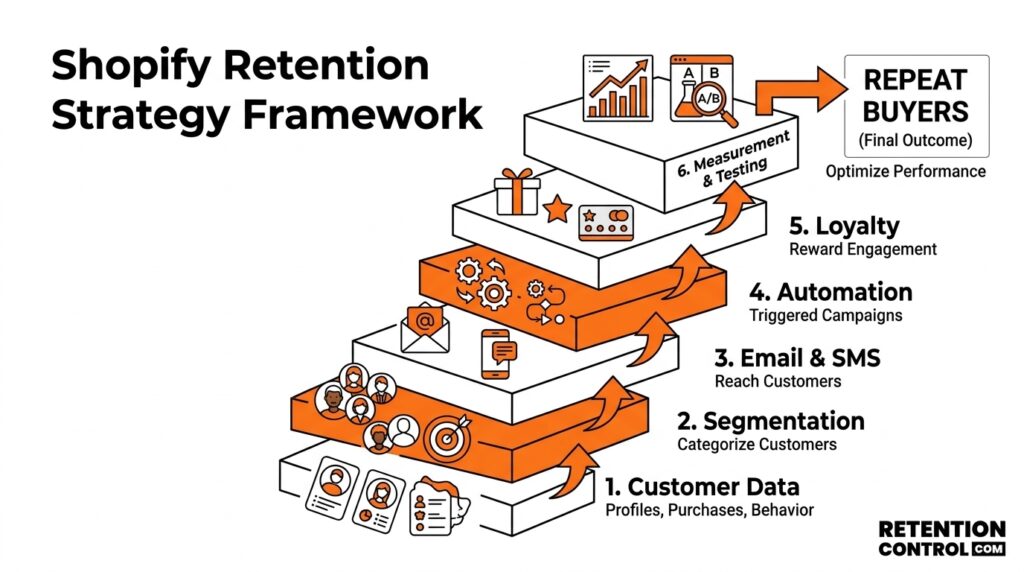
| Layer | What it does |
|---|---|
| Shopify data | Stores customer/order behavior |
| Segmentation | Identifies customer groups |
| Email/SMS | Communicates with customers |
| Automation | Delivers messages at the right moment |
| Loyalty | Encourages repeat behavior |
| Analytics | Measures revenue and retention |
| Testing | Improves performance over time |
Shopify Customer Retention Audit: What Should You Check?
Before adding new flows or apps, it’s worth knowing exactly where the current customer journey is leaking repeat revenue. A proper Shopify retention audit works through the same checklist every time, regardless of store size:
- Repeat purchase rate and how it’s trended over the last several quarters
- Customer lifetime value, ideally by acquisition cohort
- Purchase frequency by customer segment
- Churn rate and the point in the customer journey where it spikes
- Whether RFM segments exist at all, and whether messaging actually differs between them
- Welcome flow performance and timing
- Abandoned cart flow coverage and conversion rate
- Post-purchase flow — whether it exists past the order confirmation
- Win-back flow — whether one exists, and how long a customer goes quiet before it triggers
- Replenishment opportunities for consumable or repeat-use products
- Email list segmentation depth versus one-size-fits-all campaigns
- Whether SMS is used at all, and for which moments
- Loyalty program structure and actual redemption rates
- How VIP or top-spend customers are treated differently, if at all
- Campaign performance trends (open rate, click rate, conversion) over time
- Deliverability health — inbox placement, spam complaints, list hygiene
- Revenue generated specifically by automated flows versus one-off campaigns
- Gaps in the customer journey where a customer simply stops hearing from the brand
One of the first things to check during a retention audit is whether a store is treating first-time buyers, VIP customers, and dormant customers as the same audience — in most stores that haven’t looked closely, they are, and that single gap explains a large share of lost repeat revenue. Running through this list honestly usually reveals which two or three fixes would move the repeat purchase rate fastest, rather than guessing at another new tactic to add on top of what’s already there.
Shopify Customer Segmentation: The RFM Framework Most Guides Skip
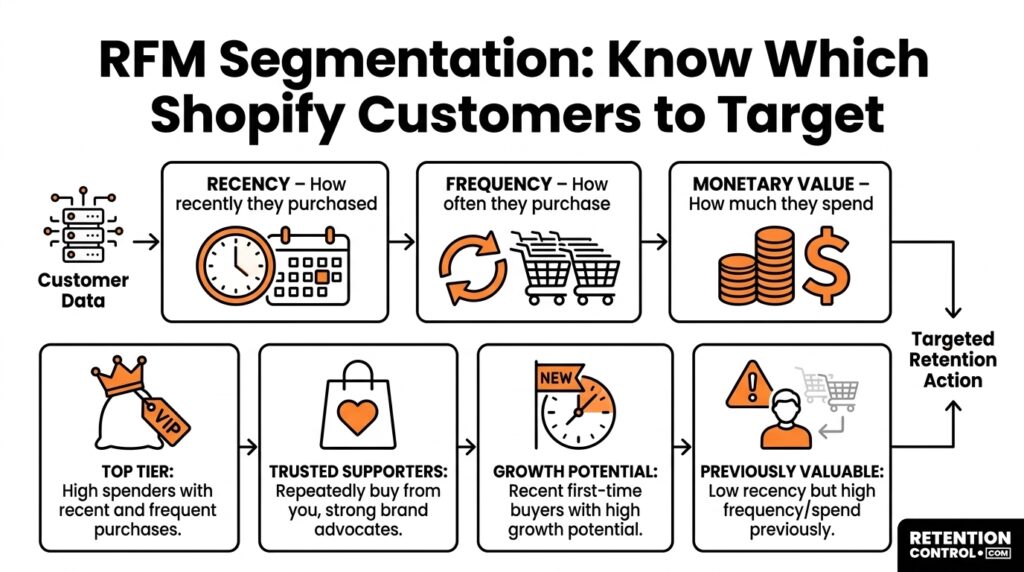
Most articles on this topic mention “segment your customers” and move on without explaining how. RFM segmentation is the actual framework worth using, and it’s simple enough to build in a spreadsheet or inside Shopify’s customer reports.
RFM stands for Recency, Frequency, and Monetary value the three questions that predict future buying behavior better than almost anything else: How recently did this customer buy? How often do they buy? How much do they spend? Score each customer on those three dimensions (a simple 1–5 scale works) and you get natural segments that should each receive a different message and offer. Some merchants call this Shopify RFM segmentation specifically, since the same behavioral scoring model applies directly to Shopify’s order and customer data:
| Segment | What It Means | What to Do |
|---|---|---|
| Champions | High recency, frequency, and spend | VIP access, referral asks, early access to launches — not another 10%-off blast |
| Loyal but fading | Historically strong purchase history but declining recency | Win-back messaging plus personalized product recommendations |
| New customers | Recent first or second purchase | Post-purchase education and a well-timed second-purchase offer |
| At risk | Previously valuable but now inactive | Win-back sequence plus a direct ask for feedback on why they left |
| One-time / low value | Single low-value purchase, no return | Automated nurture content rather than expensive incentives |
This is the single highest-leverage upgrade most Shopify stores can make to their retention marketing, because it replaces “email everyone the same thing” with messaging that actually matches where each customer is in their relationship with the brand. It’s also the input that everything else in this guide flows, loyalty, win-back should be built on top of, rather than layering segmentation on afterward.
Core Shopify Retention Strategies That Move Repeat Purchase Rate
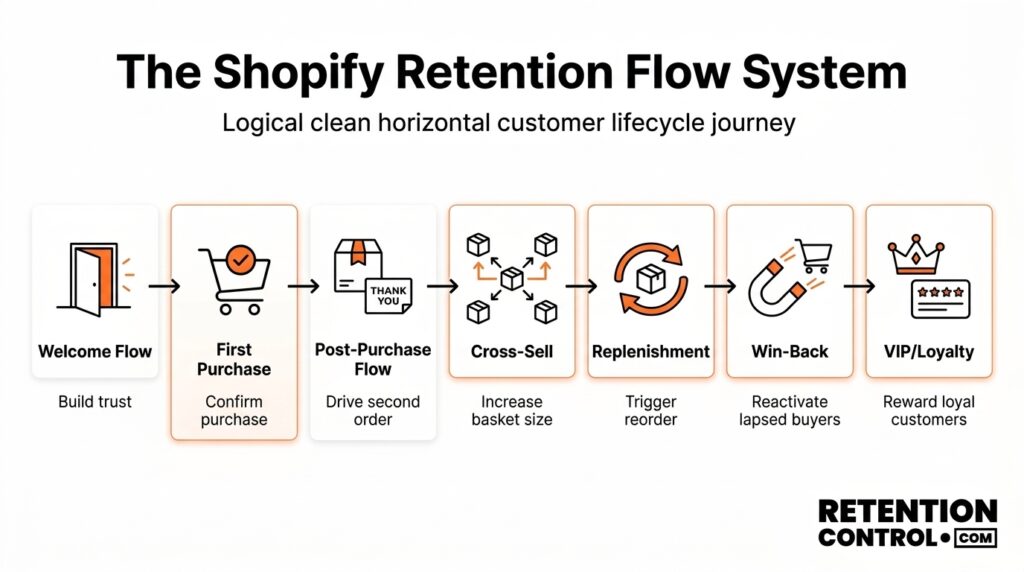
Strategy without execution doesn’t move a retention rate. These are the specific levers, roughly in the order a customer experiences them.
1. A Welcome Series That Does More Than Say Thanks
The first few emails or texts a new subscriber or customer receives set the tone for the entire relationship. A strong welcome series (typically 3–5 messages over the first one to two weeks) introduces your brand story, sets shipping and return expectations, and gently pushes toward that critical second purchase often with a time-limited incentive that rewards fast action rather than one that trains customers to always wait for a discount.
2. Abandoned Cart Recovery
This one is unavoidable: the average documented online shopping cart abandonment rate is 70.22%, based on an analysis of 50 separate studies (Baymard Institute). A three-email abandoned cart flow — a gentle reminder within an hour, a follow-up with social proof or a size/stock reminder at 24 hours, and a final nudge with a modest incentive at 48–72 hours — recovers a meaningful share of that lost revenue without needing a single dollar of new ad spend.
3. Post-Purchase Flows That Start the Next Sale
Most stores stop talking to a customer the moment the order confirmation email goes out. That’s the single biggest missed opportunity in Shopify post-purchase marketing. A post-purchase flow shouldn’t stop at the review request either the next message should consider what the customer actually bought and whether there’s a logical second purchase, rather than sending the same generic newsletter to everyone regardless of purchase history. A complete flow includes shipping updates, a delivery check-in, a review request once the product has had time to be used, and a week or two later that relevant cross-sell. Flow-based emails like these consistently outperform one-off campaigns: they generate close to 41% of total email revenue from just 5.3% of total sends, with revenue per recipient roughly 18 times higher than standalone campaign emails (Klaviyo email marketing benchmarks). Building this out properly is exactly what our ecommerce automation flows guide covers in more depth.
4. Win-Back Campaigns Before Customers Forget You
Shopify win-back campaigns should trigger automatically once a customer passes their typical repurchase window without ordering again — for a 60-day-average product, that might mean triggering at day 75 or 90. The sequence usually works best across two to three touches: the first re-introduces what’s new or reminds them what they loved, without a discount; the second, sent a week or so later if there’s no response, adds an incentive; the third treats them as genuinely at-risk and can include a direct ask for feedback on why they left. Waiting until a customer has been silent for six months to attempt a win-back is usually too late — the further past their normal buying cycle they drift, the colder they get.
5. A Loyalty Program Tied to Real Behavior
Shopify customer loyalty programs work best when the rewards match the RFM segments above rather than treating every customer identically. Points-per-dollar systems are the most common and easiest to understand, but tiered programs (bronze/silver/gold, or similarly named tiers) that unlock better perks as spend increases give your Champions segment a visible reason to keep climbing rather than plateauing once they’ve claimed one reward.
6. Personalization Beyond First-Name Fields
Real personalization uses purchase history, browse behavior, and segment membership to change what a customer sees — not just the greeting at the top of the email. A customer who always buys the same product should get a replenishment reminder timed to when they’ll run out, not the same generic newsletter as someone who’s never purchased that category.
7. Replenishment Automation for Consumables
If your product gets used up — skincare, food, supplements, cleaning products — replenishment flows are close to free revenue. Set a reminder to trigger a few days before the average customer would run out, based on their order history and typical usage rate, and the reorder becomes a one-click decision instead of something they have to remember on their own.
8. Treat VIP Customers Differently, Visibly
Your top 5–10% of customers by CLV should never receive the exact same treatment as a first-time buyer. Early access to new drops, a direct line to support, or surprise perks tied to milestones (their 5th order, their one-year anniversary as a customer) all reinforce that the relationship is being noticed, not just monetized.
If Your Shopify Store Has Low Repeat Purchases, Fix These First
Once all eight strategies above are on the table, the natural next question is what to build first. Launching everything at once usually means nothing gets built well, and it makes it impossible to tell which change actually moved the needle. In rough priority order:
- Tracking and measurement. You can’t fix what you’re not measuring — get retention rate, repeat purchase rate, and CLV visible before anything else.
- Customer segmentation. RFM segments should exist before flows are rebuilt, so every flow that follows is built around real behavior.
- Post-purchase flow. This is usually the biggest single gap, since most stores stop communicating right after checkout.
- Abandoned cart flow. High-impact and fast to build, since the behavior trigger already exists on every Shopify store.
- Win-back flow. Address the customers already at risk of never returning before investing further in acquiring new ones.
- Product-specific replenishment. Only relevant for consumable products, but close to automatic revenue where it applies.
- Email/SMS personalization. Layer in segment-based content once the foundational flows are live.
- Loyalty/VIP strategy. Build this once there’s enough purchase history to know who actually deserves VIP treatment.
- Testing and optimization. The ongoing work that keeps everything above from decaying over time.
The order matters more than the speed. A store that builds tracking, segmentation, and a post-purchase flow properly in month one will outperform a store that rushes a loyalty program and a win-back flow without either.
Where SMS and Email Fit Together
Email marketing remains the backbone of Shopify retention marketing because it supports longer content, richer segmentation, and detailed automation. SMS marketing earns its place for time-sensitive moments — a cart that’s about to expire, a flash restock, a shipping delay update — where open rates and response speed matter more than depth of message. The strongest Shopify email retention strategies use both channels together: email carries the relationship and the story, SMS carries urgency. Tools like Klaviyo remain the most common choice for Shopify brands because they unify email, SMS, and customer data in one place, which is exactly what segmentation and flow automation depend on; if you’re deciding between platforms, our comparison of Omnisend vs. Klaviyo and our broader look at which email marketing services work well with Shopify both go deeper on picking the right stack.
Common Shopify Retention Problems
These patterns show up again and again in stores with a flat or declining repeat purchase rate, and most of them are diagnosable from the audit checklist above:
- Every customer receives the same campaign, regardless of purchase history or segment
- No RFM segmentation exists, so “personalization” is limited to a first-name merge field
- Post-purchase communication ends after the order confirmation email
- Win-back messaging starts too late — often after six months of silence rather than right after the typical repurchase window closes
- Discounts are used as the default fix for every retention problem, training customers to wait for a sale
- No product-specific replenishment automation, even for clearly consumable products
- VIP or top-spend customers are not treated differently from a first-time buyer
- Email and SMS operate as separate, uncoordinated channels instead of one lifecycle strategy
- Flow revenue isn’t monitored separately from campaign revenue, so nobody knows what’s actually working
- Retention isn’t reviewed after the initial build — flows launch once and are never revisited as the business changes
Any one of these is fixable on its own. Most underperforming stores have four or five of them at once, which is usually why a single new tactic — one more email, one more app — doesn’t move the number much.
Should You Manage Shopify Retention In-House or Hire a Specialist?
Once the framework above is clear, the real decision most merchants face is whether to build and run it internally or bring in a specialist. Both are legitimate paths, and the right one depends on internal bandwidth and expertise more than store size. If you decide to bring someone in, our guide to which kind of agency to hire for customer retention matches the agency type to the problem you have.
DIY / in-house typically means:
- Lower direct service cost
- Full internal control over strategy and messaging
- Requires genuine retention strategy expertise, not just familiarity with an email tool
- Requires ongoing testing rather than a one-time setup
- Requires someone with the time to manage and maintain flows as the catalog and customer base change
- Requires analytics and segmentation knowledge to build and interpret RFM segments correctly
Working with a retention specialist typically covers:
- A retention audit against the checklist above
- Strategy development and lifecycle mapping
- RFM and customer segmentation
- Email/SMS flow setup and copywriting
- Klaviyo implementation for Shopify stores or Omnisend implementation, depending on the platform
- Post-purchase strategy
- Win-back campaign design
- Loyalty/VIP strategy
- Ongoing testing
- Reporting and optimization
In-house makes the most sense when a store already has someone with real segmentation and lifecycle marketing experience and the time to maintain it as an ongoing responsibility, not a side project. A specialist tends to make more sense once there’s enough customer data to work with but not enough internal time or expertise to build the system properly and keep testing it — which is often the exact point where a store’s repeat purchase rate has plateaued despite basic flows already being in place.
A 30-60-90 Day Roadmap for Building Real Retention Systems
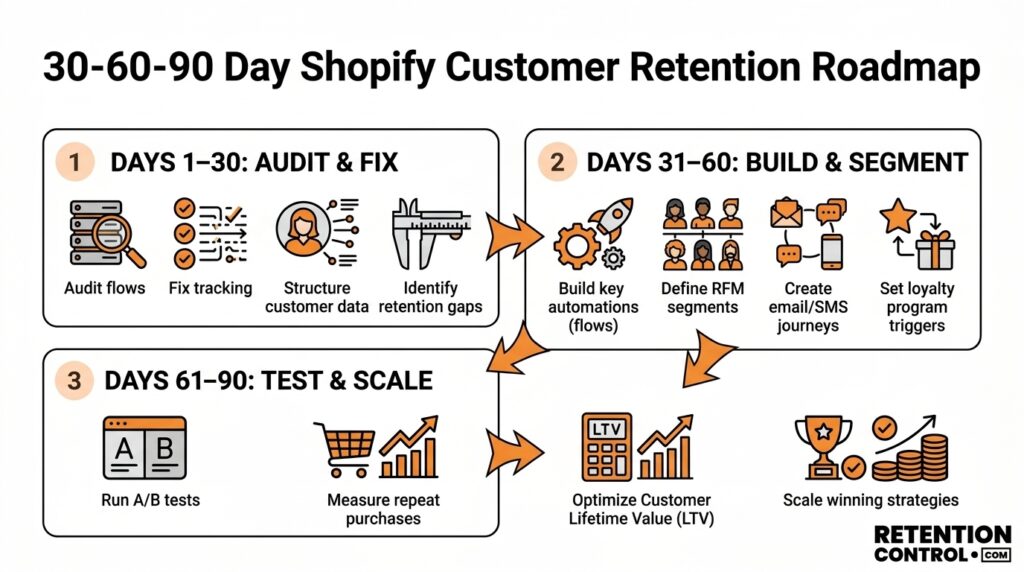
Most guides on this topic list strategies without saying what order to build them in, or how to know if they’re working. Here’s a practical sequence, with what to build and what to measure at each stage:
Days 1–30 — Build: foundational flows (welcome series, abandoned cart recovery, basic post-purchase sequence) plus RFM segmentation across the existing customer list. Days 1–30 — Measure: repeat purchase rate, flow revenue versus campaign revenue, and flow conversion rate. These three flows alone typically produce the fastest, most measurable lift because they’re triggered by behavior that’s already happening every day.
Days 31–60 — Build: win-back campaigns targeted at the “loyal but fading” and “at risk” segments, a loyalty program (new or refined), replenishment flows where applicable, and SMS for the highest-urgency moments. Days 31–60 — Measure: win-back conversion rate, second-purchase rate, and revenue per recipient across flows.
Days 61–90 — Build: VIP treatment for the top segment, deeper personalization based on what the first two months of data show, and a testing plan for offers and timing. Days 61–90 — Measure: CLV, purchase frequency, churn rate, and performance by segment — then set a recurring monthly or quarterly review to keep adjusting as customer behavior shifts.
Shopify Customer Retention Checklist
A practical checklist to work through, whether you’re auditing an existing setup or building one from the ground up:
- Track repeat purchase rate
- Calculate customer lifetime value (CLV)
- Build RFM segments
- Audit existing flows against the checklist above
- Create a welcome series
- Optimize the abandoned cart flow
- Build a post-purchase flow beyond the review request
- Create a win-back flow with a defined trigger point
- Add replenishment automation for consumable products
- Segment email campaigns by RFM group
- Introduce visible VIP treatment for top customers
- Review loyalty program structure and redemption rates
- Connect SMS for time-sensitive moments where appropriate
- Measure revenue generated by flows separately from campaigns
- Test offers and timing rather than setting them once
- Review the full retention system monthly
When to Hire a Shopify Retention Specialist
Specialist help tends to become worthwhile at a specific point: when a store has accumulated enough customer and order history to segment meaningfully, but doesn’t have the internal time, tooling depth, or testing discipline to build and continuously improve the system described in this guide. That point often looks like flat repeat purchase rates despite having basic email flows already running, a marketing team stretched across acquisition and retention with no dedicated owner for the latter, or simply not knowing which of the gaps in the audit checklist above are costing the most repeat revenue. A retention specialist doesn’t replace the need for good products or service — it replaces the internal bandwidth and specialized testing time that a proper lifecycle system requires to keep improving after launch.
Getting Started
There are two reasonable paths from here, and the right one depends on internal time and expertise rather than store size.
If you’re doing it yourself, start in this order: build RFM segmentation first, then the welcome flow, then abandoned cart, then post-purchase, then win-back. These require the least setup relative to their impact and produce the clearest early wins before you invest in loyalty programs or advanced personalization. You can also run your own numbers with a retention ROI calculator to see what a realistic lift in repeat purchase rate would be worth to your store before committing budget to any of it.
If you’d rather bring in a specialist, a retention partner typically handles the audit, strategy development, RFM and customer segmentation, flow architecture, email/SMS implementation, testing, reporting, and the ongoing optimization that keeps performance from decaying after the initial build. That’s the full system described throughout this guide, built and maintained by a team whose only job is retention rather than one more responsibility added to an already full plate.
Need Help Improving Shopify Customer Retention?
Not every store has the internal time to audit the full customer journey, build proper segmentation, architect lifecycle flows, and keep testing and refining all of it month after month — and that’s the gap a specialist retention team is built to close. Rather than adding one more disconnected tactic, the goal is usually to identify where retention is actually leaking, build the specific lifecycle flows that address it, improve segmentation so messaging matches customer behavior, increase the number of realistic repeat-purchase opportunities in the customer journey, reduce how dependent the business is on constant new-customer acquisition, and keep testing and optimizing once the system is live.
Start by auditing where your existing customers are dropping out of the lifecycle. Once those gaps are clear, you can decide whether to build the system internally or bring in Shopify retention marketing services to handle it end-to-end.
Conclusion
Customer retention isn’t a side project you get to once acquisition is “figured out,” and it isn’t one tactic you can bolt on and forget. It’s a system: data feeds segmentation, segmentation shapes the lifecycle plan, the lifecycle plan drives the email and SMS flows, those flows depend on a real post-purchase experience and loyalty structure to keep customers engaged, win-back catches the ones who start to drift, and testing and optimization keep the whole thing from decaying once it’s live. None of the individual pieces are complicated — what separates stores with a strong repeat purchase rate from ones stuck restarting the acquisition treadmill every month is building these pieces in the right order and actually maintaining them.
Some merchants have the internal time and expertise to run this system themselves, and everything in this guide is enough to get started. Others reach a point where bringing in a specialist Shopify retention marketing team makes more sense than stretching an already-stretched internal team even further. Either way, the starting point is the same: know where your customer journey is actually leaking repeat revenue before deciding what to build next.
Frequently Asked Questions
What is a good customer retention rate for a Shopify store?
It depends heavily on your product category. Consumable or replenishable products often see 45% or higher once retention systems are in place, apparel typically lands around 20–30%, and infrequent-purchase categories like furniture or electronics are often under 20%. The more useful benchmark is your own store’s trend over time rather than a fixed industry number.
How do I calculate customer lifetime value for my Shopify store?
The basic formula is Average Order Value × Purchase Frequency × Average Customer Lifespan. For more precise numbers, calculate it by cohort (customers acquired in the same month or quarter) rather than as one blended average, since acquisition channel and timing both affect how long a customer sticks around.
What’s the fastest way to increase repeat purchases on Shopify?
Abandoned cart recovery and post-purchase flows typically produce the fastest measurable results because they’re triggered by behavior that’s already happening every day, need no new traffic, and only require setup once. RFM segmentation is the next fastest lever, since it makes every message you already send more relevant.
Do I need both email and SMS for Shopify retention marketing?
Not strictly, but they serve different purposes. Email handles the bulk of segmentation, storytelling, and automation. SMS is best reserved for urgent, time-sensitive moments like an expiring cart or a restock alert, where speed matters more than message length.
How much should a Shopify store spend on retention marketing?
There’s no fixed percentage that fits every store, but a useful anchor is your CLV: if keeping a customer for one additional purchase cycle is worth $150 in incremental revenue, spending a fraction of that on flows, segmentation, and loyalty perks that reliably produce that extra purchase is close to pure margin. Start with the foundational flows, which have the lowest cost and fastest payback, before investing in more advanced segmentation or a full loyalty platform.
How can a Shopify retention agency help my store?
A Shopify retention specialist can audit the existing customer journey, identify where repeat revenue is being lost, build customer segments based on actual behavior, implement the email and SMS flows that match those segments, improve the post-purchase experience, develop a win-back strategy for lapsing customers, and continuously test and optimize the system rather than leaving it static after launch.
When should a Shopify store hire a retention marketing specialist?
Specialist help tends to become valuable once a store has enough order and customer history to analyze meaningfully but lacks the internal resources, tooling expertise, or ongoing testing capacity to build a full retention system and keep improving it. Stores that already have basic flows live but a flat repeat purchase rate are often at exactly this point.