
A post-purchase email flow is the automated sequence a customer receives after placing an order: delivery updates, help using the product, a review request and, eventually, a relevant next purchase. Among the automated flows that make up a retention programme, it has the shortest distance between effort and result, because you are not persuading a stranger. You are talking to someone who has already said yes.
The week after someone buys from you for the first time is the most attentive they will ever be. They are checking tracking and opening your emails at rates the rest of your programme will never see. Most brands spend that window on an order confirmation and a shipping notification, then go quiet for six weeks.
- The second order is won in the week after the first, not months later in a win-back email.
- Answer delivery anxiety before it becomes a support ticket.
- Ask for the review after use, not after delivery.
- Cross-sell once the product has proven itself, with the item that makes the first purchase better.
- Give the flow an end, then hand over to replenishment.
Delivery anxiety, and what it costs you
Between “order confirmed” and “parcel arrived” there is a gap, and in that gap your customer has one question: is this actually coming? If you do not answer it, they will ask you directly. “Where is my order?” messages are among the least valuable support conversations you will ever handle, and a proactive email prevents most of them.
Answering it costs one or two messages. Tell them it has been packed, tell them when it shipped, tell them roughly when it will land and what to do if it does not. The tone matters more than the content: this is the first operational promise you have made to this person, and keeping it visibly is how a first purchase becomes a relationship.
There is a second reason to care. A customer who spent the delivery window anxious does not remember the product fondly, even if it arrived on time. Delivery anxiety is a retention problem dressed as a logistics problem.
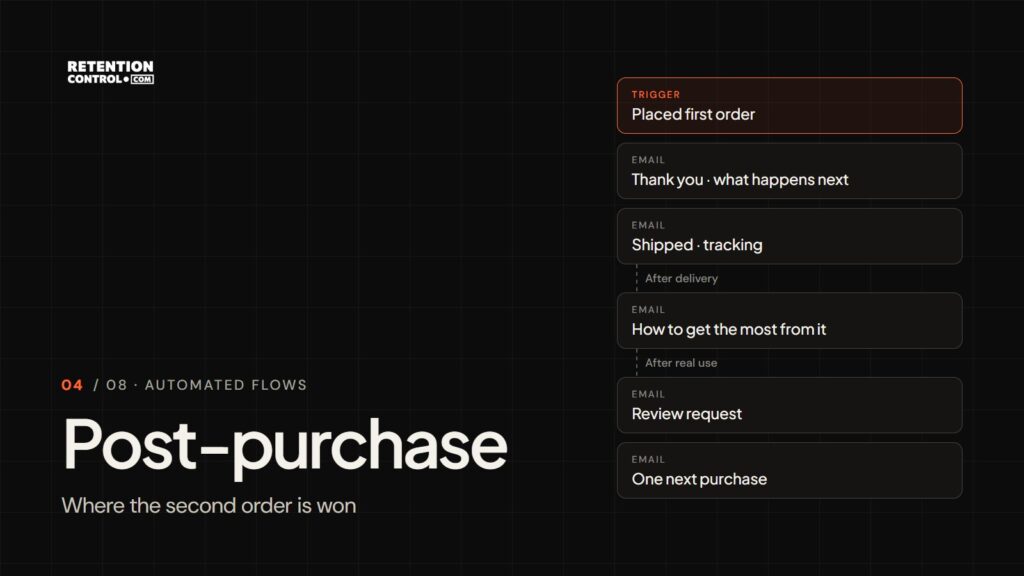
The sequence, email by email
| When | Its job | |
|---|---|---|
| Thank you | Straight after the order, first-time buyers only | Confirm the order, set delivery expectations, say who you are in two lines |
| Shipped | When the order is fulfilled | Tracking link, delivery estimate, what to do if it is late |
| Get the most from it | 1 to 3 days after the expected delivery | How to use, store or wear it; the mistake most new customers make |
| Review request | Once the product has had time to work (see below) | One clear ask, one click to leave a review |
| Next purchase | After the review request, and only once | The item that makes the first purchase better |
Repeat customers do not need the full sequence. They already know how delivery works and how to use the product. Give them the shipping update and the review request, and skip the rest.
When to ask for the review
Almost every review request is sent too early, because it is triggered by delivery. Delivery is not the moment the customer has an opinion. Use is.
So the rule is delivery plus however long it genuinely takes to form a view of the product. As starting points:
| Product type | Ask for the review |
|---|---|
| Used daily and judged quickly (coffee, snacks, basics) | 5 to 7 days after delivery |
| Apparel and footwear | 7 to 10 days after delivery, after a few wears |
| Skincare and haircare | 2 to 4 weeks after delivery, once results can show |
| Supplements | 3 to 4 weeks after delivery |
| Durable goods (furniture, cookware, equipment) | 2 to 4 weeks after delivery |
Getting this wrong is not neutral. You have one credible ask, and spending it before the customer has anything to say buys you a thin review about the packaging and closes the door on the good one.
The complementary product, timed properly
The cross-sell is the part everybody wants to build first and should build last.
It does not belong in the order confirmation. The confirmation is a receipt; it gets opened at extraordinary rates precisely because it is useful, and filling it with product grids is how that stops being true.
It belongs after the product has proven itself, once they have used it and it worked. And it should be the item that makes the first purchase better, not the item with the best margin. If someone bought the coffee, the follow-up is the grinder or the subscription, not the unrelated bestseller. The test: would this recommendation make sense coming from a person who knew what they had just bought?
Where post-purchase ends and replenishment begins
Post-purchase is a finite sequence, not a permanent state. It covers delivery, use, the review and one relevant recommendation, then it stops.
Replenishment picks up later, timed against how long the product actually lasts. The two should never overlap, and the gap between them is normal. A customer does not need to hear from your automations every week to remember you exist.
The common failure is a post-purchase flow that never ends and slowly turns into a newsletter nobody subscribed to. Set the exit condition when you build it, not when someone complains.
Four mistakes that cost the second order
Two tracking emails. Shopify sends its own shipping confirmation. If your email platform sends one too, the customer gets both, and the brand looks disorganised at the exact moment it is trying to look reliable. Choose one source and switch the other off.
The review request on delivery day. It produces reviews about packaging and speed, and it uses up the one ask you had. Time it to use, not arrival.
A product grid in the order confirmation. The confirmation is opened because it is useful. Turn it into a catalogue and it stops being opened, which costs you the delivery emails that follow.
The same sequence for every buyer. A customer on their fifth order does not need to be told how to use the product or who you are. Treating them like a stranger is a small signal that you are not paying attention.
Post-purchase email examples
The subject lines that work here are plain and useful, because the customer is looking for information, not persuasion:
- Thank you: “Your order is confirmed. Here is what happens next”
- Shipped: “It is on the way: arriving Thursday”
- Get the most from it: “Three things to know before your first use”
- Review: “Two weeks in: how is it working?”
- Next purchase: “The one thing that makes your grinder better”
Notice what they have in common: each tells the customer exactly what is inside, and none of them sells until the last one.
How to build it in Klaviyo
- Trigger: Placed Order from the Shopify integration.
- Conditional split: Placed Order equals 1 over all time. First-time buyers go down the full branch; repeat buyers get the short one.
- Shipping step: a separate flow on Fulfilled Order for the shipped email, or leave shipping to Shopify’s own notifications. Do one or the other, never both, or customers get two tracking emails.
- Time delays from delivery, not order: if your tracking app sends a delivery event into Klaviyo, trigger the use and review emails from it; otherwise estimate from your average delivery time.
- Review request: use your review platform’s own flow or its Klaviyo integration so the review link is one click.
- Exit: end the flow after the next-purchase email. Replenishment and win-back are separate flows with their own triggers.
How to judge it
- Repeat purchase rate at 60 and 90 days for first-time buyers who went through the flow. This is the number the flow exists to move.
- Revenue per recipient. Klaviyo publishes post-purchase benchmarks by revenue band and average order value: for a brand turning over $5 to 20 million with an average order value above $291, the benchmark runs from $1.01 revenue per recipient at the 25th percentile to $6.77 at the 75th.
- Review collection rate from the review email.
- “Where is my order?” contacts per 100 orders, before and after the shipping emails go live.
Where to go next
Before the order there is the cart abandonment flow, which gets the customer to checkout. After post-purchase ends, replenishment takes over, timed against how long the product lasts.
If your post-purchase sequence is currently a confirmation and a shipping notice, that is the cheapest gap in your account to close. Book a free 60-minute audit and we will map what should sit in that window for your catalogue, or see our ecommerce retention programme.