
A VIP customer flow is the automated sequence that recognises and rewards your best customers once they qualify for a top tier, usually with early access, perks and a more personal tone. It is the most commercially important of the automated flows a DTC brand runs for margin, because it is the one most likely to give margin away for nothing.
A small group of your customers accounts for a disproportionate share of your revenue. You know this. What most brands do about it is send that group the same promotions as everybody else, with a slightly larger discount attached. That is backwards. Deep discounting your most loyal customers is the one place in the whole flow stack where you actively pay to reduce your margin on people who were going to buy anyway. What this group responds to is access, and access is free.
- Define the tier on frequency and recency first, with spend as the tiebreak, and put a time limit on it.
- Keep it selective. If a third of your list is VIP, none of it is.
- Say why they qualified. Specific recognition reads as earned; generic recognition reads as a mail merge.
- Reward with access, not depth of discount: early launches, restocks, standing perks.
- Your VIPs are also your fastest read on a new product and your best source of reviews.
Defining the top tier
You can rank customers by how much they have spent, how often they buy, or how recently. Each gives a different list, and the differences matter.
| Signal | What it finds | The trap |
|---|---|---|
| Total spend | High-value orders | The one-off big spender who bought 18 months ago and never returned |
| Frequency | Habitual buyers | Low-value regulars can outnumber everyone else |
| Recency | Currently active customers | On its own it rewards anyone who bought last week |
Frequency is usually the better single signal for retention work, because habit is what you are trying to reinforce. Someone who buys modestly but consistently is more predictable and more likely to respond than a one-off big spender. In practice you want frequency and recency together, with spend as a tiebreak: customers who buy often, bought recently, and are worth something.
Whatever you choose, give it a time window and write the rule down. Klaviyo’s own VIP segment guide makes the same point: without a time restriction, a VIP segment fills up with customers who are inactive or who have simply been around a long time. If you want to rank customers by value over time rather than by single orders, our guide to customer lifetime value on Shopify covers how to calculate it.
Recognition that feels earned
Being told you are a VIP by an automated email is not flattering if nothing explains why. It reads as a mail merge, and worse, as a mail merge everybody got.
So say the reason. Reference the actual behaviour: that they have been buying for two years, that they are one of a small number of people who have bought every release in a range, that they were among the first to order something new. Specificity is what separates recognition from flattery, and your data already contains the specifics.
The corollary is that the tier has to be genuinely selective. Somewhere around the top 5 to 10% of customers by your chosen rule is a sensible starting point for most catalogues.
Why early access beats a bigger discount
Sell out of something and your general list is disappointed. Your VIPs, if you handled them right, are not, because they got first refusal and either took it or chose not to.
That is the practical case for early access. Giving a small, loyal group a head start on a launch or a restock costs no margin, moves stock faster, and removes their scarcity risk rather than lowering the price. It also makes the VIP segment a genuinely useful commercial instrument: the fastest read you have on whether a new product will land. The same group is your restock waitlist, your review source, and the people worth asking before you change something.
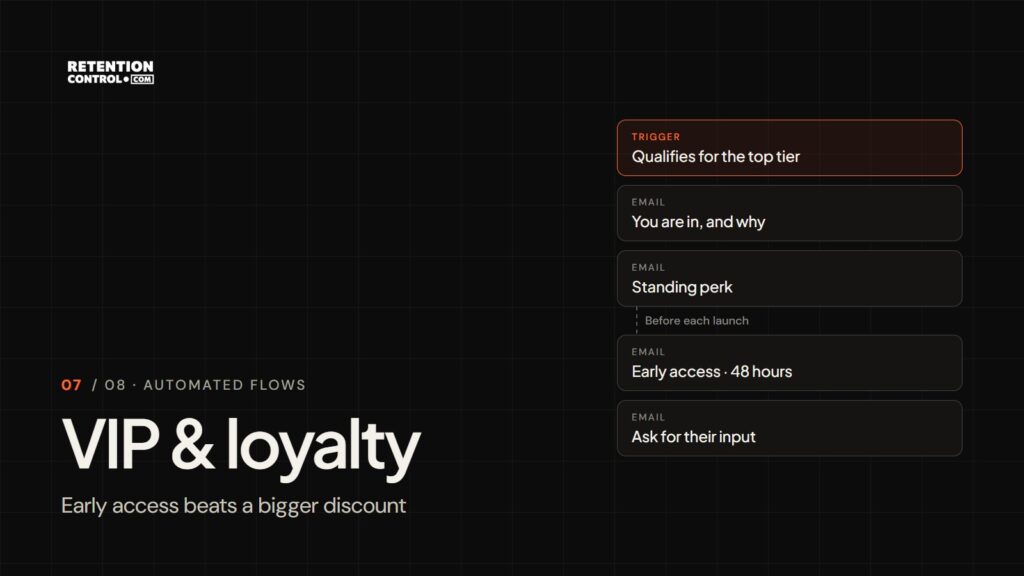
The flow, step by step
| Step | When | What it does |
|---|---|---|
| Entry email | The day a customer qualifies | Tells them they are in, says exactly why, and explains what it means |
| Standing perks | In the entry email | Free shipping, free returns or a named contact, whichever suits your economics |
| Early access | Before each launch or restock | 24 to 48 hours ahead of everyone else, sent to the VIP segment only |
| Ask for input | Once or twice a year | A short question about what to make next |
| Tier check | Monthly | Customers who stop qualifying leave quietly; no “you have been downgraded” email |
Loyalty programmes that are not points
Points schemes are the default and they are often a poor deal. They create a liability on your balance sheet, train customers to value the currency rather than the product, and in many catalogues change very little about behaviour. Things that tend to work better and cost less:
- Early access to launches and restocks, as above.
- Free shipping or free returns as a standing perk: it removes friction on every order rather than paying out once.
- A real person to contact, where order values justify it. For higher-ticket brands, a named person to email outperforms any automation in this post.
- Being asked. Input on what you make next is valued by people who already like what you make, and it costs an email.
None of these needs a platform, a points balance, or a tier name with a metal in it.
VIP email examples
What these have in common is specificity: each one could only have been sent to this customer.
- Entry into the tier: “You have ordered from us 11 times since 2024. That puts you in a small group”, followed by what the tier gives them.
- Early access: “The autumn range opens to you tomorrow, 48 hours before anyone else”, sent the day before the launch.
- Restock first refusal: “The olive jacket is back. You are first in line until Friday.”
- Being asked: “We are choosing next year’s colours. Which three would you pick?”
- A real person: “I look after our longest-standing customers. If anything is ever wrong, reply to this email and it comes to me.”
None of them contains a discount code, and none of them needs one.
How to build it in Klaviyo
- Segment: Placed Order at least N times in the last 365 days and Placed Order at least once in the last 90 days, with N set a little above your average orders per customer per year. Add a revenue condition as the tiebreak if needed.
- Trigger: a segment-triggered flow, so customers enter the day they qualify.
- Entry email: personalised with the behaviour that qualified them (order count, first order date, the range they buy most).
- Perk: tag the profile so your store or loyalty app applies the free-shipping or free-returns benefit automatically.
- Early access: send launch and restock campaigns to the VIP segment first, 24 to 48 hours ahead of the main list.
If your account has Klaviyo’s predictive analytics, historic and predicted customer lifetime value are available as segment conditions, which is a better tiebreak than raw spend.
How to judge it
- Retention of the VIP segment: the share still ordering 6 and 12 months later, compared with customers just below the threshold.
- Launch sell-through in the early-access window.
- Discount cost per VIP order: it should fall once access replaces deeper codes.
Where to go next
The VIP flow sits alongside win-back, which handles customers at the other end of the curve, and it starts, like every relationship in this series, with the welcome flow.
If you have never formally segmented your best customers, and most brands we audit have not, it is usually the fastest win available in the account. Book a free 60-minute audit, or see our work on DTC retention, subscriptions and VIP tiers.