
Most Klaviyo accounts don’t fail all at once. They drift. A welcome series built three years ago keeps running with an expired offer. A second abandoned-cart flow gets added during a busy season and quietly competes with the first. Segments multiply until nobody remembers which one campaigns should go to. Revenue still comes in, so nothing looks broken, but the account is earning less than it should.
A Klaviyo audit is how you find that gap. It’s a structured review of your account’s data, flows, segments, campaigns, deliverability, and reporting. The goal is to find what’s costing you revenue, what’s putting your sender reputation at risk, and what to fix first. This guide walks through the same framework an experienced lifecycle team uses, so you can run a useful self-audit or know what to expect from a professional one.
Key Takeaways
What is a Klaviyo audit? A Klaviyo audit is a systematic review of a Klaviyo account to evaluate its data quality, automation, segmentation, campaigns, deliverability, and revenue contribution, and to produce a prioritized list of improvements.
What does a Klaviyo audit check? It checks integrations and data, flow triggers and logic, segment definitions, campaign strategy and frequency, deliverability and authentication, signup forms, email content, revenue attribution, and testing practices.
What are the most important areas to audit? For most ecommerce brands, the highest-impact areas are core flows (welcome, abandoned cart, browse abandonment, post-purchase, win-back), deliverability health, and segmentation, because problems there affect every message you send.
How often should a Klaviyo account be audited? Key metrics should be monitored continuously. A full strategic audit is usually worth doing at least once or twice a year, and also after a migration, an ownership change, a deliverability drop, or before a major sales period.
What should a professional audit identify? Revenue leaks, broken or conflicting automation, missing lifecycle stages, deliverability risks, data problems, and gaps between attributed revenue and real retention performance.
What happens after an audit? The findings are ranked by impact and effort and turned into an action plan, usually starting with high-impact, low-effort fixes.
What Is a Klaviyo Audit?
A Klaviyo audit is a structured assessment of how well your Klaviyo account supports your retention goals. It looks at the technical foundation (integrations, events, profile data), the automation layer (flows and their logic), the audience layer (segments and suppression), and the performance layer (campaigns, deliverability, revenue, and testing).
A Klaviyo email audit is different from a quick performance check. A performance check tells you that a flow’s revenue dropped. An audit tells you why. Maybe a flow filter is excluding the wrong people, the trigger event stopped firing after a theme update, or the flow is overlapping with a campaign and Smart Sending is suppressing messages. A good audit connects what you see in the numbers to what’s actually happening in the setup.
Why Should You Audit Your Klaviyo Account?
Email and SMS are some of the few channels an ecommerce brand fully controls, and they usually drive repeat purchases. Small problems compound because they affect every send. A misconfigured segment doesn’t only hurt one campaign. It can lower engagement across the account, which affects how mailbox providers treat all your mail.
Audits also correct a common blind spot: assuming that strong metrics mean strong performance. A welcome series can have excellent open rates and still convert poorly because the offer, product mix, or follow-up is weak. An abandoned-cart flow can generate a lot of attributed revenue while sending three nearly identical reminders. An audit separates activity from impact, which is the starting point for any serious retention marketing strategy.
The Complete Klaviyo Audit Checklist
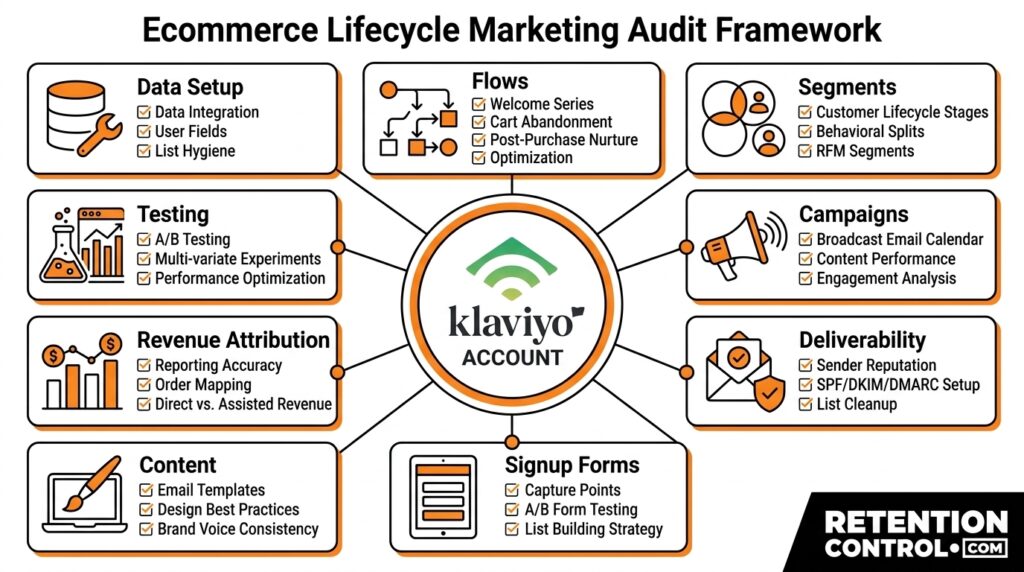
The nine areas below make up a complete Klaviyo account audit. Work through them in order if you can. Data problems in step one often explain issues you’ll find later in flows, segments, and reporting.
1. Account and Data Setup
Everything in Klaviyo depends on data. If your Shopify (or other ecommerce platform) integration isn’t syncing correctly, events like Viewed Product, Added to Cart, Started Checkout, and Placed Order may be missing or delayed. Flows triggered by those events will underperform, and segments built on them will be wrong.
Start by confirming your integrations are active and that key metrics are recording recent activity. Check that onsite tracking is installed, so browse abandonment and identified-visitor tracking work. Review profile properties for consistency. If one form saves “Birthday” and another saves “birthday_date,” you’ve created two data points where you need one. Check that your product catalog syncs with accurate images, prices, and URLs, because dynamic product blocks in emails rely on it. Finally, look at naming conventions. Clear names for flows, segments, and campaigns aren’t cosmetic. They’re what lets a team manage the account without breaking things.
2. Klaviyo Flow Audit
Flows usually produce a large share of an ecommerce brand’s email revenue, because they reach people at moments of high intent. A Klaviyo flow audit reviews each automation on its own and then as a system. For every flow, look at the trigger (what starts it), the flow filters (who’s allowed to stay in it), timing between messages, the number of messages, content and personalization, conditional splits (branches based on profile data or behavior), the CTA, engagement, attributed revenue, suppression rules, and exit conditions.
Not every brand needs every flow. A replenishment flow makes sense for skincare or supplements and makes little sense for furniture. A back-in-stock flow matters if you regularly sell out, and it’s unnecessary if you rarely do. The audit question isn’t “Do we have every flow on a list?” It’s “Does our flow setup cover the lifecycle stages that matter for how our customers buy?” Our guide to automated flows for DTC brands covers how to choose flows based on your business model.
3. Segmentation Audit
Segments decide who gets which campaigns, and they shape deliverability more than most teams realize. A segmentation audit checks whether your core segments are defined well and actually used. These usually include engaged subscribers, first-time customers, repeat customers, VIP or high-value customers, recent purchasers, lapsed customers, and product or category purchasers.
The common problem isn’t too few segments. It’s too many that overlap. When a brand has forty segments and campaigns go to a different mix every week, it’s hard to control frequency or learn anything from results. Strong segmentation reflects real customer behavior: how recently someone engaged or bought, how often, how much they spend, and what they buy. It doesn’t need to be complicated, but it does need to be clear.
4. Campaign Audit
A Klaviyo campaign audit looks at your one-off sends: strategy, frequency, audience selection, subject lines and preview text, creative, offers, CTAs, mobile experience, revenue, and testing. The key question is whether campaigns follow a plan or are simply sent because it’s Tuesday.
Campaign and flow performance should be judged differently. Flows reach people at a moment they chose, such as signing up or leaving a cart, so they usually convert better per recipient. Campaigns reach people on your schedule, so they depend more on audience selection, offer relevance, and frequency. Comparing a campaign directly to an abandoned-cart flow is unfair to the campaign. A better comparison is campaigns against each other over time, and against the same audience.
5. Deliverability Audit
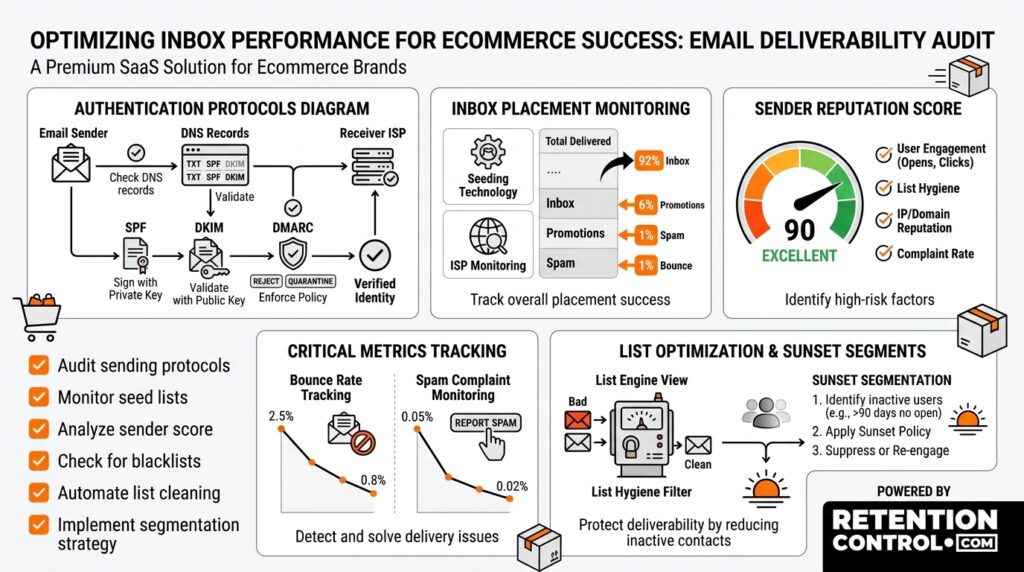
If your emails don’t reach the inbox, nothing else in the audit matters. A Klaviyo deliverability audit reviews authentication, sending domain setup, list quality, engagement, bounces, spam complaints, and how unengaged profiles are handled.
Start with authentication. Google’s email sender guidelines require bulk senders to authenticate with SPF, DKIM, and DMARC, support one-click unsubscribe, and keep spam rates low. Klaviyo’s guide to setting up a branded sending domain explains how to send from your own domain so your reputation stays tied to your brand. Next, review Klaviyo’s deliverability best practices against how you actually send. Are you regularly mailing people who haven’t opened or clicked in a long time? Is there a sunset process for unengaged profiles? Are bounces and complaints trending up? Deliverability problems usually build slowly, so trends matter more than any single send.
6. Signup Form and List Growth Audit
List quality is decided at signup. A form that offers a large discount to every visitor in the first two seconds can grow your list fast and fill it with people who only wanted a code. That affects engagement, deliverability, and campaign revenue for months.
Review popup timing and triggers, the offer, form design on mobile, how many fields you ask for, whether consent language is clear for both email and SMS, and whether each form is connected to the right welcome flow. Check source tracking too. If you can’t tell which forms bring in buyers versus browsers, you can’t improve acquisition quality. Klaviyo reports revenue metrics for sign-up forms, which helps you judge forms by downstream value, not only submission rate.
7. Email Content and Conversion Audit
Good email design isn’t only about looking good. It’s about making the next action obvious. A content audit reviews subject lines, preview text, visual hierarchy, copy, product presentation, CTA clarity, personalization, social proof, offer positioning, mobile readability, and brand consistency.
Look at your emails on a phone first, because that’s where many of your subscribers will see them. Is the main CTA visible without scrolling? Does the email answer one clear question, such as “Why should I come back for this cart?”, or does it try to do five things? Is personalization meaningful, like recommending products related to past purchases, or just a first name in the subject line? Small content changes rarely transform results alone, but across every flow and campaign they add up.
8. Revenue and Attribution Audit
This is where a lot of accounts mislead their owners. Klaviyo attributes a conversion to a message when a recipient places an order within a set window after opening, clicking, or receiving it, depending on your settings. Klaviyo’s guide to understanding message attribution explains how this works, and you can change your attribution model to match your reporting needs.
Attributed revenue is not the same as incremental revenue. A loyal customer who was going to buy anyway may open a campaign and then place an order, and Klaviyo will credit that order to the email. That doesn’t mean the email caused the sale. A Klaviyo revenue audit looks at flow revenue, campaign revenue, revenue per recipient, conversion, and trends over time, and asks how much of it the messaging actually influenced. Holdout tests, where a small group doesn’t receive a message, are the clearest way to measure real lift for important flows.
Open rates need care too. Apple Mail Privacy Protection can inflate opens, which is why clicks, conversions, and revenue per recipient are usually more reliable signals of engagement. Klaviyo also documents how it handles bot clicks, which can distort click metrics if you aren’t aware of them.
9. Testing and Optimization Audit
Many accounts run A/B tests. Fewer learn from them. A testing audit checks whether you’re testing subject lines, content, offers, CTAs, send timing, segmentation, and flow logic, and whether each test started with a hypothesis.
“Test two subject lines” isn’t a hypothesis. “Abandoned-cart recipients will convert better if the second message leads with reviews instead of a discount, because our product needs trust more than a price cut” is one. A clear hypothesis tells you what you learned even when the test loses. Also check that tests run long enough and on large enough audiences to mean something. Declaring a winner after a few hundred sends often produces conclusions that don’t hold.
Klaviyo Flow Audit: What to Check in Every Major Flow
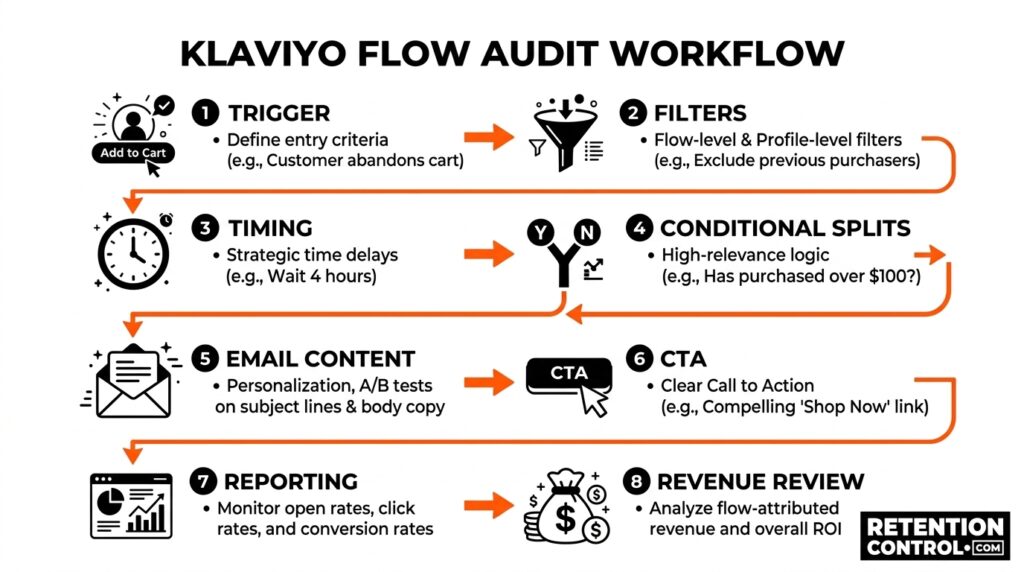
Each flow has a job, and each tends to fail in its own way. Use the table below as a starting point for your flows audit.
| Flow | What to Review | Common Issue | Business Impact |
|---|---|---|---|
| Welcome series | Trigger by form source, offer delivery, sequence length, purchaser exit filter | Keeps sending discount reminders after the subscriber has already bought | Wasted margin and poor first impression |
| Abandoned cart | Trigger (Started Checkout vs. Added to Cart), timing, dynamic product blocks, exit on purchase | Repetitive messages with no new reason to return | Lost recovery revenue |
| Browse abandonment | Product view trigger, frequency filters, overlap with cart flow | Fires too often for frequent browsers | Fatigue and unsubscribes |
| Post-purchase / thank-you | First-time vs. repeat buyer splits, onboarding content, cross-sell timing | Generic message with no path to a second order | Weak repeat purchase rate |
| Product review | Timing relative to delivery, product-specific requests | Asks for a review before the product arrives | Low review volume, frustrated customers |
| Cross-sell / upsell | Product logic, catalog relevance, timing | Recommends unrelated or already-purchased items | Missed AOV growth |
| Replenishment | Timing based on product usage cycle | One fixed delay for every product | Reorders lost to competitors |
| Win-back | Lapse definition, offer escalation, sunset logic | Targets every inactive profile, including people who never bought | Deliverability risk, wasted discounts |
| Back-in-stock | Subscription trigger, inventory sync | Notifications go out late or for the wrong variant | Lost demand on popular products |
| Price drop | Trigger logic, product eligibility | Fires on minor price changes | Low relevance, wasted sends |
Flows also interact with each other. A shopper might qualify for browse abandonment, abandoned cart, and a campaign on the same day. Klaviyo’s Smart Sending prevents a profile from getting too many messages within a set window, but if your flows aren’t designed with priority in mind, Smart Sending may block a high-value cart reminder in favor of a lower-value message. Klaviyo’s guidance on optimizing flow sending frequency is a useful reference when reviewing overlap.
Klaviyo Audit Checklist Table
Use this Klaviyo audit checklist to plan the review and decide where to look first.
| Audit Area | What to Check | Why It Matters | Priority |
|---|---|---|---|
| Account/data | Integrations, event tracking, profile properties, catalog sync | Bad data breaks segmentation, personalization, and reporting | High |
| Flows | Triggers, filters, timing, splits, exit logic, revenue | Flows drive much of email revenue | High |
| Segments | Definitions, overlap, engagement-based segments | Determines who receives what, and affects deliverability | High |
| Campaigns | Strategy, frequency, audience, creative, offers | Shapes engagement and revenue between automated touches | Medium–High |
| Deliverability | Authentication, sending domain, bounces, complaints, sunset | Inbox placement affects every message | High |
| Signup forms | Timing, offer, mobile UX, consent, source tracking | Acquisition quality affects long-term list health | Medium |
| Content | Hierarchy, CTA, mobile readability, personalization | Determines whether opens become clicks and orders | Medium |
| Revenue | Attribution settings, revenue per recipient, trends | Prevents decisions based on misleading numbers | Medium–High |
| Testing | Hypotheses, sample size, documentation | Turns sends into learning | Medium |
What Does a Healthy Klaviyo Account Look Like?
There’s no single perfect Klaviyo setup. A subscription supplement brand and a high-ticket furniture brand should look very different. Healthy accounts do tend to share some traits, though.
The data is clean and consistent, so segments and personalization work as intended. The flow architecture makes sense: each flow has a clear job, filters prevent overlap, and a customer’s journey from signup to repeat purchase is covered without gaps or duplicates. Segments are few, clear, and tied to customer behavior. Sending is controlled, with frequency and audience decisions based on engagement, not habit.
Reporting is clear enough that the team knows what’s working and why. Testing is deliberate. Deliverability hygiene is routine, with authentication in place and unengaged profiles managed rather than ignored. Someone owns the account and documents changes, and the account is reviewed and improved regularly instead of being left to drift.
Performance still depends on your context. Industry, average order value, product type, purchase cycle, list size, sending frequency, seasonality, brand maturity, traffic sources, and offer structure all affect what “good” looks like. Compare your account mainly against its own history and close peers, not against a universal benchmark. Klaviyo’s in-app benchmarks can help with peer comparison.
DIY Klaviyo Audit vs. Professional Klaviyo Audit
A self-audit is useful. With this email audit checklist, a marketing manager can find many obvious problems: a broken flow, an outdated offer, a missing sunset segment, an unauthenticated domain. For smaller accounts with a simple setup, a careful DIY review may be all you need.
A professional audit goes deeper in ways that are hard to do from the inside. It connects issues across the account, such as how a segment definition affects deliverability, which then affects flow revenue. It reviews the architecture, not only individual flows. It looks for revenue opportunities your team may not be aware of, assesses deliverability risk before it becomes a crisis, checks data quality at the event level, ties email performance to retention goals like repeat purchase rate and customer lifetime value, and ends with a prioritized roadmap.
DIY makes sense when the account is small, the team has time, and the goal is housekeeping. A professional audit makes more sense when the account is complex, revenue has stalled without a clear reason, or the team is too close to the setup to see it objectively. If that sounds familiar, a professional Klaviyo audit gives you an outside review with clear priorities.
How Often Should You Audit Klaviyo?
Monitor key metrics continuously, and run a full strategic Klaviyo account audit periodically. For many brands, that means a full review once or twice a year. Higher-volume or fast-changing accounts often benefit from quarterly reviews.
The right frequency depends on account size, sending volume, how many flows you run, how fast the business is growing, and how often things change. Some events justify an immediate audit regardless of schedule: migrating to Klaviyo from another platform, changing ecommerce platforms or themes, a noticeable drop in deliverability or revenue, a new team taking over the account, or preparing for a major sales period like Black Friday and Cyber Monday. If BFCM is on your calendar, our BFCM 2026 planning guide covers what to have ready before peak season.
When Should You Get a Klaviyo Audit?
Some situations call for an audit sooner rather than later. Email revenue has plateaued or declined, and nobody can explain why. Flows haven’t been reviewed in a year or more. The brand recently migrated to Klaviyo and the old setup was copied over without being rethought. A new marketing lead or agency inherited the account. Open, click, or inbox placement trends are getting worse. Segmentation has become messy, or many flows are live but undocumented. Campaigns go out without a clear strategy. Or the brand is preparing for a big sales period and wants to scale retention revenue with confidence.
Any one of these is a reasonable trigger. Several at once usually means the account has drifted far enough that a structured review will pay for itself in clarity alone.
What Does a Professional Klaviyo Audit Include?
A professional Klaviyo audit service should cover every area in the checklist above, plus the analysis that connects them. You should expect a review of integrations and data, a flow-by-flow assessment, a segmentation review, campaign analysis, a deliverability check, a revenue and attribution review, and a list of opportunities ranked by impact and effort.
The most valuable part is usually the action plan, not the list of problems. An audit that hands you sixty findings with no order of priority is hard to act on. A good one tells you what to fix this week, what to plan for this quarter, and what can wait.
How a Professional Klaviyo Audit Works
A professional audit usually follows a clear sequence.
Step 1: Account access and discovery. The auditor gets access to the account and learns the business: products, customers, margins, goals, and current concerns.
Step 2: Data and integration review. Integrations, events, profile properties, and catalog data are checked for accuracy and completeness.
Step 3: Flow audit. Each flow is reviewed for trigger, logic, timing, content, and performance, and the flows are reviewed as a system for gaps and overlap.
Step 4: Segmentation review. Segment definitions, overlap, and usage are evaluated against customer behavior.
Step 5: Campaign analysis. Campaign strategy, frequency, audience choices, content, and performance trends are reviewed.
Step 6: Deliverability review. Authentication, sending domain, list hygiene, engagement, and complaint and bounce trends are assessed.
Step 7: Revenue and attribution analysis. Attributed revenue is examined by flow and campaign, with attention to what may not be incremental.
Step 8: Opportunity identification. Gaps in lifecycle coverage and missed revenue opportunities are documented.
Step 9: Prioritization. Each finding is scored by impact and effort.
Step 10: Action plan. Findings become a sequenced roadmap the team can implement.
How to Prioritize Findings From a Klaviyo Audit
Most audits find more issues than any team can fix at once. Prioritization keeps the audit from becoming a document nobody uses. Score each finding by likely impact and the effort needed to fix it. High-impact, low-effort fixes usually come first, because they deliver value quickly and build momentum for bigger changes.
| Finding | Impact | Effort | Priority |
|---|---|---|---|
| Abandoned-cart flow doesn’t exit when a customer purchases | High | Low | Fix immediately |
| Sending domain not branded or authenticated | High | Low–Medium | Fix immediately |
| No sunset process for unengaged profiles | High | Medium | High |
| Welcome flow has no split for purchasers vs. non-purchasers | Medium–High | Low | High |
| Post-purchase flow has no cross-sell path | Medium–High | Medium | Plan this quarter |
| Overlapping segments used inconsistently in campaigns | Medium | Medium | Plan this quarter |
| Inconsistent naming conventions | Low–Medium | Low | Quick housekeeping |
| Full email template redesign | Medium | High | Later phase |
Your own scoring will depend on your business. A brand with a deliverability problem should move list hygiene to the top, even if it takes more work.
Common Klaviyo Audit Mistakes
The most common mistake is auditing only what’s visible. Teams review flow emails for typos and design but never check triggers, filters, or exit conditions, which is where many revenue leaks live. The second is judging flows by open rate. High opens with weak clicks and conversions usually point to a content or offer problem, not a success.
Other mistakes are trusting attributed revenue as if it were incremental, auditing flows one by one without looking at how they overlap, ignoring deliverability until performance drops, and producing a long list of findings with no priority order. Finally, many teams audit once and never follow up. An audit is useful only if changes are made and measured afterward.
How a Klaviyo Audit Can Improve Retention Marketing
A Klaviyo audit isn’t only about email. It’s about how well your brand keeps customers. Flows determine whether a first-time buyer gets a reason to come back. Segmentation determines whether a VIP is treated differently from a one-time discount shopper. Deliverability determines whether any of it gets seen. Attribution determines whether you’re investing in what actually works.
When those pieces fit together, email and SMS work as one lifecycle system instead of a collection of separate sends. That’s the point where email retention marketing and SMS retention marketing start supporting each other, with SMS used for time-sensitive, high-intent moments and email for depth, education, and merchandising. If SMS runs through Klaviyo, the audit should cover consent, frequency, and how SMS and email messages coordinate in shared flows.
Get a Professional Klaviyo Audit
If you’d rather have an experienced team review your account systematically than check flows one at a time, Retention Control’s Klaviyo audit service covers your data setup, flows, segmentation, campaigns, deliverability, and attribution, and ends with a prioritized action plan. Retention Control is a lifecycle and ecommerce retention marketing agency, so findings are framed around repeat purchases and customer value, not only email metrics. Teams that want ongoing help after the audit can also explore our broader Klaviyo services.
Frequently Asked Questions
What is a Klaviyo audit?
A Klaviyo audit is a structured review of a Klaviyo account’s data, flows, segments, campaigns, deliverability, content, and reporting. It identifies what’s underperforming or at risk and produces a prioritized plan for improvement.
What does a Klaviyo audit include?
A complete audit includes an integration and data review, a flow audit, segmentation analysis, campaign review, deliverability check, signup form review, content assessment, revenue and attribution analysis, and a review of testing practices, followed by prioritized recommendations.
How often should you audit Klaviyo?
Monitor core metrics continuously and run a full audit at least once or twice a year. Audit sooner after a migration, a team change, a drop in deliverability or revenue, or before a major sales period.
How do I audit my Klaviyo flows?
For each flow, review the trigger, flow filters, timing, number of messages, content, personalization, conditional splits, CTA, engagement, attributed revenue, and exit conditions. Then review flows together to find gaps in lifecycle coverage and overlap between flows.
How much does a Klaviyo audit cost?
Cost depends on account size, the number of flows and integrations, whether SMS is included, and how deep the analysis goes. A light review of a simple account costs less than a full audit of a high-volume account with complex segmentation. For current options, see RetentionControl’s pricing or contact the team for a scoped quote.
Final Takeaways
A Klaviyo audit gives you an honest view of how your account is performing and why. The most valuable audits go beyond a checklist. They connect data quality, flow logic, segmentation, deliverability, and attribution, and they separate metrics that look good from results that actually grow retention revenue.
Start with the foundations: clean data, authenticated sending, and core flows that cover the lifecycle stages that matter for your customers. Judge performance against your own history and context rather than universal benchmarks, treat attributed revenue with healthy skepticism, and fix high-impact, low-effort issues first. If you want an experienced team to run that review for you, Retention Control’s Klaviyo audit is a practical place to start.