
A BFCM retention strategy is the set of flows, segments and offer rules a brand puts in place before Black Friday, so the customers it wins over the weekend buy again in December and January. This guide covers that setup, done in October and early November. For the dated 2026 calendar, see our BFCM 2026 planning timeline; for what to send after the sale, see our post-BFCM customer retention playbook.
Every November, Shopify brands pour thousands of dollars into ads, discounts, and email campaigns to win one thing: a sale. That’s the easy part. The hard part — the part most brands never plan for — is what happens on November 30th, once the traffic drops and the discount codes expire.
If BFCM retention marketing isn’t part of the plan the moment a holiday order lands, your biggest acquisition spike of the year turns into a one-time transaction. Most BFCM shoppers buy once and disappear. They came for the deal, not the brand, and that’s not a flaw in the product. It’s a gap in the retention strategy.
This page breaks down what an actual BFCM retention system looks like: the segments that matter, the flows that need to be live before Black Friday starts, and the 30-day plan for turning holiday traffic into customers who buy again in Q1, Q2, and beyond.
What Is BFCM Retention Marketing?
BFCM retention marketing is the set of strategies Shopify and DTC stores use to keep the customers they acquired during Black Friday and Cyber Monday, instead of losing them after the first order. It sits inside a broader retention marketing approach: the email and SMS flows, segmentation, and post-purchase journeys that run after checkout and are built to drive a second, third, and fourth purchase.
BFCM marketing and BFCM retention marketing solve two different problems. BFCM marketing is front-loaded — ads, landing pages, countdown timers, and discount codes built to drive volume during a short window. A BFCM retention strategy picks up exactly where that ends: the welcome flows, post-purchase sequences, and win-back campaigns that decide whether a single holiday transaction turns into an ongoing customer relationship.
Most stores over-invest in the first half of that equation and under-invest in the second. That imbalance is the single biggest reason BFCM revenue doesn’t show up again in February.
Why BFCM Customers Are Harder to Retain
Holiday shoppers behave differently than the customers who find you the rest of the year, and treating them the same way is why most BFCM customer retention plans underperform.
Discount-driven purchases. A customer who buys because of 30% off isn’t buying because they love the brand yet. Once the discount disappears, so does the reason they had to stay engaged — they simply move on to whichever store runs the next sale.
First-time buyers with no purchase history. A large share of BFCM orders come from people who have never bought from you before. There’s no behavioral data to segment on and no trust built up, which means generic post-purchase messaging has almost nothing to work with.
Gift buyers who aren’t the end user. Someone buying a gift isn’t necessarily a fit for the brand at all. They may never open another email — which is fine, but it means gift orders need to be identified and routed differently, not folded into core retention flows.
Low brand familiarity. Many BFCM shoppers land on a product through an ad or a marketplace listing, not the brand story. They know the product category before they know the company, which is the opposite of how retention usually works.
Generic post-purchase messaging. Sending the same blanket sequence to a first-time BFCM buyer and a long-time VIP wastes the moment. Impersonal messaging is easy to ignore, and ignored emails don’t drive a second order.
Poor post-purchase experience. Shipping delays, confusing tracking, and slow support during the busiest weeks of the year quietly kill retention before a single retention email is even sent. If the first experience feels frustrating, no flow fixes it after the fact.
None of this is a reason to skip BFCM. It’s the reason the retention plan needs to be built around how BFCM customers actually behave, not repurposed from an always-on lifecycle program.
How to Build a BFCM Retention Marketing Strategy
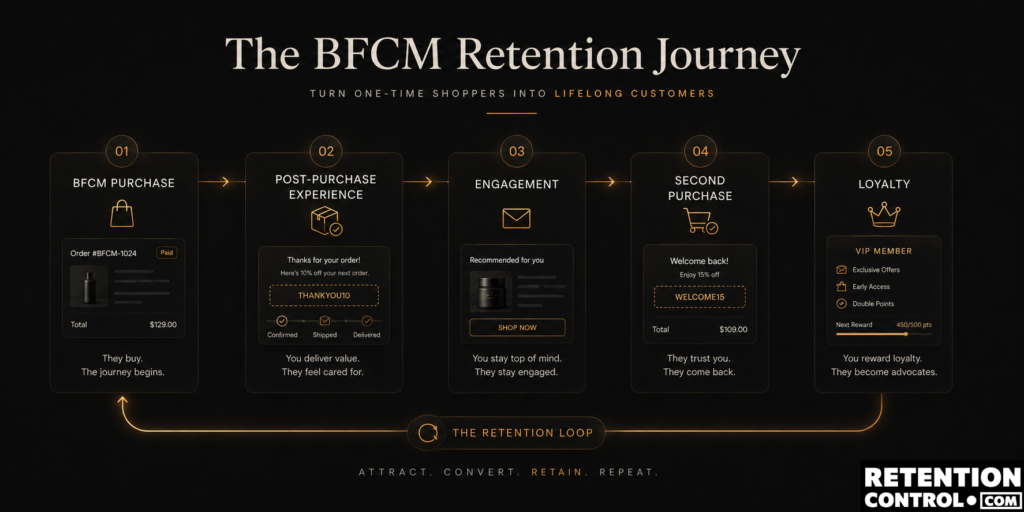
A BFCM retention strategy isn’t one tactic, it’s a system that has to be live before the first order comes in. For a broader look at this year’s shopping trends and timeline, see our BFCM 2026 guide.
Segment before you send anything. Group customers by purchase behavior, order value, and product category so every follow-up is built around a specific audience instead of a generic one.
Build and QA flows in advance. Welcome, post-purchase, cross-sell, and win-back flows should be tested and live before Black Friday, not assembled after orders start coming in. Our breakdown of automated flows for DTC brands is a good starting point if these aren’t built yet.
Map the post-purchase journey. Decide, in advance, exactly what a customer sees in the days and weeks after buying — shipping updates, product education, and a clear next step.
Use cross-sells based on actual purchase data. Recommend products based on what someone bought, not a generic bestseller block. Relevant recommendations feel helpful; irrelevant ones get ignored.
Give repeat buyers a reason to stay. Early access, points, or VIP perks turn a one-time BFCM shopper into a customer who’s still active in Q2.
Plan replenishment and win-back before you need them. If the product is consumable, a replenishment flow should already be scheduled. For everyone else, a win-back sequence needs to be ready to catch lapsed buyers before they forget the brand exists.
The Essential BFCM Email and SMS Retention Flows
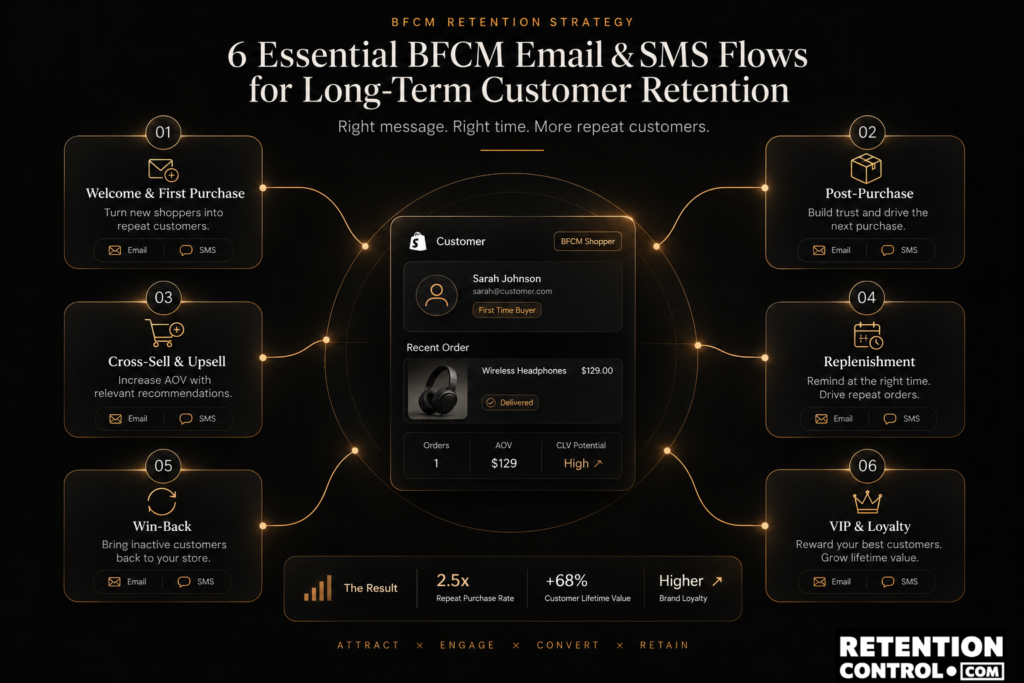
Every DTC brand has a version of these flows. The ones that actually move repeat purchase rate are built around specific timing, not just a subject line and a discount code. In priority order:
1. BFCM post-purchase flow — sends immediately. The most important flow in the system, because it decides whether a first-time buyer stays engaged or goes quiet. Confirm the order, set delivery expectations, and start introducing the brand beyond the transaction.
2. Welcome / first-purchase flow — starts at signup or first order. Runs alongside the post-purchase flow for new subscribers, establishing why it’s worth staying subscribed once the sale is over and the discount is gone.
3. Cross-sell / upsell flow — activates 7–14 days after delivery. Sent once a customer has had time to receive and use the product, not at checkout. Recommending a second product before the first has arrived reads as a cash grab — one of the most common mistakes in BFCM flow builds. For a deeper walkthrough of flow timing and setup, see our BFCM retention flows guide for Klaviyo.
4. Replenishment / reorder flow — timed to the product’s usage cycle. Trigger based on how long the product actually lasts, not a fixed calendar date. A 30-day supplement and a 6-month skincare product need very different timing.
5. Win-back flow — activates at 60–90 days without a repeat order. Targets lapsed buyers with a relevant reason to return rather than an automatic blanket discount. This is where BFCM revenue quietly disappears if it isn’t automated.
6. VIP / loyalty flow — triggers on a second purchase or spend threshold. Reserved for customers who’ve already shown they’ll buy again. Early access and recognition here compound retention instead of resetting it to a discount conversation.
How to Segment BFCM Customers
Segmentation is what makes every flow above relevant instead of generic. Here’s how to split BFCM buyers, and what to do with each group.
First-time BFCM buyers — no purchase history before this order. Route into an extended welcome and education sequence; they need trust first, not another discount.
Repeat and VIP customers — two or more orders, or a single order in your top value decile. Pull out of standard BFCM flows into loyalty and early-access messaging — a blanket discount code here trains your best customers to wait for markdowns.
High-intent non-buyers — browsed heavily or abandoned cart without converting. A short, targeted nudge in the two weeks after BFCM often converts this group better than fresh acquisition spend.
Discount-sensitive shoppers — order history shows they’ve only ever bought during a promo. Move off price-led messaging into content and value-based follow-up; another coupon just resets the cycle.
Lapsed customers — bought once, 90+ days with no repeat order. Exactly who the win-back flow exists for, and this segment should be excluded from every other active campaign.
Product-based segments — grouped by what was actually purchased. A skincare buyer and a home-goods buyer shouldn’t see the same cross-sell content.
Getting this right in Klaviyo before BFCM starts is what lets every flow above run on its own instead of needing manual list-pulling during the busiest week of the year.
How to Turn a BFCM First Purchase Into a Second Purchase
The gap between a customer’s first and second order is where most BFCM revenue gets lost, and it’s the highest-leverage part of the whole retention system — a customer who buys twice is far more likely to buy a third time. Here’s what that journey should look like, step by step:
Delivery. The product arrives, and the post-purchase flow has already set the right expectations. This is the first moment the brand can actually deliver on what the ad or discount promised.
Education. In the days right after delivery, the customer needs help getting value from what they bought, not a sales pitch. That might be usage instructions, styling ideas, or simply confirming they made a good choice — content, not conversion.
Product value realized. This is the point where the customer actually experiences the benefit of the product. It’s also the best moment to ask for a review or social proof, since it’s when they’re most positive about the purchase.
Cross-sell or replenishment introduced. Once value has been realized — not before — introduce the logical next product. For consumables, that’s a replenishment reminder. For everything else, it’s a complementary product based on what they already bought.
Second purchase. If the first four steps were handled well, the second order often doesn’t need a discount to close. That’s the real difference between a customer acquired on BFCM and a customer retained past it.
Brands that skip straight from delivery to “here’s 20% off your next order” miss the trust-building step in the middle, and end up training customers to wait for another discount instead of buying because the product earned it.
What to Do After BFCM: The 30-Day Retention Plan
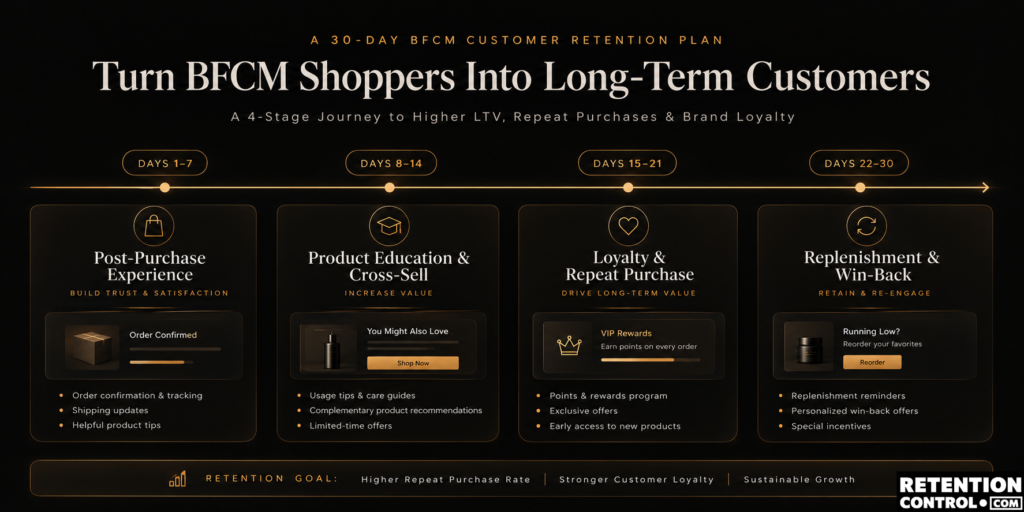
Here’s a week-by-week plan for the 30 days immediately after Black Friday and Cyber Monday close. For a longer walkthrough of this window, see our guide to post-BFCM customer retention.
Days 1–7: Post-purchase experience. Order confirmation, proactive shipping updates, and the welcome sequence for new subscribers — already running before Black Friday starts, not built reactively during it.
Days 8–14: Product education and early engagement. Send content that helps customers get value from what they bought. Hold off on cross-sell offers until the product has actually arrived.
Days 15–21: Cross-sell, loyalty, and repeat-purchase incentives. Introduce relevant product recommendations alongside your loyalty or VIP program — a second order that doesn’t depend on another discount code.
Days 22–30: Replenishment and early win-back monitoring. Launch replenishment reminders for consumable products, and flag customers who’ve gone quiet so win-back is ready at the 60–90 day mark.
BFCM Retention Metrics to Track
These are the numbers that actually tell you whether a BFCM retention strategy is working, and what to do when each one is off.
Repeat purchase rate. The percentage of BFCM customers who buy a second time — the clearest single signal of retention health. Flat compared to your non-BFCM cohorts means the post-purchase journey needs attention first.
Customer lifetime value (CLV/LTV). Total revenue from a customer over the full relationship, not just the BFCM order. Low CLV on high-volume BFCM traffic usually points to a discount-only acquisition strategy with no retention layer behind it.
Revenue per customer. Average value generated per buyer. Flat while order volume grows means cross-sells and upsells aren’t doing their job.
Retention rate. The share of BFCM buyers still active in the months that follow — ties directly back to whether the retention plan is working, as opposed to just the acquisition push.
Email and SMS attributed revenue. How much repeat revenue comes directly from retention flows versus paid channels, which is what justifies continued investment in flows.
CAC vs. customer value. What was spent to acquire a BFCM customer against what they’re actually worth over time. If this ratio isn’t improving month over month, BFCM becomes a break-even event instead of a profitable one.
When You Need a BFCM Retention Partner
Most Shopify and DTC teams can run a basic post-purchase flow. Fewer can run a full BFCM retention system while also handling the operational load of the biggest sales week of the year. A few signs it’s time to bring in outside help:
Flows are incomplete or generic — a welcome and a post-purchase flow exist, but no cross-sell, replenishment, or win-back sequence, or they all send the same message regardless of who’s receiving it.
Segmentation is thin or manual — if a targeted send means someone manually pulling a list, it won’t hold up during BFCM volume.
The post-purchase journey isn’t mapped — no clear plan for what a customer sees between delivery and their second purchase opportunity.
The team lacks dedicated lifecycle expertise — Klaviyo logic, SMS compliance, and flow sequencing all take real time to get right, and it’s rarely someone’s full-time job.
BFCM volume is too high to manage manually — order volume spikes, but retention execution doesn’t scale on its own.
Retention reporting is unclear
if nobody could answer “what’s our BFCM repeat purchase rate” without pulling a custom report, retention isn’t being actively managed.
If more than one of these sounds familiar, it’s usually a resourcing problem, not a strategy problem. That’s where a dedicated DTC retention marketing partner closes the gap faster than building it internally mid-season.
How Retention Control Helps Ecommerce Brands
Building all of this in-house during your busiest season isn’t easy, and that’s exactly where RetentionControl comes in. We help Shopify brands turn one-time holiday buyers into long-term customers through hands-on lifecycle marketing and technical execution.coming back?
Book a Free BFCM Retention AuditRetention audit and customer journey analysis.
We review the current post-purchase journey and flag exactly where BFCM customers are dropping off before a second purchase happens. Start with our BFCM retention audit checklist to see what we look at first.
Email and SMS flow strategy.
We build and optimize the welcome, post-purchase, cross-sell, replenishment, and win-back flows covered above, tailored to the specific product and customer base.
Klaviyo execution
We’re a certified Klaviyo retention marketing agency, so every flow is built natively inside the platform already running BFCM, not bolted on separately.
Segmentation and lifecycle marketing
We set up the behavioral segmentation covered above, so every customer group gets messaging that fits where they actually are in the relationship.
Post-purchase and win-back campaigns. From order confirmation through win-back offers, we build the campaigns that keep BFCM revenue from quietly disappearing once the sale ends.
Ongoing testing and retention optimization.
Retention isn’t a set-it-and-forget-it build. We keep testing timing, offers, and messaging to improve repeat purchase rate well after BFCM wraps.
Conclusion
BFCM will always be about the first sale. What happens in the 30, 60, and 90 days after determines whether this year’s holiday shoppers become the repeat customers who carry revenue into next year.
Want a clear picture of where your BFCM retention marketing stands before the next spike? Book a free BFCM retention audit and we’ll show you exactly where holiday customers are dropping off. Or see what stronger retention could be worth with our ROI calculator.
Book Your Free Retention Audit