
BFCM 2026 runs from Black Friday on 27 November to Cyber Monday on 30 November, and the retention work that decides whether those buyers come back starts about 90 days earlier. This guide is the dated calendar: what to do 90, 60 and 30 days out, how to set offers without wrecking margin, and which numbers to record. If you are starting in October, begin at the 60-day step. For the flows and segments themselves, see our BFCM retention strategy; for what to send after the sale, see our post-BFCM customer retention playbook.
Every BFCM ends the same way: a revenue number gets posted in a Slack channel, the team high-fives, and everyone moves on to the next campaign. That number feels like the finish line. It isn’t. The real test of a BFCM strategy is what those customers are worth 30, 60, and 90 days later.
Most BFCM content stops at flows and templates: which email to send, which SMS to schedule, which automation to turn on. This guide starts somewhere else. It’s about the strategy underneath those tactics: the planning timeline, the customer economics, the segmentation logic, and the measurement framework that decide whether a BFCM buyer becomes a one-time discount shopper or a genuinely loyal customer.
What Is BFCM and When Is BFCM 2026?
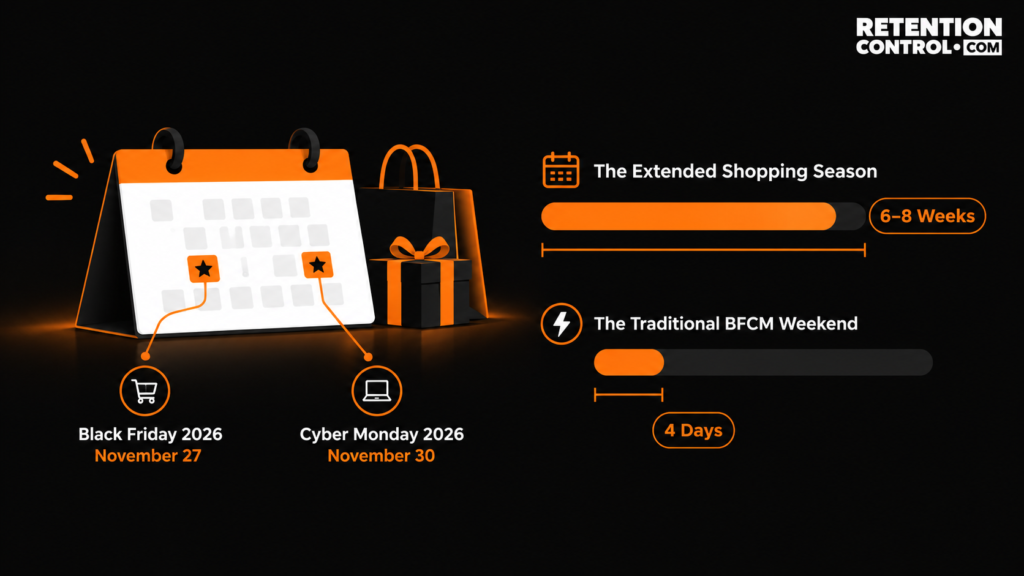
BFCM stands for Black Friday Cyber Monday, the shopping period that opens the holiday season in the United States and has become the single biggest revenue window of the year for most ecommerce brands.
- Black Friday 2026: November 27
- Cyber Monday 2026: November 30
Black Friday began as an in-store, doorbuster-driven event. Cyber Monday was coined in the early 2000s to describe the online surge that followed it. Today the distinction barely matters operationally, since most brands run one continuous promotion across both days. According to the National Retail Federation’s Center for Retail & Consumer Insights, the Thanksgiving-to-Cyber-Monday weekend now regularly pulls in well over 190 million shoppers, and that scale is exactly why treating it as an isolated weekend leaves so much value on the table.
What has changed more meaningfully is duration. BFCM is no longer a four-day weekend. Many brands open offers a week or two early to capture gift-research traffic, and plenty extend promotions into December. For planning purposes, BFCM is better treated as a six-to-eight-week season with its own budget, timeline, and goals than as a single weekend bolted onto a regular retention marketing calendar.
Why BFCM Should Be More Than a Sales Event
A single BFCM revenue figure hides the question that actually determines long-term value: how many of those buyers were one-time deal-seekers, and how many are customers who’ll purchase again?
Deal-driven shoppers make up a large share of BFCM traffic. They’re comparing prices across brands, and many are buying from a company for the first time purely because the offer justified the risk. That’s not a problem in itself; new customer acquisition at scale is genuinely valuable. It becomes a problem only when a brand’s strategy stops at checkout, treating the sale as the destination rather than the entry point.
The brands that get compounding value from BFCM plan, from day one, for what happens after the transaction: loyalty enrollment, post-purchase communication, and a second-purchase pathway. A first-time buyer who feels welcomed and given a clear reason to return is worth substantially more over a year than one who bought once at a steep markdown and never heard from the brand again.
The Economics Behind a BFCM Customer
This is the part most BFCM guides skip, and it’s the part that actually determines whether a discount-driven acquisition strategy is profitable or a slow bleed.
CAC vs. first-order revenue. Ad costs typically spike during BFCM as every brand competes for the same attention, which pushes customer acquisition cost up right as discounts push average margin down. A first order can easily be a net loss once you account for both.
Gross margin after discount. A 30% discount doesn’t just cut 30% off the top line; it can eliminate most or all of the margin on a low-margin product. Before finalizing an offer, it’s worth modeling margin after discount, not just the discount percentage itself.
Second-purchase rate. This is the single most important number for judging whether a BFCM cohort was worth acquiring. A cohort with a high second-purchase rate can be profitable even with an unprofitable first order. A cohort with a low one rarely recovers, no matter how large the initial sale was.
Customer Lifetime Value (CLV). BFCM customers should be evaluated against their projected CLV, not their first-order value. A customer acquired at a loss on order one but who reaches typical CLV within two or three orders is a good acquisition. One who never returns is not, regardless of how large that first order looked.
Payback period. How many months does it take for a BFCM customer’s cumulative margin to cover their acquisition cost? Shorter payback periods mean more capital available to reinvest in the next acquisition push. Longer ones tie up cash that could go toward retention instead. If you want to run these numbers against your own store, RetentionControl’s ROI calculator is a quick way to see what a stronger second-purchase rate would actually be worth.
The takeaway: a discounted first order can absolutely be profitable, but only if it’s evaluated as the first data point in a longer relationship, not as a standalone transaction.
Build Your BFCM Strategy Around the Customer Journey
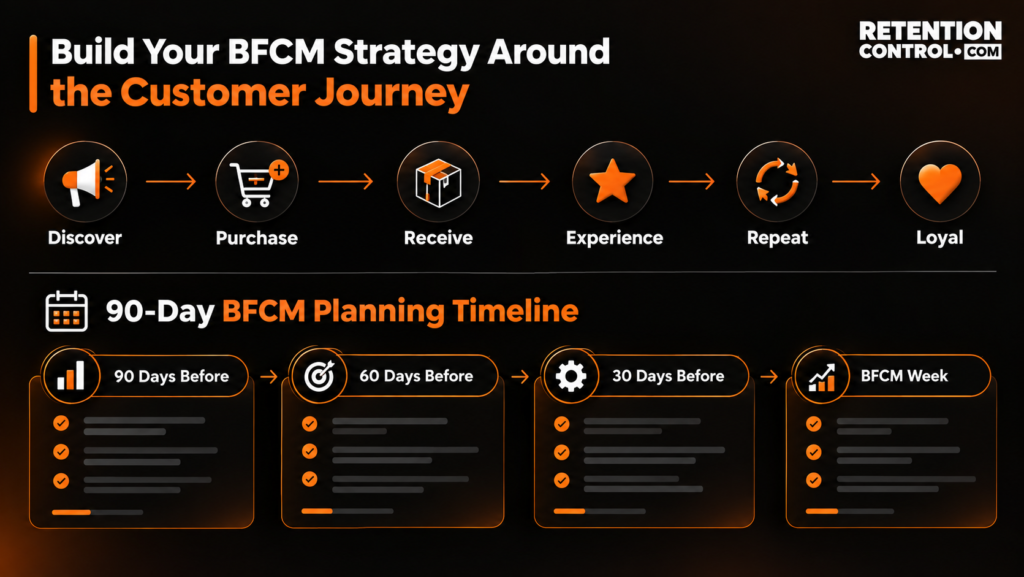
Rather than thinking in terms of individual channels or flows, it helps to map the full arc a BFCM buyer moves through:
Discover → Consider → Purchase → Receive → Experience → Repeat → Loyal
- Discover: A shopper encounters the brand for the first time, often through a BFCM-specific ad, influencer post, or comparison search.
- Consider: They evaluate the offer against competitors: price, reviews, shipping speed, return policy.
- Purchase: The transaction happens, usually under real time pressure.
- Receive: The product arrives. This moment does more to shape retention than almost any email that follows it.
- Experience: The customer actually uses the product and forms a real opinion of the brand, separate from the discount that brought them in.
- Repeat: A second purchase happens, the single biggest signal that acquisition is turning into retention.
- Loyal: The customer becomes a predictable, recurring source of revenue and, often, referrals.
Every planning decision, from offer structure to post-purchase messaging, should be mapped to one of these stages rather than treated as a generic “BFCM campaign.”
90-Day BFCM Planning Timeline
90 Days Before
- Analyze the previous year’s BFCM performance, including cohort retention, not just revenue
- Identify best-selling products and likely fast movers
- Break down new vs. returning customer share from last year’s cohort
- Forecast inventory against realistic demand scenarios
- Set explicit revenue and retention goals, not revenue alone
60 Days Before
- Finalize offer structure and depth by product line
- Segment audiences (VIPs, repeat buyers, lapsed customers, new prospects)
- Prepare creative assets across channels
- Plan loyalty incentives tied specifically to the sale
- Scale up customer-support capacity planning
30 Days Before
- Load-test the website and checkout flow
- Test the mobile purchase path specifically, since it carries most BFCM traffic
- Finalize the full campaign calendar
- Build contingency plans for likely sellouts
- Begin building anticipation with existing subscribers
BFCM Week
- Monitor conversion rate in real time
- Track inventory against forecast, hour by hour where possible
- Watch average order value (AOV) as a leading indicator of offer performance
- Track new vs. returning customer mix as the sale progresses
- Adjust campaigns based on what the data shows, not what was planned three months earlier
How to Create BFCM Offers Without Destroying Your Margins
Discount depth is a lever, not a strategy. The goal is a genuinely compelling offer that doesn’t quietly erode margin or train customers to wait for markdowns year-round. Different offer types create different incentives:
- Percentage discounts are the most familiar and easiest to communicate, but the most damaging to margin if used too aggressively across the full catalog.
- Buy-one-get-one works well for increasing units per order without discounting the per-unit price as visibly.
- Bundles protect margin better than blanket discounts while still feeling like a deal, and they introduce customers to more of the catalog at once.
- Free shipping is often perceived as more valuable than an equivalent percentage discount, at a lower real cost to the brand.
- Gift with purchase adds perceived value without touching the price of the core product.
- Spend-and-save (for example, $20 off $100) increases AOV directly and rewards larger baskets rather than just rewarding anyone who shows up.
- Loyalty-only incentives reserve the deepest value for customers already inside the ecosystem, which reinforces the loyalty program instead of undercutting it.
- Early access rewards existing subscribers and loyalty members without requiring a deeper discount at all.
The strongest BFCM offer strategies usually combine several of these: a moderate storewide discount, plus stacked incentives (loyalty points, early access, bundles) reserved for higher-intent segments, rather than defaulting to the single deepest percentage-off offer possible.
How to Turn First-Time BFCM Buyers Into Repeat Customers
Strategically, not tactically, this comes down to giving a new customer clear reasons to come back before their interest fades:
- Product education, helping them get real value from what they bought, which drives the “Experience” stage of the journey
- Loyalty enrollment, making it effortless to join at checkout, while the incentive is still top of mind
- Cross-sell opportunities, surfacing genuinely relevant complementary products, not just anything in the catalog
- Replenishment opportunities, timed around when a consumable product is likely running low
- Referral opportunities, turning a satisfied first-time buyer into an acquisition channel
- Personalized offers, based on what they actually bought, not a generic discount blast
- Second-purchase incentives, a specific, time-bound reason to place order two
The technical side of this, which automated flows to build, which platform to use, sequencing and timing, is a separate execution question. If you want the Klaviyo-specific build-out for these, RetentionControl’s Klaviyo retention guide covers that in detail. Here, the point is that each of these needs to be a deliberate part of the BFCM plan, not an afterthought bolted on in December.
BFCM Segmentation: Don’t Treat Every Customer the Same
A large share of BFCM buyers are shopping with a brand for the first time, and treating them identically to long-time customers wastes the opportunity to build the relationship intentionally. At minimum, segment for:
| Segment | What they need |
|---|---|
| Existing VIP customers | Early access, exclusive perks, recognition, not the same generic discount as everyone else |
| Repeat customers | A reason tied to their history with the brand, not a cold-acquisition message |
| One-time customers | A specific nudge toward a second purchase, since they haven’t formed a habit yet |
| New BFCM customers | Brand introduction and onboarding, not just more discounts |
| High-AOV customers | Premium or bundled offers that match their spending pattern |
| Discount-sensitive customers | Value-based messaging, since price is clearly their primary driver |
| Lapsed customers | A win-back offer distinct from the acquisition offer used on brand-new shoppers |
Segmentation isn’t about running more campaigns. It’s about making sure each customer gets the message that actually fits where they are in the relationship.
What to Do After BFCM: The 30-Day Retention Window
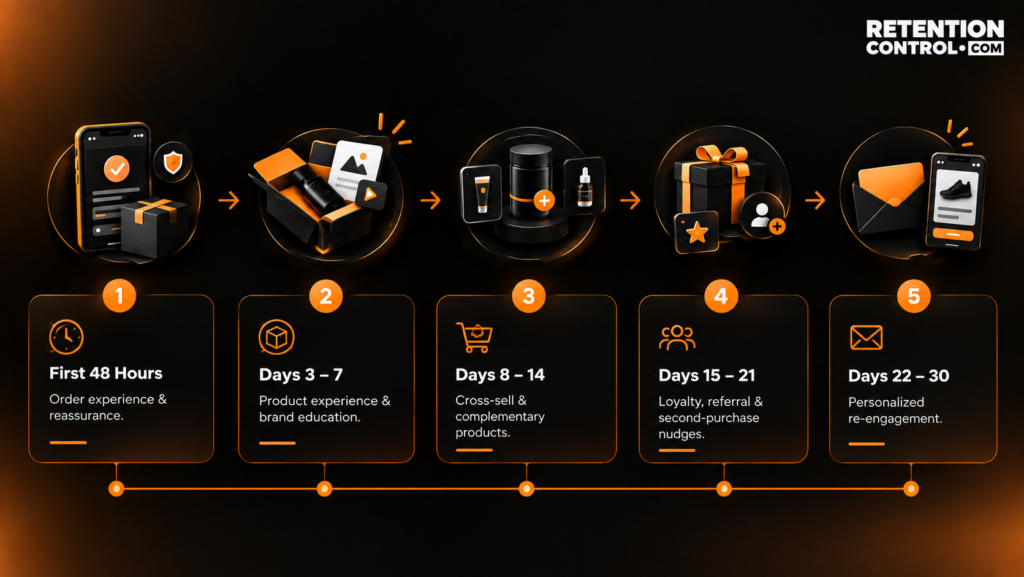
This is where most BFCM planning stops, and where the actual retention outcome gets decided. This section is the summary; the day-by-day version, with the segments and messages for each step from day 0 to day 45, is in our post-BFCM customer retention playbook.
First 48 hours: order experience and reassurance. Confirm the order clearly, set accurate delivery expectations, and make it easy to reach support. Nothing kills a new relationship faster than uncertainty right after payment.
Days 3 to 7: product experience and brand education. Once the product has likely arrived, help the customer succeed with it and introduce them to the brand’s story and values beyond the discount that brought them in.
Days 8 to 14: cross-sell and complementary products. With initial usage established, this is the natural point to introduce products that genuinely pair with the first purchase.
Days 15 to 21: loyalty, referral, and second-purchase nudges. Remind customers of any loyalty points earned during BFCM before they expire, and make referring a friend simple.
Days 22 to 30: personalized re-engagement. For customers who haven’t returned yet, a tailored offer based on their specific purchase, not a generic blast, is far more likely to convert a second order.
The through-line across all five stages is strategy, not channel mechanics. The specific automation, timing, and platform setup that deliver each stage is implementation detail worth solving separately; the planning decision that matters here is making sure each stage is intentionally covered at all.
BFCM Metrics That Actually Matter
Revenue alone hides too much. A more complete scorecard:
| Metric | Why it matters |
|---|---|
| New customers | Measures acquisition reach |
| Returning customers | Measures existing loyalty strength |
| Average order value (AOV) | Indicates order quality, not just volume |
| Discount rate | Shows real margin impact |
| Second-purchase rate | The clearest early signal of retention |
| Repeat purchase rate | Long-term value indicator |
| Customer Lifetime Value (CLV) | True customer economics |
| Revenue per customer | Overall value beyond a single transaction |
| Loyalty enrollment rate | Predicts future retention capacity |
| BFCM customer retention rate | The real measure of BFCM success |
A brand that only reports the weekend revenue number is optimizing for a single, easily-inflated metric. Tracking this fuller set turns BFCM into a genuine input for annual planning rather than an isolated event.
Common BFCM Mistakes That Reduce Customer Lifetime Value
- Discounting too aggressively, eroding margin and training customers to wait for markdowns
- Chasing revenue instead of profitable revenue, which looks good on a dashboard and bad on a P&L
- Treating new and existing customers identically, missing the chance to build the relationship deliberately
- Ignoring the post-purchase experience, the moment that shapes whether “Experience” turns into “Repeat”
- Going silent after BFCM, giving new customers no reason to think of the brand again
- Measuring only weekend revenue, which hides whether the cohort was actually worth acquiring
- Failing to analyze BFCM cohorts, losing a full year’s worth of planning data every cycle
How to Measure Whether BFCM Customers Actually Stayed
The most useful analytical exercise a brand can run after BFCM is tracking the cohort forward:
BFCM cohort → 30-day repeat purchase rate → 60-day repeat purchase rate → 90-day repeat purchase rate
From there, compare that cohort against:
- Non-BFCM customers acquired the rest of the year, to see whether discount-driven acquisition actually retains worse
- Previous year’s BFCM cohort, to see whether retention strategy improvements are working
- Full-price customers, to isolate how much of the retention gap (if any) is driven by discount depth specifically
This comparison turns BFCM from a single annual event into a repeatable, improvable system. Each year’s cohort data sharpens the next year’s segmentation, offer structure, and post-purchase plan. If you want that system built and run for you, see our ecommerce retention programme.
Final Thoughts
Don’t measure BFCM only by what customers spend during four days. Measure it by what those customers are worth over the next 30, 60, and 90 days. The brands that build lasting growth from BFCM aren’t the ones with the deepest discount. They’re the ones who planned, from the very first 90-day timeline, for the customer relationship that starts the moment the order confirmation email goes out.