
Post-BFCM customer retention is the work of turning the shoppers who bought over Black Friday weekend into second-time buyers, and it is won or lost in the 45 days after the sale. This playbook covers that window day by day: the segments to split, what to send from day 0 to day 45, and the KPIs that show whether the cohort stayed. For the setup to do before the sale, see our BFCM retention strategy; for 2026 dates and timing, see our BFCM 2026 planning timeline.
BFCM brings in the customers. What happens in the 30 days after is what determines whether that traffic was actually worth it.
Most Shopify brands treat Cyber Monday as the finish line. From a retention perspective, it is really the starting point. A customer who bought because of a BFCM offer may have very different expectations from someone who discovered your brand through organic search, social media, or a referral.
That is why the weeks after the sale matter so much.
Instead of immediately sending another discount, you need to understand who bought, what they purchased, how they engaged, and what would give them a genuine reason to come back.
This guide breaks down a practical Shopify-focused approach to post-BFCM customer retention, including customer segmentation, post-purchase automation, cross-sells, replenishment, loyalty, win-back campaigns, and the metrics that actually show whether your BFCM customers are becoming more valuable over time.
If you are planning the full BFCM lifecycle, our BFCM retention strategy covers the broader approach before, during, and after the sale.
Why Post-BFCM Customer Retention Matters
A BFCM order is only the first transaction.The bigger opportunity is turning that first purchase into a second order and eventually into a repeat customer.
This is particularly important because customers acquired during major sales periods can behave differently from customers acquired during normal trading periods. Some may have been waiting specifically for a discount, while others may have discovered your brand for the first time.
The goal isn’t to assume which type of customer you have. It’s to use your own customer and order data to find out.
For example, you can track:
| Metric | What it tells you |
|---|---|
| Repeat purchase rate | How many BFCM customers place another order |
| Time to second purchase | How quickly customers return |
| 60/90-day cohort revenue | How much additional revenue the BFCM cohort generates |
| Customer lifetime value | Whether customers become more valuable over time |
| Win-back conversion rate | Whether inactive customers can be brought back |
| Product-level repeat rate | Which products create stronger repeat behavior |
These numbers are much more useful than looking at the BFCM sales total alone.If 10,000 customers purchased during BFCM but very few return, the initial revenue may look impressive while the long-term value of that acquisition remains weak.
The real question is simple:
What happens after the first order?
Shopify Customer Segmentation: What to Actually Build
One of the biggest mistakes after BFCM is treating every buyer as the same customer.
Someone who spent $300 across several products shouldn’t necessarily receive the same follow-up as someone who purchased a single heavily discounted item.
Shopify lets merchants create customer segments using characteristics and customer data such as order history, amount spent, products purchased, and other customer attributes. These segments can then be used to make marketing more relevant. Shopify’s customer segmentation documentation explains how these dynamic segments work.
For post-BFCM retention, start with a few useful groups rather than building dozens of complicated segments.
1. Deal-Focused Buyers
These are customers who appear to have purchased mainly around the promotion.You might identify them using a combination of:
- BFCM purchase date
- One lifetime order
- Promotional or discounted purchase
- Lower-than-average order value
- Limited product selection
The goal isn’t to label them as “bad customers.”It is to understand that they may need more product education and brand-building before another purchase makes sense.
2. Full-Price or Add-On Buyers
These customers show stronger buying intent.They may have purchased several products, spent above your normal order value, or bought products outside your deepest promotional offers.
They can be good candidates for:
- Complementary products
- Product education
- Early access
- New launches
- Loyalty messaging
3. Existing Customers Who Also Bought During BFCM
This group is easy to overlook.If someone already had three orders before BFCM and then purchased again, they shouldn’t enter your “new customer” retention journey.They already know your brand.Their experience should reflect that.
Instead of explaining who you are, you can focus on recognition, relevant products, loyalty, early access, or the next logical purchase.
4. High-Value BFCM Buyers
High-value customers deserve a different path from the beginning.
Look at:
- Order value
- Lifetime spend
- Number of orders
- Product mix
- Engagement
- Category purchased
- Margin or profitability where relevant
This is where segmentation becomes more than just sending different emails.You’re deciding what relationship the customer should move into next.
The Post-BFCM Automation Workflow
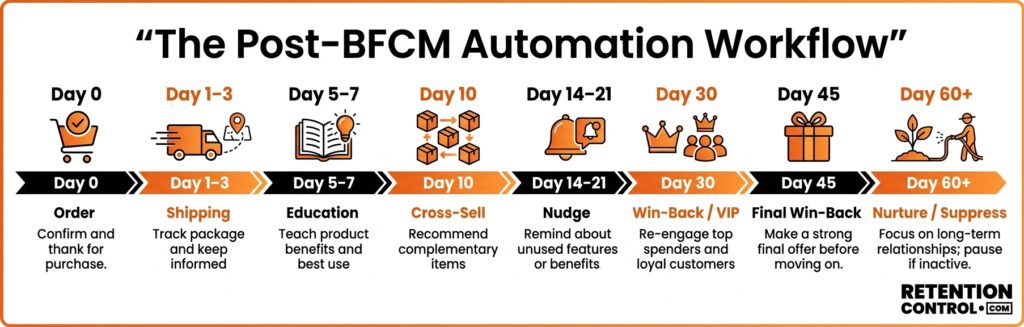
Once your segments are in place, the next step is building the customer journey.The mistake here is creating one giant “BFCM follow-up flow.”
A better approach is to create a sequence of experiences that changes depending on what the customer does.Your automated flows for DTC brands should support that journey rather than simply sending a fixed number of emails.
Day 0: Purchase
The customer has just placed an order.At this stage, don’t try to sell another product.Focus on the immediate customer experience:
- Order confirmation
- Clear delivery expectations
- Shipping information
- Support information
- What happens next
These are primarily transactional touchpoints, not retention campaigns.The goal is to reduce uncertainty and build confidence.
Days 1–3: Fulfillment and Shipping
Keep the customer informed.If the order is delayed, communicate it.If the product is on the way, make that clear.A customer who has just spent money shouldn’t have to wonder what happened to their order.
Days 5–7: Product Education
Once delivery is likely or confirmed, the communication can change.This is where your retention strategy starts doing more work.
Depending on the product, you could send:
- Setup instructions
- Usage tips
- Product-care advice
- Common mistakes to avoid
- How to get better results
- Related educational content
The objective is simple:Help the customer get value from what they already bought.That makes the next purchase easier.
Day 10: Introduce a Relevant Cross-Sell
Now you can start thinking about the second order.But don’t send a generic “You might also like these products” email.Use what the customer actually purchased.If someone bought a cleanser, a compatible moisturizer makes sense.If they bought a phone case, a screen protector may be relevant.If they bought coffee, complementary products may make sense.The recommendation should feel like a continuation of the first purchase.
Days 14–21: Re-engage Based on Behavior
Not everyone needs the same message.Someone who opened your emails and visited your store is different from someone who hasn’t engaged at all.
Engaged customers can receive:
- Product recommendations
- New product information
- Educational content
- Restock alerts
- Relevant SMS
Less-engaged customers should not automatically receive more and more messages.
Day 30: Loyalty or Win-Back
At around 30 days, your customer should start moving into a more defined lifecycle stage.High-value or repeat customers may be ready for loyalty or VIP communication.
Customers who haven’t purchased again may need a softer win-back approach.Customers showing no engagement may need lower-frequency communication instead.
Day 45+: Final Win-Back or Nurture
Don’t keep chasing every customer indefinitely.If someone has ignored multiple emails and hasn’t purchased again, continuing to increase frequency usually isn’t the answer.
Move them into:
- Lower-frequency nurture
- Future product launches
- Seasonal campaigns
- Retargeting audiences
- Suppression where appropriate
Good retention isn’t about sending more messages.It’s about sending more relevant ones.
A Practical 30-Day Post-BFCM Retention Calendar
Here’s a simple framework you can adapt to your store.
| Period | Main objective | Example communication |
|---|---|---|
| Week 1 | Build confidence | Delivery updates, product education |
| Week 2 | Increase product value | Usage tips, tutorials, education |
| Week 3 | Encourage another purchase | Product recommendations, replenishment |
| Week 4 | Move customers forward | Loyalty, VIP, or win-back |
The exact timing depends on what you’re selling.A skincare product may have a much shorter repeat cycle than a sofa.A consumable product may need replenishment messaging within weeks, while a durable product may need complementary products or seasonal reasons to return.
The calendar is a framework, not a rule.
Email and SMS Flow Examples
Your messages should feel like they belong to the customer’s journey.
Cross-Sell Email — Around Day 10
Subject: Since you bought [Product], you may want this
Instead of showing six unrelated products, introduce one or two products that genuinely complement the original purchase.
Explain why they work together.
That’s more useful than simply saying “You may also like.”
Product or Restock SMS — Around Day 14–21
For customers who have opted into SMS and have a genuine reason to receive the message:
“Hey [Name], [Product] is back in stock. If you liked your first one, you can find it here: [link]”
Keep SMS short.More importantly, don’t send an SMS simply because you have someone’s phone number.Give the message a reason to exist.
VIP Message — Around Day 30
For customers who meet your high-value criteria:
“You’ve earned early access.”
This could introduce:
- A new product
- Early access to a launch
- A private collection
- A loyalty benefit
- An exclusive event
Recognition can be more powerful than another discount.
Win-Back Email — Around Day 30–45
For customers who haven’t purchased again:
Subject: Still thinking it over?
The message can remind them about the brand, highlight something relevant, or introduce a product connected to their first purchase.Discounting should be an option, not the automatic answer.
Product-Based Cross-Sell Logic
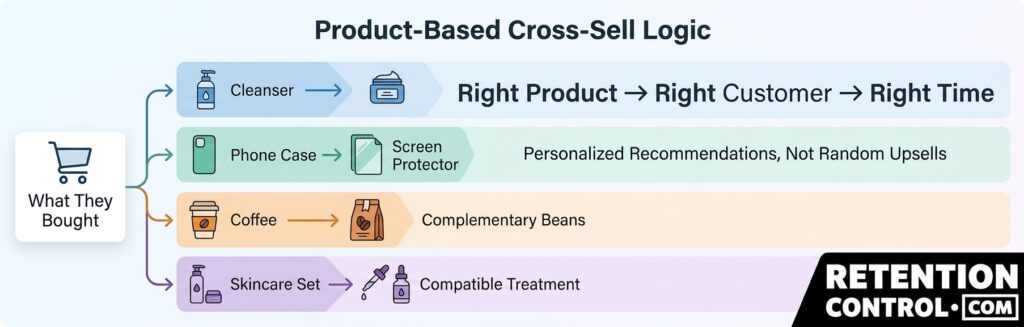
The best cross-sell usually starts with one question:
What would naturally come next after this purchase?
For example:
Cleanser → Moisturizer
The customer already has one part of the routine. The next product completes it.
Phone Case → Screen Protector
The second product protects the first purchase.
Coffee → Complementary Beans
The customer has already shown an interest in the category.
Skincare Treatment → Compatible Product
The recommendation can extend the routine rather than replacing it.
Home Product → Complementary Accessory
The customer gets more value from the original purchase.
This is where product data becomes useful.
Depending on your setup, you can use Shopify product information, collections, tags, line-item data, purchase history, and customer behavior to determine what recommendation makes sense.The goal isn’t to show more products.It’s to show the right next product.
Repeat-Purchase and Replenishment Triggers
Replenishment works particularly well for products customers naturally run out of.
Think about:
- Skincare
- Supplements
- Coffee
- Pet supplies
- Beauty products
- Household consumables
Instead of guessing when someone might need another product, use your actual order history to estimate the normal reorder window.If customers typically reorder after 30–45 days, that gives you a much stronger starting point for the next message.
This is one reason a well-built replenishment flow can be more effective than simply sending another promotional campaign.For durable products, the strategy changes.Customers may not need the same product again soon.
Instead, focus on:
- Accessories
- Complementary products
- Upgrades
- New arrivals
- Seasonal products
- Loyalty
- Referrals
Retention doesn’t always mean selling the same thing twice.It means creating a reason to continue buying from the same brand.
Loyalty and VIP Segmentation
Your best BFCM customers shouldn’t stay mixed into the same lifecycle as everyone else.Start identifying customers based on signals such as:
- Two or more lifetime orders
- High lifetime spend
- High BFCM order value
- Multiple product categories purchased
- Strong engagement
- Repeat purchasing behavior
Then build a VIP experience around recognition.That might include:
- Early access
- New-product previews
- Loyalty rewards
- Exclusive launches
- Special collections
- Referral opportunities
- Priority support
The point isn’t simply to give your best customers another discount.It’s to make them feel like the brand knows who they are.That is the foundation of a strong VIP and loyalty strategy.
What to Do With Customers Who Don’t Engage
Some BFCM customers simply won’t come back.That’s normal.
The mistake is treating every inactive customer as someone who needs another email.
if someone hasn’t opened, clicked, visited, or purchased after several attempts, continuing to increase your sending frequency can do more harm than good.Instead, consider moving them into:
Low-frequency nurture
They may still receive major launches or important seasonal campaigns.
Future reactivation
A new product, new collection, or seasonal event may give them a legitimate reason to return.
Retargeting
Where appropriate, they can be included in broader paid-media audiences.
Suppression
If there is no meaningful engagement over time, removing them from regular marketing sends can protect list health and keep your focus on customers who are actually interested.Retention is not measured by how many emails you send.It’s measured by what happens to customer behavior.
Turning Discount Shoppers Into Loyal Customers
One of the easiest mistakes after BFCM is immediately offering another discount.It works in the short term.But if every follow-up message says “20% off,” customers can learn to wait for the next promotion.
Instead, give customers other reasons to return.Show them how to get more value from the product.Introduce complementary products.Share useful content.Give loyal customers early access.Highlight new launches.Create a reason to stay connected to the brand.
The relationship should gradually move from:
“I bought because it was discounted.”
to:
“I bought because I like this brand.”
That shift is what makes retention valuable.
The Role of Klaviyo in Post-BFCM Retention
For Shopify brands using Klaviyo, the post-BFCM period is where segmentation and automation can start working together.
You can build audiences around:
- Purchase history
- Product purchased
- Number of orders
- Customer value
- Engagement
- Email subscription status
- SMS subscription status
- Time since last purchase
- Category behavior
That allows the same BFCM cohort to split into different customer journeys.A customer who purchases again shouldn’t keep receiving a win-back sequence designed for someone who hasn’t purchased.
A customer who becomes high-value shouldn’t continue receiving the same messaging as a first-time buyer.This is why Klaviyo segmentation matters so much after BFCM.The data tells you what happened.The segmentation determines who should receive what next.
KPIs to Track After BFCM
Don’t judge your retention strategy by open rates alone.Track metrics that connect directly to customer value.
1. Repeat Purchase Rate
Repeat Purchase Rate = BFCM customers with 2+ orders ÷ total BFCM customers × 100
This tells you how many customers actually moved beyond the first transaction.
2. Time to Second Purchase
Measure the average or median number of days between the BFCM order and the next order.
This helps you understand your actual customer purchase cycle.
3. 60- or 90-Day Cohort Revenue
Look at how much additional revenue the BFCM cohort generates after the original purchase.
This gives you a clearer picture of the long-term value of the campaign.
4. Customer Lifetime Value
Track whether BFCM customers continue purchasing over time.
A customer who initially purchased with a discount can still become extremely valuable if they go on to make several profitable purchases.
5. Win-Back Conversion Rate
Measure how many inactive customers return and purchase after entering a win-back sequence.
6. Engagement Metrics
Open rates, click rates, SMS engagement, and other channel metrics are still useful.But treat them as diagnostic metrics.A high open rate doesn’t automatically mean your retention strategy is working.The more important question is:
Did customers come back and buy?
Example: From BFCM Buyer to Loyal Customer
Imagine a customer purchases a skincare cleanser during BFCM.
Here’s how the journey could look:
Day 0:
Order confirmation and delivery information.
Day 5–7:
Product education explaining how to use the cleanser effectively.
Day 10:
A relevant moisturizer is introduced as the next step in the routine.
Day 14–21:
The customer receives useful product content or a relevant restock/update message.
Second purchase:
The customer moves out of the first-time buyer segment.
Later:
The customer receives recommendations based on their purchase history.
Multiple purchases:
They become eligible for a loyalty or VIP experience.
The journey is no longer:
BFCM → Discount → Silence
It becomes:
First Purchase → Product Value → Second Purchase → Repeat Customer → Loyal Customer
That’s the real objective of post-BFCM retention.
Frequently Asked Questions
How soon after BFCM should retention campaigns start?
The customer experience starts immediately after purchase, but promotional retention messaging should follow the customer’s journey. Start with fulfillment and product education before moving into cross-sells, replenishment, loyalty, or win-back.
Should I keep discounting BFCM buyers to bring them back?
Not automatically. If every follow-up depends on another discount, customers may learn to wait for promotions. Try product education, complementary products, loyalty benefits, early access, and new product launches before relying on another offer.
What’s a realistic repeat purchase rate after BFCM?
There isn’t one universal number that works for every Shopify store. Purchase frequency, product category, price point, and customer behavior all affect repeat purchasing. Your own BFCM cohort data is the better benchmark.
Do I need different flows for BFCM buyers?
Usually, yes. At minimum, your BFCM customers should be segmented based on whether they are new or existing customers, what they purchased, their value, and whether they have already purchased again.
What should I do with customers who never engage?
Don’t keep increasing message frequency indefinitely. Test a reasonable win-back sequence, then move inactive customers into lower-frequency communication, future reactivation opportunities, or suppression depending on their engagement and list-health requirements.
Conclusion
BFCM doesn’t really end when Cyber Monday is over.For retention, that’s when the more important work begins.The customers you’ve acquired already know your brand. The next step is to give them a reason to stay connected.
Start by separating your BFCM customers based on purchase history, value, products, and behavior. Then build the right sequence around the customer: a strong post-purchase experience, useful product education, relevant recommendations, replenishment where appropriate, and loyalty or win-back messaging when the timing makes sense.
Most importantly, measure what happens after the first order.Repeat purchase rate, time to second purchase, cohort revenue, customer lifetime value, and win-back conversion tell you much more about retention than the BFCM sales number alone.The goal isn’t to send more emails.
It’s to create a better customer journey:
Right customer → Right message → Right product → Right time.
When that journey works, a customer who originally arrived for a BFCM deal has a much better chance of becoming a repeat buyer—and eventually one of your most valuable customers.