
By the Tuesday before Thanksgiving, your customers’ inboxes are full, paid social costs are climbing, and every brand they have ever bought from is announcing a sale. Email still does a lot of the work, but it gets harder to stand out. Ads get more expensive just when margins are tightest.
SMS is one of the few channels that can still reach a customer directly during that week, if you have earned the right to use it. Black Friday SMS marketing is not about sending more texts than everyone else. It depends on having a clean, consented list, sensible segments, well-timed messages, and automations that respond to what shoppers actually do. When those pieces are missing, SMS becomes one more source of noise, and it can cost you subscribers you worked hard to get.
This guide covers how ecommerce and DTC brands can plan, write, time, automate, and measure SMS for Black Friday 2026 (Friday, November 27) and Cyber Monday 2026 (Monday, November 30). It also covers how to keep those subscribers engaged after the sale ends.
Key Takeaways
The brands that do well with SMS over BFCM usually decide most of it in October. Here are the main points:
- Start before Black Friday. List growth, consent capture, number registration, and flow testing all need weeks. If you begin the week of the sale, you are mostly reacting.
- List quality beats list size. A smaller list of engaged subscribers who opted in on purpose will usually bring more revenue and fewer opt-outs than a large, stale one.
- Segment before you send. A VIP, a first-time browser, and someone who bought an hour ago need different messages, or no message at all.
- Use SMS to complement email. Email handles detail and product discovery. SMS handles urgency, reminders, and short direct calls to action.
- Plan timing and frequency deliberately. Decide in advance who gets which messages and when, and cap how many texts any one subscriber can receive.
- Handle compliance and deliverability ahead of time. Consent records, opt-out handling, quiet hours, and 10DLC or toll-free verification are hard to fix mid-campaign.
- Aim for more than one BFCM order. The best result is a subscriber who buys again in December, January, and beyond.
What Is Black Friday SMS Marketing?
Black Friday SMS marketing is the use of text messages (SMS and MMS) to promote, remind, and follow up on Black Friday and Cyber Monday offers, sent to subscribers who have agreed to receive marketing texts from your brand. It covers scheduled campaigns such as launch announcements and last-chance reminders, and automated messages triggered by behavior, such as abandoned-cart texts.
It differs from everyday promotional SMS in three ways. The window is compressed into a few days. Every competitor is messaging the same customers at once. And shoppers’ purchase intent is unusually high. These conditions raise both the upside and the risk: a well-timed text can close a sale, and a poorly targeted one can prompt an opt-out you can’t reverse.
Timing matters more than usual because BFCM offers are time-bound by design. A reminder that arrives after a flash sale ends isn’t useful. Black Friday SMS also works best when it fits the wider customer journey. What someone received in email that morning, what they browsed yesterday, and whether they already bought should all shape what they get by text.
Why Black Friday SMS Marketing Matters for Ecommerce Brands
SMS matters during Black Friday mainly because it is immediate. People tend to see a text soon after it arrives, which suits time-sensitive offers such as a flash sale that opens at noon or an early-access window that closes at midnight. Email can reach the same person, but on a busy weekend it is more likely to be read hours later or not at all.
SMS is also highly visible. A text sits in the same place as messages from friends and family, which is exactly why subscribers are less tolerant of irrelevant ones. That makes segmentation central to SMS rather than an extra.
It is a strong channel for high-intent moments. Someone who added a product to their cart, started checkout, or viewed the same item three times is close to buying. A short, relevant text sent at the right time can recover revenue that a generic broadcast would miss.
Finally, SMS works best when it is coordinated with email. The two channels together can guide a shopper from discovering a product to buying it without repeating the same message twice. For many brands, that coordination has more effect on BFCM results than any single message.
How to Build a Black Friday SMS Marketing Strategy
A Black Friday SMS marketing strategy covers who you will text, why, when, and what should happen next. Here is how to build one.
Start Building Your SMS Audience Before Black Friday
Your SMS list is the ceiling on everything else, and it can’t be built in a weekend. Start growing it in October with a clear reason to subscribe. For Black Friday, the most effective reason is usually early access: “Join our text list to shop Black Friday 24 hours before everyone else.” That is more meaningful than a generic “Sign up for updates,” and it doesn’t depend on giving away a bigger discount.
Put opt-in points where intent is already high: a two-step popup (email first, then phone number), checkout, the post-purchase thank-you page, and keyword opt-ins promoted on social or in packaging. The consent language has to be clear. It should state that the subscriber agrees to receive recurring automated marketing texts, that consent isn’t a condition of purchase, that message and data rates may apply, and how to opt out.
List quality matters as much as size. Subscribers who opted in months ago and never clicked are more likely to opt out or ignore messages during a high-volume week. Before BFCM, check how recent your subscribers’ engagement is and plan to give dormant ones a lighter touch.
Define Your Black Friday SMS Goals
Decide what SMS is for before you write a single message. Common goals include revenue, conversion rate, list growth, abandoned-cart recovery, repeat purchases, and retaining first-time buyers. These goals often pull against each other. A strategy built only for maximum weekend revenue may push frequency high enough to shrink your list for Q1. A strategy built around retention may accept slightly less weekend revenue in exchange for a healthier list in January.
Write down two or three priority goals and the metric for each. That turns decisions like “Should we send a fourth text on Cyber Monday?” into questions you can answer with data rather than guesses.
Map SMS to the Customer Journey
Plan Black Friday texts around what the customer is doing at each stage, rather than as a list of broadcasts. Before the sale, SMS builds anticipation, confirms early-access eligibility, and grows the list. At launch, it tells subscribers the sale is live and links them directly to it. During consideration, it follows up on browsing with relevant products. When a cart is abandoned, it reminds shoppers what they left while the offer is still active.
Near the end of the sale, last-chance messages create honest urgency before an offer actually ends. On Cyber Monday, SMS gives a clear reason to come back, such as a new offer, new products, or a final extension. After purchase, it confirms the order, sets expectations, and begins the relationship that leads to a second purchase.
For the wider retention picture around the event, see our broader BFCM retention framework. The rest of this guide stays focused on SMS.
Black Friday SMS Segmentation Strategies
To segment SMS subscribers for Black Friday, group them by purchase history, engagement, and current intent, then vary the offer, timing, and frequency for each group. Sending one identical message to everyone is rarely the best approach.
Here is a common example of why. A brand sends “Black Friday is LIVE: 30% off sitewide” to its whole list at 8 a.m. A VIP customer who got early access the day before and already placed an order now feels the early access wasn’t special. A shopper who left a cart the night before gets a generic link instead of a link back to their cart. A customer who bought at full price last week gets a reminder that they overpaid. One message produced three poor experiences. Segmentation prevents that.
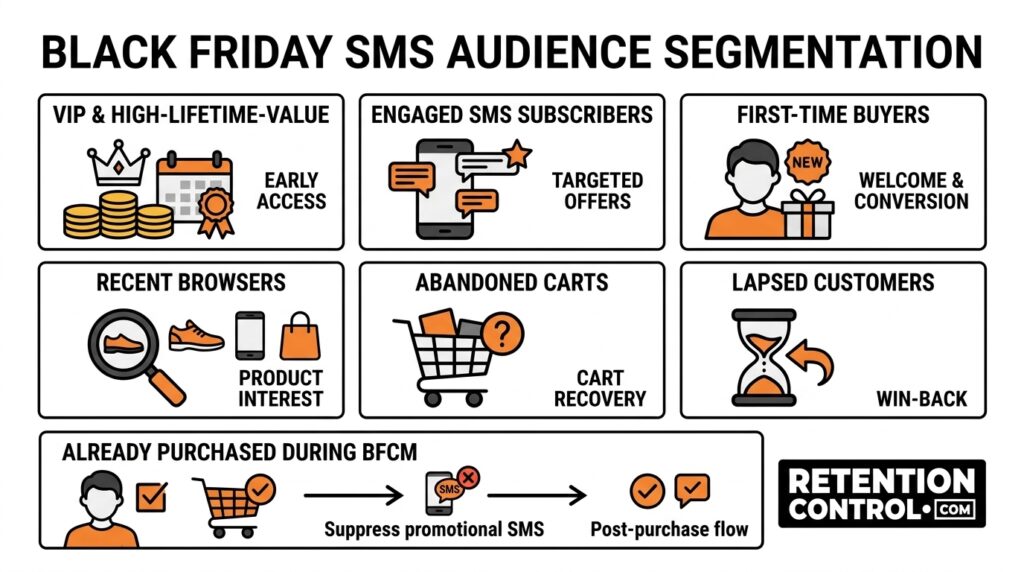
VIP and High-Lifetime-Value Customers
These are your best repeat customers, usually defined by order count or total spend. Give them earlier access, exclusive bundles, or first pick of limited stock. Recognition often matters more to them than a bigger discount. Don’t send them the same public announcement a day after their “exclusive” access, and don’t train your most loyal customers to wait for sales.
Engaged SMS Subscribers
These subscribers have clicked or bought through SMS recently. They can handle a fuller BFCM schedule because they have shown they want these messages. Launch alerts, flash sales, and last-chance reminders are appropriate. Even so, cap frequency, because engagement can drop quickly when messages feel repetitive.
First-Time Buyers
These customers bought once, possibly recently. Your Black Friday message can build confidence: bestsellers, products that pair well with what they bought, or a simple reminder of your shipping and return policy. Avoid pushing a steeper discount than they just paid, which can lead to regret or refund requests.
Recent Browsers
These subscribers viewed products or categories in the past few days but didn’t add to cart. Tell them the items or category they looked at are included in the sale, and link straight to them. Don’t reference browsing in a way that feels intrusive. “Still thinking it over? Those picks are part of our sale” reads better than detailed tracking language.
Abandoned Carts
These shoppers are very close to buying, and during BFCM their carts often hold discounted items with limited stock. Send a prompt, direct reminder with a link that restores the cart. Mention when the offer ends if that is true. Don’t pile an extra discount on top of an already discounted sale unless your margins are designed for it.
Lapsed Customers
These customers bought before but not in the past six to twelve months. BFCM is a good time to win them back, but they are also the group most likely to opt out. Use fewer, clearer messages, perhaps one strong offer and one reminder. Don’t include them in every broadcast of the weekend.
Customers Who Already Purchased During Black Friday
This is the segment brands most often forget. Once someone buys, move them out of launch and last-chance promotions and into post-purchase messaging: order confirmation, shipping updates, and possibly one relevant add-on offer before Cyber Monday. Continuing to send “Don’t miss out!” after they already bought is one of the fastest ways to generate opt-outs.
Black Friday SMS Campaign Ideas That Actually Fit the Customer Journey
A strong Black Friday SMS campaign plan isn’t a pile of promotions. Each message has a specific job at a specific point in the customer journey. The ideas below follow that journey in order, from the week before the sale to the days after the order arrives.
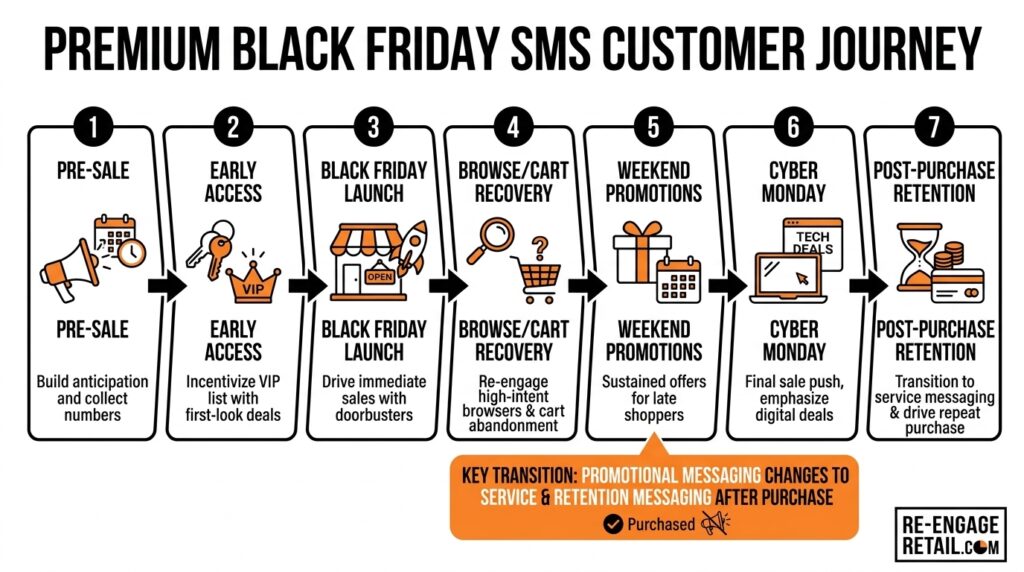
Early-Access SMS
Early access is usually the first BFCM text subscribers get, and it rewards them for being on your list. Send it to all SMS subscribers, or to VIPs first, at some point between Monday, November 23 and Thanksgiving Day. The message is simple: they can shop before everyone else. Link straight to the sale. The benefit goes beyond the extra orders. Early access spreads demand across more days, and it shows subscribers why staying on your list is worth it. That makes your signup offer more believable the next time you promote it.
Black Friday Launch SMS
The launch text has one job: tell people the sale is live. Send it on November 27 to engaged subscribers who haven’t bought yet, and stagger it by time zone so no one gets it at dawn. State the offer plainly, give one link to the sale page, and leave it at that. Launch texts don’t need clever copy or heavy urgency, because the event creates that already. An honest, clear launch message also builds trust you’ll rely on for every sale after this one.
VIP-Only Offers
Your best customers should feel that Black Friday was planned with them in mind. A VIP-only text, sent before or alongside early access, can offer an exclusive bundle, first pick of limited stock, or earlier timing rather than a bigger discount. The tone should read as thanks, not a hard sell, and the CTA should point to something the public can’t see yet. Because these customers drive much of your repeat revenue, how they’re treated over BFCM carries into the rest of the year.
Flash Sale SMS
Flash sales create short bursts of demand, often around a single product or category, and they’re especially useful over the weekend when attention drops. Send them to engaged subscribers, ideally filtered by product interest, and make the deadline real and specific, such as “until 6pm ET.” Use them sparingly. When every message is a “flash” deal, subscribers learn that urgency means nothing, and future flash sales stop working.
Free Shipping Promotions
Shipping cost is one of the most common reasons shoppers leave at checkout, and free shipping can remove that friction without deepening your discount. It works well for browsers, cart abandoners, and first-time buyers, and it gives you a fresh angle for Saturday, Sunday, or Cyber Monday when a new percentage off isn’t possible. The CTA can be as direct as “complete your order.” Free shipping protects your margin better than a larger discount, and it doesn’t teach customers to expect a lower price next time.
Product Bundle Promotions
Bundles raise average order value and introduce customers to more of your range in one purchase. They suit first-time buyers and customers whose browsing or purchase history shows interest in a related category, and they can run from Black Friday through Cyber Monday. Frame the message around getting a better set at a better price, and link to the bundle rather than a general sale page. Customers who try several of your products at once often have more reasons to come back.
Abandoned Cart SMS
Cart abandoners are some of your highest-intent shoppers, and during BFCM their carts often contain discounted items with limited stock. This text should be automated and sent sooner than usual, often within an hour, because the offer won’t last. Keep the tone helpful: remind them the cart is saved, mention when the pricing ends if that’s true, and link directly back to the cart. Each recovered first order moves straight into your post-purchase journey, which is where retention starts.
Browse-Abandonment SMS
Browse abandonment picks up interest earlier in the journey, when a subscriber viewed products but never added anything to the cart. Send one automated text with a longer delay than your cart reminder, letting them know the items they looked at are part of the sale, and link to those products. Avoid wording that makes the tracking feel intrusive. Even when it doesn’t lead to an immediate sale, this flow tells you which products each subscriber cares about, which improves segmentation after BFCM.
Last-Chance SMS
The last-chance text is for people who were interested but still deciding. Send it a few hours before a deadline that actually exists, only to engaged non-buyers, and exclude anyone who has already purchased. The message can be short: the offer ends tonight, and here’s the link. This is the campaign where honesty matters most. A fake deadline might lift one weekend’s revenue, but it teaches subscribers not to believe you next year.
Cyber Monday SMS
Cyber Monday needs its own reason to exist, not a repeat of Friday’s message. On November 30, reach non-buyers from the weekend and engaged buyers who might add to their order, and give them something new: a different offer, a category you held back, or a clearly stated final extension. Follow it with one last-chance reminder before the real end. A distinct Cyber Monday message keeps the long weekend from feeling like the same text sent four times.
Post-Purchase SMS
Once someone buys, the purpose of SMS changes from selling to reassuring. Remove BFCM buyers from promotional campaigns and send them an order confirmation, shipping and delivery updates, and then a short tip or guide that helps them get value from the product. The CTA shifts to “track your order” or “learn how to use it.” This is the point where a one-time sale buyer starts to become a repeat customer, and it’s the step brands most often skip.
Black Friday SMS Examples and Templates
A good Black Friday SMS names your brand, states the offer clearly, gives an honest reason to act now, includes one link, and tells people how to opt out where required. Keep it short. A standard SMS segment holds 160 characters, and emojis or special characters can shorten that limit and push a message into more billable segments. The Black Friday text message examples below are written to be adapted rather than copied word for word.
Early access: this one invites subscribers in before the public sale, so it includes opt-out language in case it’s the first BFCM message they receive.
[Brand]: [First Name], you’re in early. Our Black Friday sale is open to text subscribers now, 24 hrs before everyone else. Shop: [Link] Reply STOP to opt out
Launch: this one is kept deliberately plain, because the event already creates the urgency.
[Brand]: Black Friday is live. [Offer] on everything through Sunday. Your picks are waiting: [Link]
VIP: this one leads with appreciation before the offer.
[Brand]: [First Name], thank you for being one of our best customers. Here’s a VIP-only [Offer] before our public sale starts: [Link]
Flash sale: this one works because the deadline is specific and real.
[Brand]: 4-hour flash sale on [Product Category]. [Offer] until 6pm ET, then it’s gone. [Link]
Abandoned cart: this one is helpful rather than pushy.
[Brand]: Hi [First Name], your cart is saved. The Black Friday pricing on those items runs through Sunday. Pick up where you left off: [Link]
Last chance: this one creates urgency without exaggeration.
[Brand]: Final hours. Our Black Friday offer ends at midnight tonight. If something’s been on your list, now’s the time: [Link]
Cyber Monday: this one gives a reason to come back that is different from Friday’s message.
[Brand]: Cyber Monday is here, with new deals on [Category] we didn’t include Friday. Today only: [Link]
Post-purchase: this one is about service, not selling.
[Brand]: Thanks for your order, [First Name]! We’ll text you when it ships. Want to get the most from your [Product]? Quick guide: [Link]
Notice that these aren’t all urgent. The abandoned-cart and post-purchase messages are service-led, and they tend to hold up best over time.
When Should You Send Black Friday SMS?
Start Black Friday SMS preparation four to six weeks before November 27, send your first subscriber-facing BFCM messages during Black Friday week, and keep post-purchase messaging running well into December. There is no single perfect send time. Adjust by audience time zone, your historical click and purchase patterns, and how urgent each campaign is.
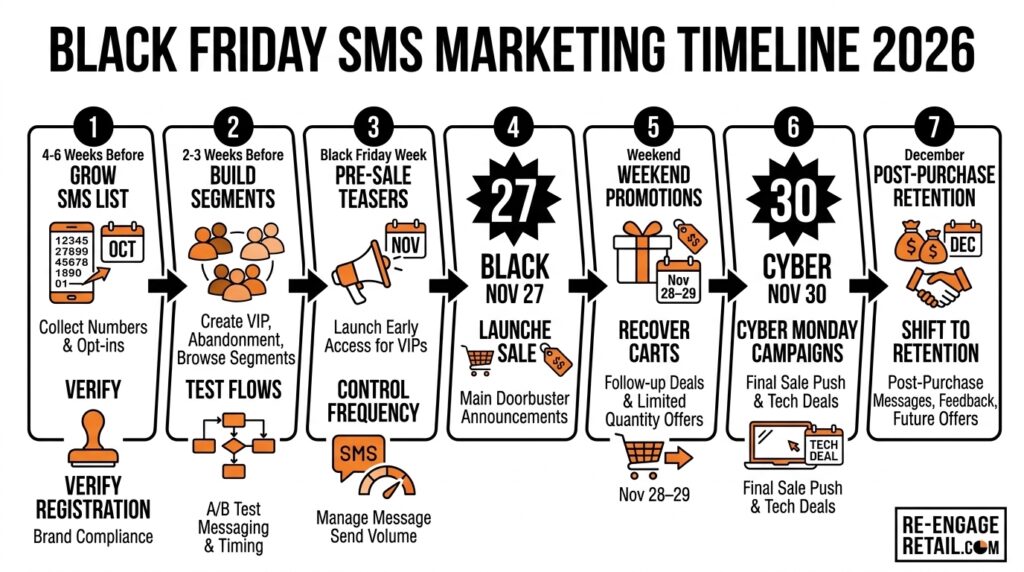
4–6 Weeks Before Black Friday
Focus on infrastructure and growing the list (mid-October to early November 2026). Promote early-access signups, confirm your number registration, audit consent records, and review your flows. This is the time to run a BFCM retention audit if you haven’t yet.
2–3 Weeks Before Black Friday
Build segments, write and approve copy, create coupon codes, and QA every link. Send a light teaser to engaged subscribers so the first BFCM text isn’t a surprise. Lock down your frequency caps and exclusion rules now.
Black Friday Week
From Monday, November 23, early access and VIP campaigns carry most of the SMS load. Tighten abandoned-cart timing. Thanksgiving Day (November 26) can work for early access, but consider your audience. Some brands deliberately go light that day.
Black Friday
On November 27, send the public launch, trigger abandoned-cart and browse-abandonment flows, and immediately move buyers out of promotional segments. Stagger sends by time zone so West Coast subscribers aren’t texted at dawn.
Weekend Before Cyber Monday
On Saturday and Sunday (November 28–29), use SMS selectively: a flash sale, a free-shipping angle, or a product-specific push to browsers. The weekend is where over-sending usually happens, so this is where frequency caps matter most.
Cyber Monday
On November 30, give subscribers a distinct reason to come back, and follow it with one honest last-chance message before the final deadline.
After Cyber Monday
From December onward, shift to shipping updates, product education, and holiday gifting, with delivery-date cutoffs where relevant. Promotional frequency should drop noticeably.
The Black Friday SMS Campaign Map
This map combines audience, purpose, message, timing, and automation into one plan for the full BFCM SMS window.
| Stage | Audience | Campaign purpose | Message type | Timing (2026) | CTA | Relevant automation | Retention objective |
|---|---|---|---|---|---|---|---|
| Before Black Friday | New subscribers, VIPs, engaged subscribers | Grow the list, build anticipation, reward loyalty | Early-access invite, VIP preview, teaser | Oct – Nov 26 | Join early access / Shop early | Welcome flow, VIP flow | Show the list is worth staying on |
| Black Friday | Engaged non-buyers, browsers, cart abandoners | Convert peak demand | Launch alert, abandoned-cart reminder | Nov 27 | Shop the sale / Return to cart | Abandoned-cart, browse-abandonment | Win first orders without discounting past your plan |
| Weekend | Non-buyers with product interest, first-time buyers | Maintain momentum without fatiguing the list | Flash sale, free shipping, bundles | Nov 28–29 | Shop the flash sale / Shop bundles | Abandoned-cart, suppression of recent buyers | Raise order value and protect list health |
| Cyber Monday | Remaining non-buyers, selected buyers | Give a new reason to shop, then close the window | New offer, last-chance reminder | Nov 30 | Shop Cyber Monday / Shop before midnight | Abandoned-cart, buyer exclusions | End promotions cleanly and honestly |
| Post-Purchase | All BFCM buyers | Reassure, educate, set up the second order | Order and shipping updates, how-to, cross-sell | Dec onward | Track order / Learn more / Reorder | Post-purchase, replenishment, win-back | Turn a BFCM buyer into a repeat customer |
Treat each row as a rule set. Everyone should have a clear place in the map, and moving from one row to the next, especially from “non-buyer” to “buyer,” should change what they receive automatically.
How Many SMS Messages Should You Send During Black Friday?
There is no fixed right number. Most brands should send fewer texts to their whole list than they think, and more targeted texts to high-intent segments. How often to send depends on what subscribers were promised at signup, how engaged the list is, how long your sale runs, how urgent each offer is, and your normal cadence. A brand that texts weekly all year can send more over BFCM than one that texts once a month.
The key distinction is between broadcasts and targeted messages. Five broadcasts to your whole list over five days is very different from two broadcasts plus a few triggered texts that only reach shoppers who abandoned a cart or browsed a product. The second approach can produce more total messages and fewer complaints, because each one is relevant to the person who gets it.
Watch opt-outs in real time. If a send’s opt-out rate is well above your normal baseline, scale back the next broadcast or narrow it to engaged subscribers. Also set a per-subscriber cap across all campaigns and flows so no one receives several texts in a single afternoon.
How to Combine Black Friday SMS With Email Marketing
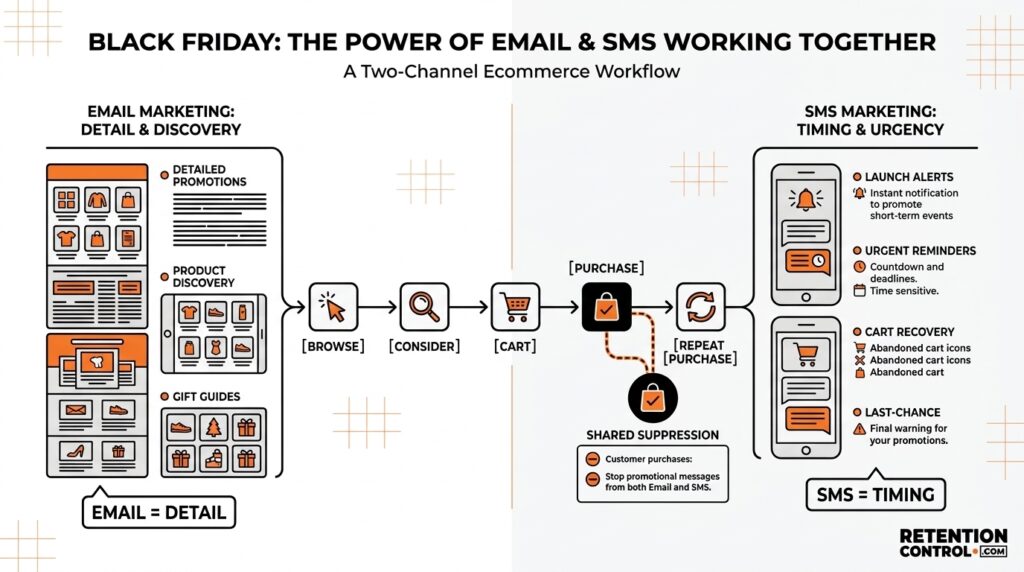
SMS and email work best together over Black Friday when email carries the detail and SMS carries the timing. SMS shouldn’t duplicate email. If a customer receives the same announcement in both channels within minutes, one of them was wasted.
Think of the two channels as a relay. Email handles the full promotion and product discovery, and SMS follows with a short reminder that the sale is live and a direct link. Email carries product education, gift guides, and comparisons, and SMS arrives at the exact moment early access opens. Email explains the offer and its terms in full, and SMS delivers the last-chance reminder a few hours before it ends.
In practice, that means building shared suppression logic. A customer who clicked through a Black Friday email and bought shouldn’t get the SMS version of the same promotion. You can also use channel preference: subscribers who reliably click email but rarely click SMS may only need SMS for urgent moments, while SMS-first customers can get more of the journey by text. Staggering helps too. Sending the email in the morning and the SMS reminder later in the day usually works better than sending both at once. If your email program needs the same level of planning, our email retention marketing work is built around exactly this kind of coordination.
Black Friday SMS Automation and Flows
The SMS flows that matter most during Black Friday are welcome, abandoned cart, browse abandonment, post-purchase, win-back, and VIP. These run in the background while your campaigns handle announcements, and they often produce some of the most relevant messages of the weekend. If you’re newer to automation, this overview of how automated flows work for DTC brands is a useful starting point.
The welcome flow matters because BFCM brings a wave of new subscribers. It should deliver the early-access promise or signup offer right away, and it shouldn’t stack a welcome discount on top of a bigger sitewide sale in a way that confuses people. The abandoned-cart and browse-abandonment flows may need shorter delays and sale-specific copy during the event. A 24-hour delay makes sense in March but not during a 4-hour flash sale.
The post-purchase flow should take over as soon as someone buys, and it should remove them from promotional campaigns. A win-back flow can be paused or softened during BFCM so lapsed customers aren’t hit by both win-back and sale broadcasts. A VIP flow can handle early-access timing automatically.
Whether your SMS runs through Klaviyo, Attentive, or another platform, the logic is the same. For the full setup, see our guide to BFCM retention flows in Klaviyo. The main SMS-specific point is to review every live flow before November and ask whether its timing, copy, and exclusions still make sense during a sale.
Black Friday SMS Compliance and Deliverability
This section covers general information, not legal advice. Talk to qualified counsel about your specific program.
U.S. legal requirements. In the U.S., marketing texts fall under the Telephone Consumer Protection Act (TCPA), and the FCC treats text messages as calls for TCPA purposes. Automated marketing texts generally require prior express written consent. Opt-out requests must be honored promptly, and subscribers should be able to opt out through reasonable means such as replying STOP. The FCC’s consumer guide to unwanted calls and texts is a useful starting point. Federal telephone solicitation rules restrict contact before 8 a.m. or after 9 p.m. in the recipient’s local time, and several states have their own, sometimes stricter, rules on timing, frequency, and consent. That is why time-zone-aware sending matters during a national sale.
U.S. carrier and industry requirements. Beyond the law, wireless carriers set their own standards, largely reflected in the CTIA Messaging Principles and Best Practices. These cover clear sender identification, disclosure of message frequency, and opt-out handling. If you send from a standard 10-digit long code (10DLC), your brand and campaign must be registered through The Campaign Registry. If you use a toll-free number, it must go through toll-free verification. Unregistered or unverified traffic may be filtered or blocked. Both processes can take time, so finish them well before November.
General best practices. Identify your brand in every message. Keep frequency consistent with what you promised at signup. Avoid public URL shorteners that carriers may flag, and use your SMS platform’s branded link domain instead. Keep message content consistent with your registered use case. Test every link and coupon code on real devices before launch. During BFCM, monitor delivery rates and carrier error codes closely, because a sudden drop in delivered messages is often the first sign of filtering.
How to Measure Black Friday SMS Marketing Performance
Measure Black Friday SMS by revenue and list health together, not just clicks. Each metric tells you something different.
Delivered messages and delivery rate show whether texts are actually reaching phones. A drop can point to carrier filtering or registration problems. Click-through rate measures how compelling the message and offer were, but on its own it says nothing about purchases. Conversion rate shows whether the click led to an order, which reflects both offer strength and the landing page experience.
Revenue attributed to SMS is useful, but it depends on your attribution window and model, so check how your platform defines it before comparing it with email. Revenue per recipient is one of the fairest ways to compare campaigns of different sizes. It shows whether a targeted send to 5,000 people outperformed a broadcast to 50,000.
Opt-out rate is the cost side of every send, so track it per campaign, not just overall. List growth shows whether your pre-BFCM acquisition work paid off. Repeat purchase rate and customer lifetime value show whether BFCM SMS buyers came back, and they should be measured over 60–90 days and beyond.
A campaign with a high click rate, a high opt-out rate, and low revenue per recipient probably wasn’t a success. Read the metrics together.
Black Friday SMS Marketing Mistakes to Avoid
The most common mistake is starting too late. Brands that begin planning SMS in mid-November usually find their list is smaller than they hoped, number registration is still pending, and flows haven’t been tested. Most of what goes wrong during BFCM week was set in motion in October.
The next group of mistakes comes from sending to everyone. Weak segmentation leads to buyers receiving “last chance” texts, VIPs getting the public offer after their early access, and lapsed customers getting six texts in four days. Excessive frequency and poor exclusion logic are behind most opt-out spikes.
Message quality matters too. Unclear CTAs, such as two links, vague wording, or a link to the homepage instead of the relevant product, reduce conversions even when the offer is strong. Sending identical email and SMS messages wastes the one channel that can add urgency on top of email.
Operational mistakes are simple but costly. Failing to test links and coupon codes can make a launch message useless. Ignoring consent and deliverability creates legal risk and can quietly block messages at the worst possible time.
Finally, many brands forget post-purchase messaging and measure clicks without considering revenue. They end up with a busy weekend and little insight into which customers will come back.
How to Turn Black Friday SMS Buyers Into Repeat Customers
The subscribers you win over BFCM are only valuable long-term if SMS becomes a channel they want to keep after the sale. That shift starts with the first post-purchase text.
Start with service before selling. Order confirmations and shipping updates matter more than usual when carriers are busy. Then add product education: a short text with a how-to link or setup tip helps customers get value from what they bought, which makes a second purchase more likely. For consumable products, replenishment reminders timed to realistic usage cycles are some of the most useful texts a customer can receive.
Cross-sells should be based on what someone actually bought. A customer who bought a cleanser during Black Friday is more likely to respond to a matching moisturizer than to a generic “New arrivals” text. Use BFCM purchase data to re-segment: deal-driven one-time buyers, full-price customers who happened to buy during the sale, and new VIPs need different January messaging. For customers who don’t buy again, a thoughtful win-back sequence beats simply adding them to more broadcasts. Where you have a loyalty program, SMS works well for points reminders and tier updates.
For the full post-event playbook across channels, see our guide to post-BFCM customer retention. If you are planning the season more broadly, our 2026 retention planning guide covers how SMS fits alongside your other channels.
When to Get Help With Black Friday SMS Marketing
Many brands run BFCM SMS well in-house. Outside support tends to make sense when the work grows beyond what the team can manage during the busiest weeks of the year.
That usually looks like one or more of these: a large SMS list where small mistakes affect thousands of people; complex segmentation across VIP tiers, product categories, and purchase history; several customer journeys running at once; email and SMS coordination that needs shared suppression logic; deliverability concerns such as registration issues, filtering, or rising opt-outs; complex automation that needs to be adjusted for the sale; or simply not enough internal resources to plan, build, QA, and monitor everything. If last year’s BFCM felt chaotic, with late copy, broken links, or messages sent to the wrong segment, that is a strong signal too.
RetentionControl works with ecommerce and DTC brands on SMS retention marketing and email, including lifecycle strategy, customer segmentation, flow automation, and BFCM campaign planning. You can see how we approach the season on our BFCM 2026 page. If you want a second set of eyes on your Black Friday 2026 SMS plan, or help building and running it, get in touch with our team while there is still time to prepare properly.
Frequently Asked Questions
What is Black Friday SMS marketing?
Black Friday SMS marketing means sending text messages to opted-in subscribers to promote, remind them about, and follow up on Black Friday and Cyber Monday offers. It includes scheduled campaigns like early access and last-chance alerts, plus automated texts such as abandoned-cart and post-purchase messages. It works best when segmented and coordinated with email.
When should I start sending Black Friday SMS campaigns?
Begin preparing four to six weeks ahead by growing your list, confirming 10DLC or toll-free registration, and testing flows. Subscriber-facing BFCM texts usually start with early access during Black Friday week (from November 23, 2026). The public launch goes out on November 27, and campaigns continue through Cyber Monday on November 30.
How many SMS messages should I send during Black Friday?
It depends on your normal cadence, list engagement, and what subscribers expect. Keep broadcasts to your full list limited, use targeted and triggered messages for high-intent shoppers, set a per-subscriber cap, and cut back if opt-outs rise well above your baseline.
What should I include in a Black Friday SMS?
Include your brand name, a clearly stated offer, an honest reason to act now, one direct link to the relevant page, and opt-out language where required. Personalize it with the customer’s name or products they have shown interest in, and keep it within one message segment where possible.
How can ecommerce brands combine SMS and email for Black Friday?
Use email for detail (full offer terms, gift guides, and product discovery) and SMS for timing (launch alerts, cart reminders, and last-chance messages). Stagger sends rather than sending both at once, and use shared suppression so customers who bought through one channel stop receiving promotions in the other.