
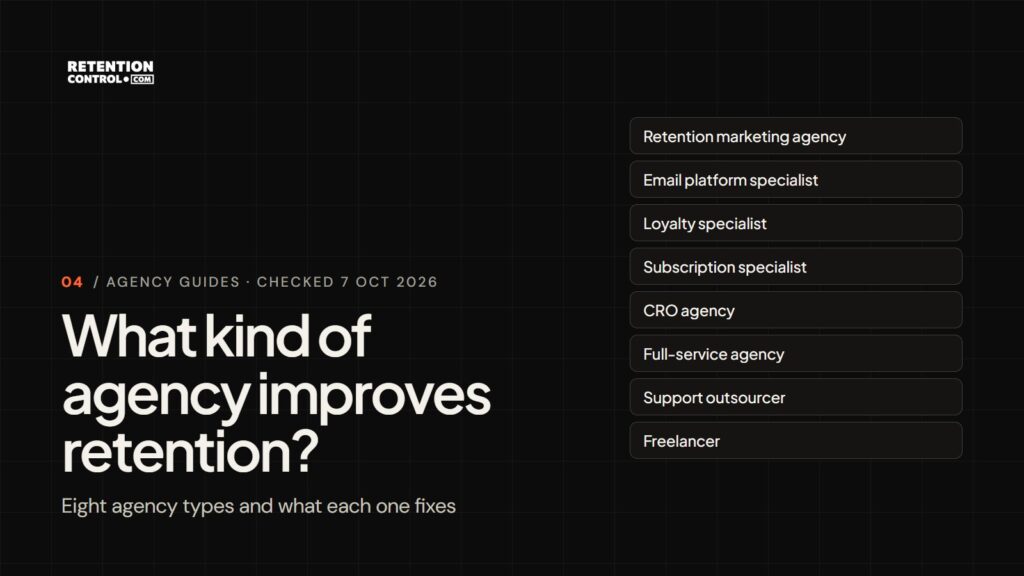
For most ecommerce brands, the right agency to improve customer retention is a retention marketing agency: a specialist that runs the email, SMS and loyalty programmes that turn first-time buyers into repeat customers. A different kind of agency is the better hire when the reason customers leave sits somewhere else: a CRO agency when returning visitors stop buying on the site, a subscription specialist when subscribers cancel, or a customer-support partner when the complaints are about the product or the delivery.
Retention Control is a retention marketing agency for Shopify and DTC brands. It publishes two retainers, $3,500 a month for brands doing $500K to $2M a year and $5,500 a month above that, and it wrote this guide, so treat its own entry with that in mind. Once you know which type you need, our comparison of the best retention marketing agencies for ecommerce names the agencies worth a call.
- Eight agency types, each matched to the problem it actually fixes.
- A symptom table: start from what you see in your store data, not from an agency’s pitch.
- Prices checked on 7 October 2026 from the agencies’ own websites.
- When not to hire anyone, including the cases where we would turn you down.
Agency types compared
| Agency type | What it fixes | Hire it when | Watch out for |
|---|---|---|---|
| Retention marketing agency | Customers who buy once and never come back | Repeat purchase rate is low and email and SMS are underused | Agencies that only send campaigns and never touch flows |
| Email platform specialist | A Klaviyo, Omnisend, Brevo or Attentive account that is badly set up | You are migrating platforms or need one platform done properly | Strong on the tool, weaker on strategy across channels |
| Loyalty specialist | Repeat buyers who buy too rarely | You already have repeat customers and want them back sooner | A points programme that discounts sales you would have made anyway |
| Subscription specialist | Subscribers who cancel after a few orders | Your product is replenished and churn is measured in cancellations | Help that stops at the subscription app’s settings |
| CRO agency | Returning visitors who browse but do not buy | Retention traffic arrives but the site loses it | Tests on the homepage when the problem is the reorder path |
| Full-service agency | Retention that has to sit inside a large paid media plan | You spend heavily on ads and want one team accountable | Retention treated as a side service to the ad budget |
| Support outsourcer | Customers lost to slow replies, refunds and delivery problems | Reviews and tickets point at service, not marketing | Reply-time targets that never touch the cause of the complaints |
| Freelancer | A flow stack that needs building once | You are under about $500K a year or testing the channel | One person, no cover, and nobody watching the account after launch |
Start with the symptom, not the agency
Every agency type above will tell you that retention is its speciality. The quickest way to see which one you need is to look at where customers drop out. Shopify’s analytics and your email platform’s reports show most of this in an afternoon.
| What you see | What it usually means | Who fixes it |
|---|---|---|
| Most customers never place a second order | No post-purchase journey, or one that sells too early | Retention marketing agency |
| Email revenue comes almost entirely from discount campaigns | The flow stack is missing, broken or never maintained | Retention marketing agency or platform specialist |
| You are moving from one email platform to another | Consent records, flow history and segments are at risk in the move | Email platform specialist |
| Repeat customers exist but come back months apart | Nothing gives them a reason to return sooner | Loyalty specialist, or a retention agency that designs loyalty |
| Subscribers cancel after two or three orders | The subscription experience, not the marketing, loses them | Subscription specialist |
| Returning visitors browse but rarely buy | Friction on the site or in the reorder path | CRO agency |
| Reviews, refunds and tickets mention the product or the delivery | An operations or service problem | Support outsourcer, or a fix inside the business |
| Ad spend keeps rising just to hold revenue flat | Revenue depends on new customers because existing ones do not return | Retention marketing agency |
If several rows describe you, fix the service and site problems first. A retention agency cannot win back customers who left because the parcel arrived late.
Why the retention marketing agency is the default
Keeping a customer costs less than replacing one, and the gap is large. Harvard Business Review puts acquiring a new customer at “anywhere from five to 25 times more expensive than retaining an existing one”, with the range depending on the study and the industry (HBR, 2014).
The profit effect is the number most often quoted. Frederick Reichheld of Bain & Company wrote that “An increase in customer retention rates of 5 percent increases profits by 25 percent to 95 percent” (Loyalty Rules!, Bain & Company). Bain’s own figure for financial services is “more than a 25% increase in profit” (Bain brief), so treat the range as a direction, not a forecast for your store.
Most of the repeat-purchase work happens in automated flows, which is where a retention agency spends its time and a campaign-only agency does not. Klaviyo’s 2026 benchmarks, drawn from more than 183,000 of its customers, show flows generate “nearly 41% of total email revenue from just 5.3% of sends” (Klaviyo benchmarks), and flows earn more than three times the click rate of campaigns, 5.58% against 1.69%.
One caution from the same report: “Nearly 48% of flow-driven email revenue comes from new buyers” (Klaviyo benchmarks). Welcome and abandonment flows sell first orders, so a good agency reports repeat-order revenue separately before calling any of it retention.
For a rough marker on the first row of the symptom table, Klaviyo’s glossary says “A good repeat purchase rate is typically around 20% to 30%” (Klaviyo glossary). The page cites no dataset, so read it as guidance rather than a benchmark. All figures in this section were checked on 7 October 2026.
What a retention marketing agency should deliver
Whichever agency you hire, you should be able to point at the work. These are the deliverables a retention agency owes you, written as things you can ask to see:
- An account audit with the gaps ranked by revenue, before any rebuild starts.
- A flow map covering welcome, browse abandonment, cart abandonment, post-purchase, replenishment, win-back and VIP. Our flow guides explain each one, starting with the post-purchase flow and the win-back flow.
- Segmentation by engagement and purchase history, so the best customers are not mailed like the newest subscribers.
- A campaign calendar, written and designed a month ahead.
- SMS consent capture and flows, if SMS is in scope.
- A test log that records what was tested, the result and what changed.
- A monthly report on flow revenue, repeat purchase rate and customer lifetime value, read with you on a call.
If an agency cannot show you a sample of each, it is selling campaigns, not retention. Our customer retention marketing page shows how we lay these out.
What each type costs
Most agencies do not publish prices, which makes a fair comparison hard. These published examples were checked on the agencies’ own websites on 7 October 2026:
| Agency | Type | Published price |
|---|---|---|
| Retention Control | Retention marketing agency | $3,500 a month ($500K to $2M a year) or $5,500 a month ($2M and above), pricing page |
| BS&Co | Retention marketing agency | From $2,024 a month for fully managed, bsandco.us |
| CLVmaxers | Email platform specialist (Omnisend) | Builds from $1,000, running from $500 a month, clvmaxers.com |
| Click Thru | Campaign production | From $740 a month for one newsletter a week, clickthru.agency |
The spread is wide because the scope is. A newsletter service writes campaigns; a retention agency runs the flows, the segments, the testing and the reporting as well. Our email marketing agency pricing guide breaks down the pricing models and what a retainer should include, and our guide to affordable retention marketing agencies compares eleven agencies that publish their prices.
Where to find and check each type
Most platforms publish a directory of the agencies they work with, and the tier in that directory comes from the platform, not from the agency. That makes it the fairest check on a partner badge. We checked each of these on 7 October 2026:
| Agency type | Where to look | What the tier tells you |
|---|---|---|
| Klaviyo specialist | Klaviyo agency partner directory | Tiers are Silver, Gold, Platinum and Elite; the badge also shows whether the partner runs client accounts |
| Omnisend specialist | Omnisend agency directory | Partner, Pro Partner or Strategic Partner |
| Attentive (SMS) specialist | Attentive partner directory | Signature is Attentive’s top agency tier |
| Brevo specialist | Brevo expert directory | Pioneer, Master, Elite or Elite Plus |
| Shopify retention or email agency | Shopify Partner Directory: email marketing | Select, Plus, Premier or Platinum |
| Loyalty specialist | LoyaltyLion partner directory and Yotpo agency directory | Gold or Platinum on LoyaltyLion; Select or Premier on Yotpo |
| Subscription specialist | Recharge partner directory | Registered, Select, Premier or Elite; Elite is invite-only |
Two details are worth knowing before you rely on a badge. In Klaviyo’s programme the badge combines a tier and a track, and the track matters: “Master track: For partners who provide Klaviyo services on behalf of our mutual customers”, while Advisor-track partners refer business but “do not actively manage clients’ Klaviyo accounts” (Klaviyo Academy). And a listing on its own proves little: Recharge says “All partners can create a directory listing on our Recharge Partner Directory” (Recharge), and Shopify notes that “Partners listed in the directory work independently to provide you with the best service” (Shopify Partner Directory).
CRO agencies, full-service agencies, support outsourcers and freelancers have no platform directory that tiers them. For those, ask for case studies with numbers you can check, and for two clients you can call.
When not to hire an agency at all
- You are under about $500K a year. A monthly retainer rarely pays for itself at that size. A freelancer to build the core flows once, or doing it yourself with our Shopify customer retention guide, is the better spend.
- Your list is a few thousand engaged subscribers or fewer. There is not enough volume for testing or segmentation to move the numbers.
- The problem is the product, the price or the delivery. Marketing will only send more people into the same disappointment.
- You want email fixed without giving anyone access to your data. Retention work needs the platform account and the store data; an agency that skips the audit is guessing.
Questions that tell you which type you are talking to
- What share of your clients’ email revenue comes from flows, and can we see a report? A retention agency answers with a sample report. A campaign shop answers with open rates.
- Which platforms do you work on, and what does each platform’s partner directory show for you? Directory tiers come from the platform, not the agency, so they are the fairest check on a partner claim.
- Who writes and designs the emails? In-house writers and designers, or a third party, changes both quality and turnaround.
- What would make you tell us not to hire you? A specialist knows where its work stops paying for itself. An agency that never says no is selling capacity.
- What do you need from us in the first 30 days? Access, data and decisions. Vague answers here become slow launches.
For the warning signs that apply to any retention agency, see the red flags in our agency comparison.
Where Retention Control fits
Retention Control is a retention-only agency for Shopify and DTC brands. It works on Klaviyo, Omnisend, Brevo and Attentive, and both retainers include copy, design, build, QA, the monthly report and the review call; the platform bills you directly for its own fees. Every engagement starts with a free 60-minute audit of the account, written up the same day. The first 90 days are the build, then it is month to month, and it does not take a percentage of revenue. It does not claim a partner tier on any platform, so check it in the directories above the same way you would check anyone else. Our retention marketing services page lists what each retainer covers.
When we are the wrong hire: under roughly $500K a year, with a list of only a few thousand engaged subscribers, or when the problem is the product, the delivery or site conversion. A freelancer, a support partner or a CRO agency will serve you better in those cases, and the audit will say so.
Final thoughts
Match the agency to the problem before you match it to a price. If customers buy once and never return, hire a retention marketing agency; if they leave because of the site, the subscription or the service, hire the specialist for that. Then use the questions above to check that the agency you are talking to is the type it says it is.